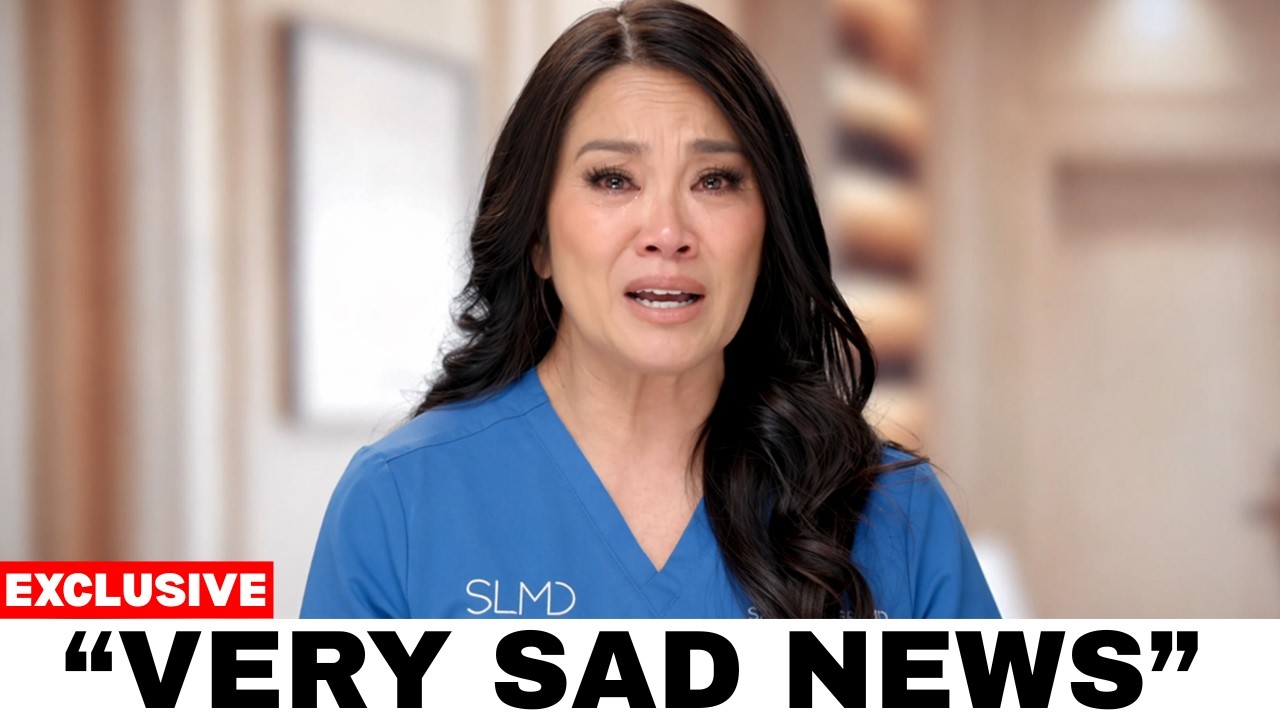
The silence in the operating room was broken only by the soft hum of medical equipment and the murmur of a patient under local anesthesia. The cameras were rolling, capturing every second for the show that had made her a global phenomenon. Dr.
Sandra Lee, the woman known to billions as Dr. Pimple Popper, was mid-procedure, her gloved hands steady as she worked to extract a stubborn cyst. But beneath the surgical mask, something was terribly wrong.
 A wave of heat, sudden and violent, washed over her body. Her head felt clouded, her thoughts sluggish. She dismissed it as a hot flash, a symptom of her age, and pushed through the procedure with the professionalism that had defined her two-decade career.
She had no idea that a part of her brain was already dying.
The day would not end in the operating room. After finishing her patient list, Dr. Lee drove to her parents’ home near the practice in Upland, California.
The restlessness she felt was profound, an inability to settle that she couldn’t explain. Shooting pains ran down one leg, a strange and alarming sensation she tried to rationalize away. When she attempted to descend the stairs, her balance faltered.
Her legs felt disconnected from her will, moving as if through water. That night, sleep was impossible. The fear that had been a dull throb in the back of her mind began to crescendo.
The following morning, the fear became a deafening roar. She held out her left hand and watched it collapse, unable to maintain its own strength. When she tried to speak, the words came out slurred and tangled.
In that terrifying moment, the physician in her finally recognized the truth she had been fighting against. She was having a stroke.
For a woman who had spent her life studying the human body, the irony is devastating. Sandra Lee knew the warning signs of a stroke cold. Face drooping, arm weakness, speech difficulty, sudden confusion, problems with balance.
She had exhibited almost every single one of them. Yet, even with her medical training, she almost convinced herself to stay home. This is not a story of personal failure, but a chilling reflection of a broader medical crisis.
Research has long documented that women experiencing strokes are significantly more likely to have their symptoms dismissed, both by themselves and by medical professionals, because the signs so often mimic other conditions. Sudden sweating, fatigue, and restlessness in a woman in her mid-50s are frequently attributed to menopause. Dr.
Lee had the same instinct. Her brain was under attack, and her first thought was, “Hot flash.” It was her father, Dr.
Soon Seng Lee, a retired dermatologist who had built the very practice she now runs, who cut through the denial. He looked at his daughter and issued a command that would ultimately save her life. He told her to get to the emergency room immediately.
The MRI results were stark and unforgiving. Sandra Lee had suffered an ischemic stroke, a full blockage of blood flow to a part of her brain. The clot had starved millions of cells of oxygen, and in the world of neurology, time is brain.
Every minute a stroke goes untreated, the brain loses approximately 2 million cells that will never regenerate. The diagnosis was a shock that reverberated through her entire being. “It was just a shock,” she later recalled in an interview with People magazine.
“As a physician, I couldn’t deny that I had slurred speech, that I was having weakness on one side, but I was like, ‘Well, this is a dream, right?'” The reality was far from a dream. It was a nightmare that threatened to end everything she had built.
 “What essentially happened is I had a part of my brain that died,” she said, a statement that stopped every room it entered. For a surgeon whose entire career is built on the precision of her hands, the steadiness of her gaze, and the calm articulation of her voice, the stroke was an attack on her very identity. The tools of her trade—her fine motor skills, her balance, her speech—had all been compromised in a single, silent moment.
The public knows Sandra Lee as the cheerful, steady presence who extracts blackheads and pops cysts with a satisfying finality. They know her as the woman who built a media empire from a small dermatology office, amassing over 6 billion views on YouTube and turning her nickname into a household name. But the public does not know the relentless pressure that fueled that empire.
Behind the camera, Dr. Lee was running a machine that demanded constant maintenance. A full surgical practice, a YouTube channel requiring fresh content, and the production of a hit television show for TLC that ran for nine seasons.
The stress was chronic, the hours were punishing, and her own health was pushed to the periphery. She admitted to having high blood pressure and high cholesterol, conditions she was not adequately managing. The stroke, she now realizes, was not a random act of bad luck.
It was the inevitable bill coming due for years of neglecting the most important patient in her care: herself.
Her neurologist, Dr. May Kim Tenser of USC’s Keck Medical School, provided a broader, more alarming context. Doctors are now seeing a nearly 15% increase in stroke prevalence among patients between the ages of 45 and 64.
Dr. Lee, at 55, falls directly in the middle of that demographic. This is not an anomaly.
It is a public health crisis that is disproportionately affecting a generation of high-performing professionals, particularly women, who are conditioned to prioritize work over well-being. The story of Dr. Pimple Popper is a cautionary tale for every woman who has ever ignored a headache, pushed through exhaustion, or chalked up a physical symptom to stress or menopause.
The consequences of that neglect can be catastrophic and permanent.
The immediate aftermath of the stroke was a brutal confrontation with her own mortality and her own limitations. Filming on season 2 of her new Lifetime show, Dr. Pimple Popper: Breaking Out, was halted immediately.
Twenty planned episodes, a brand-new platform, and a second chance at a television career after TLC ended the original series—all of it stopped on a November morning in 2025. The woman who had an answer for everyone else’s skin problems had no answer for what was happening inside her own brain. For two full months, she did not operate.
She did not film. She barely spoke publicly. Instead, she entered a world of intensive physical and occupational therapy, working on tasks that most people take for granted.
She had to relearn how to walk in a straight line. She had to rebuild the grip strength in her left hand, a hand that was essential for holding a scalpel. “I don’t like that I don’t have total control of my left hand,” she told People.
“If I feel like I’m not at my best, it’s very scary.” The psychological toll was just as heavy as the physical one. She described experiencing a form of PTSD, triggered by the very environment where her life changed forever.
 “It was very scary for me,” she said. “There’s a lot of PTSD because it happened while I was filming the show.”
Her speech also changed in subtle ways that she notices constantly, even if others don’t. “I notice it right now that I may don’t speak exactly the way I used to,” she admitted. “You’re really embarrassed to speak because you notice it.”
For a woman who has spent years narrating her work to millions of viewers, this new self-consciousness is a profound and painful shift. She is hyper-aware of every word, every pause, every moment where her articulation might falter. The stroke did not just take a part of her brain; it took a piece of her confidence.
Yet, in January of 2026, she made the decision to walk back into the operating room. She returned to the set where her brain had started dying, facing the cameras and the patients with a courage that is difficult to fathom. The decision to return was not just about her career.
It was about reclaiming her identity. She refused to let the stroke define her, even as she acknowledged that she is forever changed by it.
What makes Dr. Lee’s story even more poignant is the cultural context in which she chose to share it. Sandra Lee is Chinese-American.
Her father is from Singapore, and her mother is from Malaysia. She was raised inside a culture that values stoicism, that treats illness as a private matter, and that often associates public vulnerability with personal failure. In many Asian cultures, having a stroke is viewed as a sign of weakness, a stigma that prevents people from seeking help or speaking openly about their recovery.
Dr. Lee could have kept her ordeal private. The stroke happened in November of 2025.
She returned to work in January of 2026. The public had no idea. She could have let the new season air without explanation, letting the footage speak for itself.
Instead, she chose to break a profound cultural taboo. She went public with her story in an exclusive interview with People magazine, published on April 14th, 2026. She explained that in Asian cultures, they don’t tell people they’ve had a stroke because it can be seen as a sign of weakness.
By speaking out, she was going against everything her upbringing taught her about how a strong person handles adversity. She did it anyway, and she was specific about why. “I want to get the word out that if you have symptoms like I had, make sure you see your doctor.
Take care of yourself.”
The timing of her disclosure was deliberate and strategic. She went public just six days before season 2 of Dr. Pimple Popper: Breaking Out premiered on Lifetime on April 20th, 2026.
The show includes actual footage from the day of her stroke and her subsequent recovery. By speaking first, she controlled the narrative. She chose the frame and the language.
 She transformed her worst moment from a potential spectacle into a conversation about health, resilience, and the importance of listening to your body. She turned her trauma into a teaching moment for the millions of people who watch her. When Dr.
Lee calls the stroke a “blessing in disguise,” she says it without the hollow performance of gratitude that often accompanies survival stories. She says it the way a doctor talks about a diagnosis: plainly, precisely, as a fact she has already examined from every angle. “I want to think about it as a blessing in disguise because it reminds you to take better care of yourself,” she said.
For years, she was outrunning the bill. She was treating the warning signs as problems for “later” and prioritizing the work as urgent “right now.” The stroke ended that calculation completely.
The recovery has been a lesson in humility. She now takes blood thinners every day. She performs home exercises before bed.
She monitors the numbers she ignored for years. Her pace is slower, not because she chose it, but because her body finally demanded it. And in that forced slowdown, she found a clarity that had eluded her for decades.
“It really makes you realize how precious life is,” she said. The story of Sandra Lee is not just a story about a celebrity doctor who had a health scare. It is a story about the immigrant drive that built the American Dream.
Her father, Dr. Soon Seng Lee, discovered dermatology from a borrowed book hidden behind a privacy curtain in a rural Malaysian clinic. He emigrated to the United States with almost nothing, built a practice from zero, and raised a daughter inside that practice who would go on to become the most watched dermatologist in human history.
Decades later, that same father looked at his daughter in the hallway of their home, saw the stroke written across her face, and sent her to the emergency room in time. His knowledge, passed down through generations, saved her life.
Sandra Lee did not just survive a stroke. She survived the moment when everything she had been given, everything she had built, and everything she had put at risk all collided in a single November morning. She walked back into the place where it happened, turned the cameras back on, and chose to let the world see exactly what that looked like.
The new season of her show is not just a return to form. It is a testament to the fragility of life and the strength of the human spirit. She is back on screen, her hands working, her voice close to what it was.
Her neurologist says her symptoms are mostly resolved. By every external measure, she has recovered. But the full arc of this story carries a weight that no headline can fully capture.
It is a story about a woman who almost lost everything and, in the process, found out what everything actually means. It is a story about the silent tragedies that happen in the lives of high-performing women every day, and the urgent need to prioritize health over hustle. Dr.
Pimple Popper built an empire on the satisfaction of fixing problems. Her greatest challenge now is living with the one problem she cannot fix, and showing the world that there is a profound strength in that vulnerability.