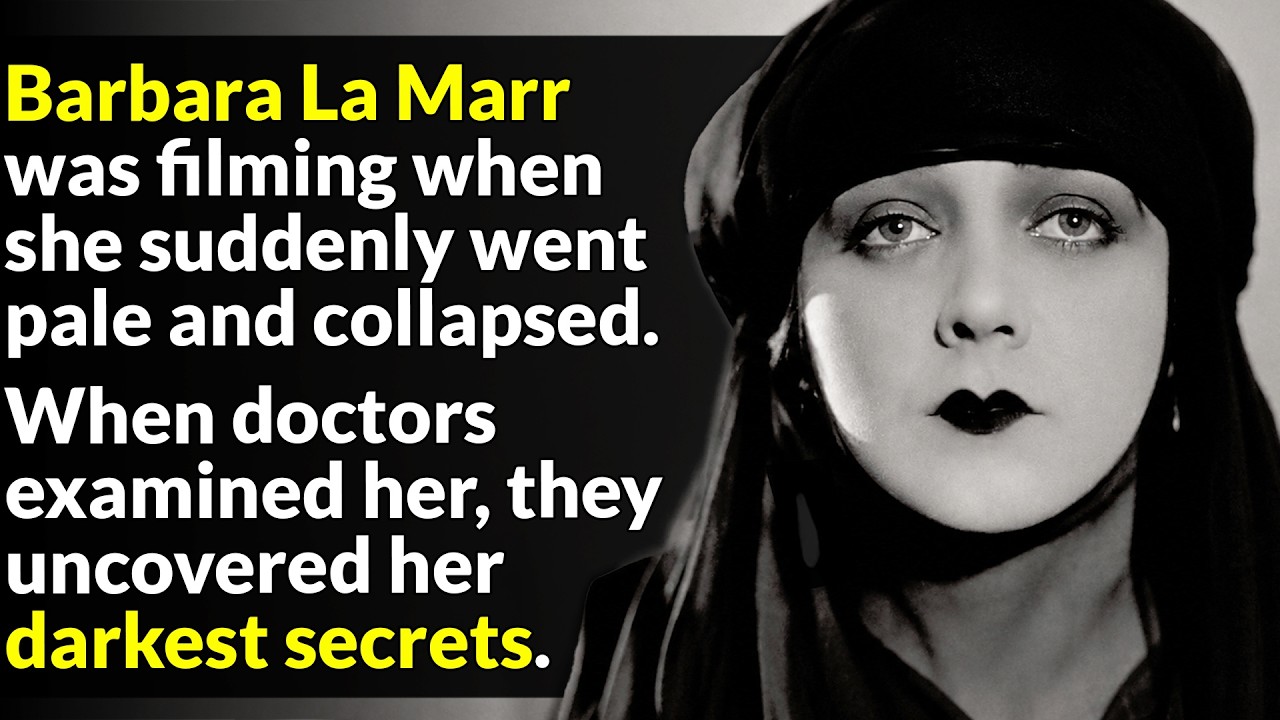
Hollywood’s most dazzling secret was buried with Barbara La Marr on a sweltering July afternoon in 1926, as 3,000 mourners surged against police barricades, some fainting in the heat, others clawing at the floral tributes that adorned her casket. The crowd had come to pay respects to the “Girl Who Was Too Beautiful,” a vamp whose dark eyes and darker past had captivated a generation. But as the procession lurched forward, the mob turned feral, ripping petals and wreaths from the hearse in a frenzy that bordered on the macabre.
They did not know, and would not know for decades, that the woman they were burying had taken her most scandalous truth to the grave. La Marr, the starlet who had collapsed on a film set just weeks earlier, was not merely a tragic figure consumed by the machine of fame. She was a mother who had orchestrated an elaborate, desperate lie to protect a son she would never see grow up.
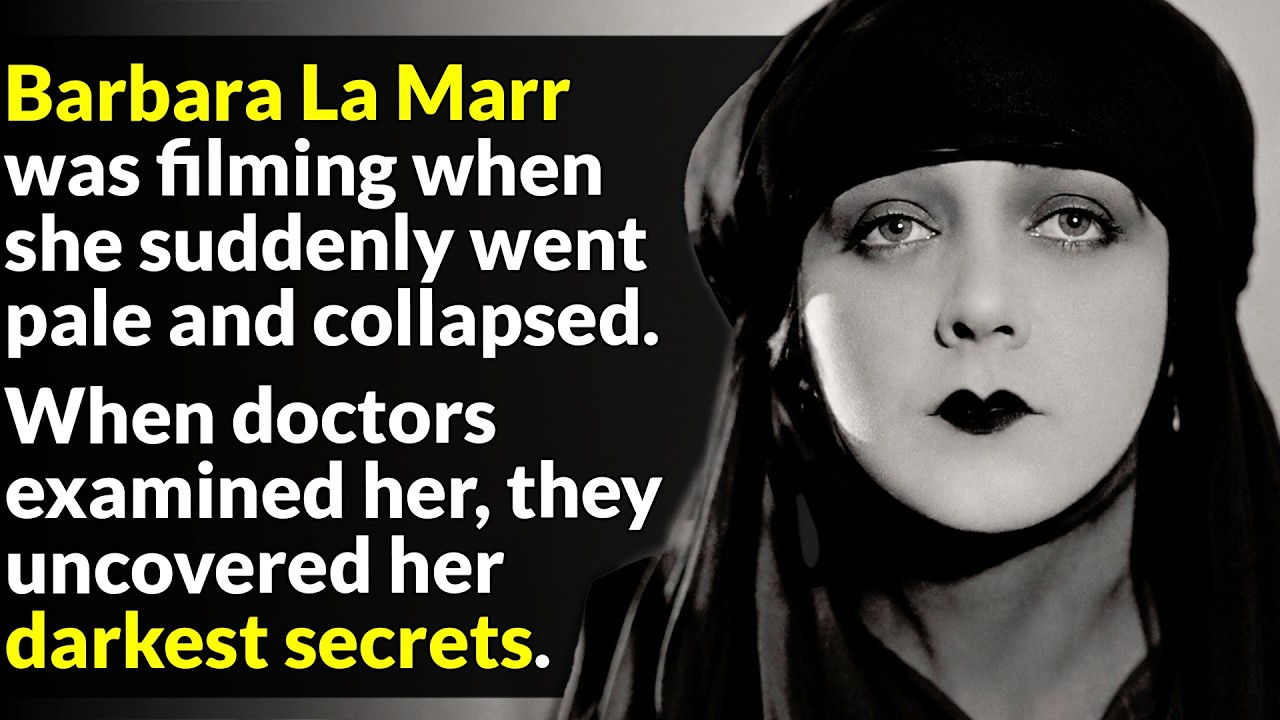 The revelation, when it finally surfaced, would rewrite everything the public thought they knew about the silent era’s most enigmatic femme fatale.
The collapse came without warning, a sudden, horrifying rupture in the carefully constructed facade of a comeback. It was 1925, and La Marr was pouring every ounce of her dwindling strength into “The Girl from Montmartre,” a film she hoped would resurrect a career that had spiraled into freefall. Witnesses on the set described the scene with chilling clarity: La Marr, already gaunt and pale, suddenly went white as bone, her body contorting violently before she crumpled to the floor in a heap of silk and sequins.
The cast and crew rushed to her side, their shouts echoing through the soundstage, but she was unresponsive, lost in a coma that would grip her for days. When doctors finally examined her, the diagnosis was brutal and unforgiving. Tuberculosis had ravaged her lungs, and nephritis was destroying her kidneys, the inevitable toll of years of self-destruction.
The woman who once boasted, “I cheat nature. I never sleep more than 2 hours a day,” had finally met a foe she could not outrun. But even as her body failed, her mind was racing, plotting one final, heartbreaking act of deception.
Barbara La Marr was born Retha Watson, a name that carried none of the glamour she would later manufacture, and her origin story was as classic as any Hollywood fairy tale, until it curdled into something far more sinister. Growing up at the turn of the century, she was a child performer, a dancer who dazzled audiences in vaudeville shows before her family relocated to Los Angeles to chase their own fortunes. She was just a teenager when the city’s intoxicating promise of fame wrapped its tendrils around her, and she began performing in racy burlesque shows, desperate to break into the fantasy realm of cinema.
But in 1913, at the tender age of 16, her thirst for the spotlight led her into a real-life nightmare. Her half-sister Violet and a man named C. C.
Boxley invited her on a road trip to Santa Barbara, a journey that would forever alter the trajectory of her life. The trio set off in high spirits, but as the days dragged on, La Marr’s unease grew into a cold, creeping dread. She realized, with sickening clarity, that she was not a companion on this trip; she was a captive, and her captors had no intention of letting her go home.
The pair only released her when they discovered warrants for their arrest on kidnapping charges, a twist that turned La Marr’s terror into a strange, unsettling opportunity.
 When the press got wind of the kidnapping, La Marr did not shrink from the attention; she devoured it. She testified against her own sister in court, then, when the truth ran dry, she began fabricating new details to keep the journalists hooked, even claiming she was adopted. Police reports from the time painted a disturbing picture: the teenager did not seem worried about her ordeal, but rather appeared “in a happy frame of mind” and told people she enjoyed the trip immensely.
It was a chilling glimpse into the psyche of a woman who would come to view even her own suffering as currency in the economy of fame. Within days, a monster was born, not a monster of malice, but a monster of need, an insatiable hunger for attention that would consume everything in its path. The very next year, she returned from Arizona with another tale, claiming she had met a rancher named Jack La Tell, married him within 24 hours, and watched him perish of pneumonia just three weeks later.
Whether La Tell ever existed remains a mystery, a figment of a fevered imagination or a tragedy lost to time, but it set the pattern for a life defined by sensational claims and unverifiable truths.
Her first provable marriage, in July 1914, was a disaster of operatic proportions. She wed a man named Max Lawrence, only to discover days later that his real name was Lawrence Converse, a gun for hire who was already married with children. The authorities arrested him for bigamy the very next day, and three days after that, he was dead, felled by a blood clot to the brain.
La Marr, just 18 years old, had already lived through more drama than most people experience in a lifetime, but she was far from done. In 1916, she married dancer Philip Ainsworth, a wealthy scion who ended up behind bars for passing bad checks. The marriage crumbled within a year, and a bizarre rumor began to circulate that La Marr had died in Salt Lake City from a broken back.
She was, of course, very much alive, and the notice of her survival sent another shockwave through a public that was becoming addicted to her chaotic narrative. She moved on to Ben Deeley, a man more than twice her age, a drinker and gambler who pulled her into his orbit of self-destruction. With Deeley, she finally made a real crack at Hollywood, not as an actress, but as a screenwriter, penning scripts while also touring as a dancer with partners like Rudolph Valentino and Clifton Webb.
Her big break came when Mary Pickford spotted her and declared, “My dear, you are too beautiful to be behind a camera.” Within a year, La Marr had transformed into one of the biggest vamps of the silent era, a precursor to the femme fatale, starring in films like “The Prisoner of Zenda” and “Trifling Women.”
 Her Hollywood image was of a beautiful man-eater stuffed with dark secrets, and life imitated art with terrifying precision. She earned the nickname “The Girl Who Was Too Beautiful” after a judge insisted she go home, claiming she was too stunning to be alone in the city. She leaned into the persona, quipping, “I take lovers like roses, by the dozen,” and she cultivated an air of mystery, refusing to let people call her a star while accidentally leaking her own poetry to the press.
But the partying was taking a toll. She admitted to sleeping only two hours a day, and her weight began to climb, a terrifying prospect for a woman whose entire identity was built on her appearance. She tried crash diets, and when those failed, she reportedly resorted to the tapeworm diet, swallowing a pill containing a parasite in a desperate bid to stay thin.
It didn’t work, and her health continued to deteriorate. In 1921, her marriage to Deeley fell apart, and she threw herself into even more reckless behavior. Then, in 1923, she made a surprising announcement: she had adopted a baby boy, Marvin, from an orphanage, claiming she had fallen madly in love with him during a PR visit.
She cut through all the red tape and took him home that same afternoon, a whirlwind decision that seemed perfectly in character for a woman who never did anything slowly. But the adoption was a lie, a carefully constructed cover for a scandal that would have destroyed her career. Marvin was her biological son, born out of wedlock between her marriages to Deeley and her new husband, Jack Dougherty, whom she wed before her divorce from Deeley was even final.
The same year she married Dougherty, La Marr sprained her ankle on the set of “Souls for Sale,” and rumors swirled that she became addicted to opiates while recovering. Her ex-husband Deeley, claiming he was still legally her husband, tried to extort her, threatening to reveal all her affairs unless she paid up. In court, La Marr looked horrific, her late nights and constant partying etched into her face.
When the judge asked her to read Deeley’s complaint, she sobbed, “My eyes are too full of tears to read it.” The courtroom drama tanked her career, and the press, once enamored with her antics, turned on her completely. Her performances grew lackluster, with one reviewer noting, “She has not grown one atom as an actress.”
She suffered a mental breakdown, confined for weeks with a throat infection complicated by intestinal disorders, and she emerged a shadow of her former self, malnourished, nervous, and angry. Determined to stage a comeback, she threw herself into “The Girl from Montmartre,” but her body had reached its breaking point. The collapse on set was the final act.
 As she lay in the hospital, fading fast, she made a gut-wrenching decision: she gave her son Marvin to her friend, actress Zasu Pitts, and Pitts’ husband Tom Gallery. The couple adopted the boy, renaming him Donald Gallery, and he would never see his mother alive again. On July 30, 1926, Barbara La Marr died at the age of 29, her body finally succumbing to the years of abuse she had heaped upon it.
Her friend, producer Paul Bern, was by her side until the very end, a detail that would later fuel speculation about Marvin’s true parentage.
The secret of Marvin’s birth remained hidden for decades, a bombshell that only detonated long after La Marr was gone. It was revealed that she had orchestrated the entire adoption plot, first giving birth to the baby, then sending him to an orphanage so she could “adopt” him and cover up the scandal of an illegitimate child. She never revealed the father’s identity, and no one ever came forward.
Marvin, now Donald Gallery, later claimed he believed his father was Paul Bern, the man who had stayed with La Marr until the end. But that theory was disproven, and the mystery of Marvin’s father remains unsolved to this day. La Marr’s legacy, however, lived on in unexpected ways.
When Louis B. Mayer was searching for a stage name for a new star, he chose “Hedy Lamarr” in homage to Barbara, a name that would become synonymous with Golden Age glamour. But the original La Marr, the woman who burned so bright and so fast, left behind a story that was far darker than any film she ever starred in.
She was a woman who lied about her life, exaggerated her tragedies, and fabricated her joys, all in a desperate bid to stay in the spotlight. And in the end, her biggest secret, the son she loved so fiercely that she would rather give him away than see him tainted by scandal, was the one truth she could not bear to tell. The crowd at her funeral didn’t know they were mourning a mother’s sacrifice.
They only saw the beauty, the tragedy, the myth. But the truth, as always, was far more devastating.