My husband collapsed and died in his girlfriend’s condo on a Tuesday night in February. By the time I reached the hospital, his mother was already asking about the life insurance payout. Before I drove home that night, I had moved the funds, called my attorney, and frozen every joint account. Ten days later, our townhouse was listed.
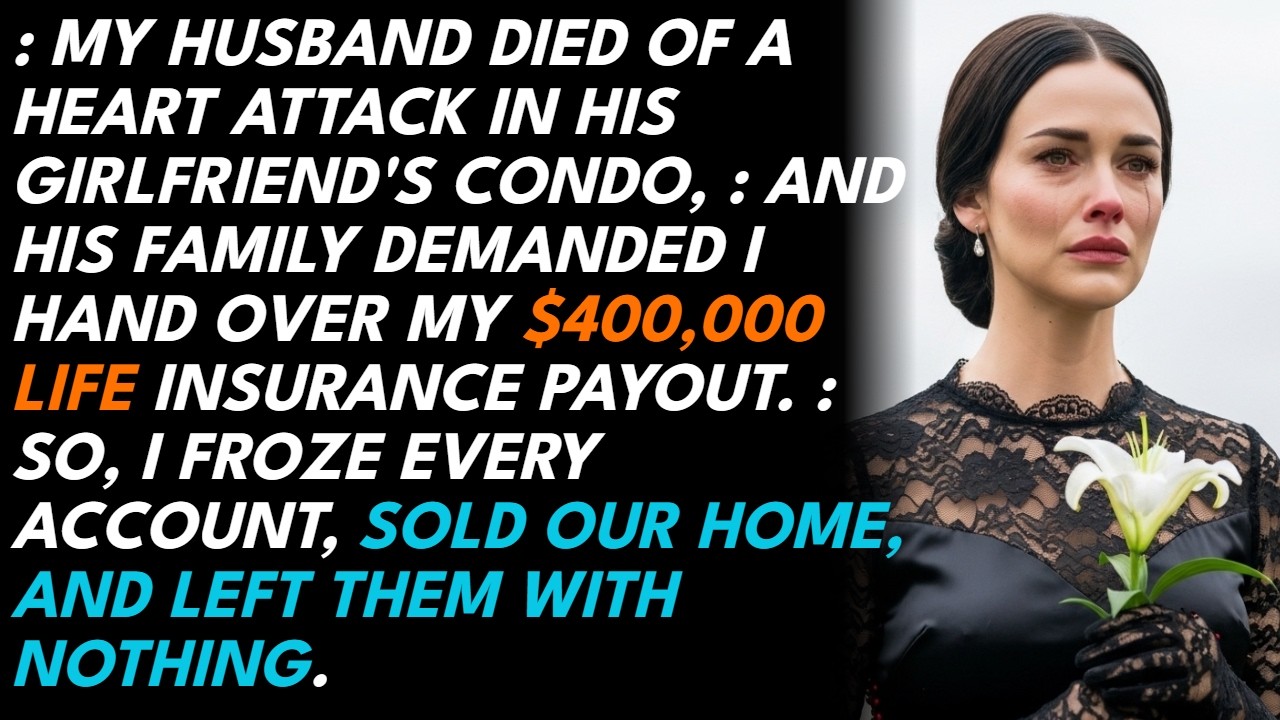
His family never saw a single dollar of it. Let me go back, because you need to understand how I got from there to here. I bought the Lincoln Park townhouse when I was 28, nearly two years before I met Warren. I’d been a pediatric nurse practitioner for four years, working doubles whenever the schedule allowed, saving everything I didn’t spend.
My mother called me relentless about it. My college friends thought I was no fun. But on a cold October morning, I stood in an empty living room with hardwood floors and south-facing windows, holding keys and a deed with only my name on it, and I knew exactly what every sacrifice had been for. I met Warren at a mutual friend’s birthday party about a year and a half later.
He was the kind of man who’s good at rooms, easy with strangers, warm without effort. He worked as a financial analyst in the Loop. Smart, funny, and, I thought then, genuinely kind. We dated for a little over a year, got engaged on a trip to Asheville, and married in a small ceremony in Oak Park.
I added Warren’s name to the townhouse deed — or rather, I didn’t. My attorney had explained that as long as the property stayed titled solely in my name and I continued paying the mortgage from my personal premarital account, it would remain separate property under Illinois law. I kept the same account I’d had since before I met him. He knew about the arrangement.
We discussed it once. He said it made sense. Then we ordered takeout and never talked about it again. For the first two and a half years, we were okay.
Not a fairy tale, but okay. We cooked dinner together most nights. We had a fantasy baseball league we took absurdly seriously. We went to his parents’ house in Evanston for the holidays and to my parents in Indianapolis for Thanksgiving.
The normal infrastructure of a life. The shift happened gradually enough that I kept explaining it away. Warren started staying late more frequently. Client dinners that ran long, he said.
Quarterly crunch. A difficult project stretching him thin. I was working doubles at the clinic through most of that year and didn’t have the bandwidth to scrutinize what I couldn’t name. I was tired, he was tired, and I told myself this was what the third year of a marriage looked like.
There were three things I noticed and didn’t confront. First, a hotel charge on our joint account. $340 at a downtown Chicago hotel on a Thursday when Warren had told me he was visiting a client in Milwaukee. When I asked casually, he said it was a miscoded expense from a coworker’s dinner that he needed to get reimbursed.
I accepted that. Second, a Saturday afternoon he was supposedly working overtime when I called and it went to voicemail three times before he called back slightly breathless, saying he’d been in a meeting. Third, a name I saw when I glanced at his phone screen. Just a letter, just a “B” with a heart emoji in the notification preview that he tilted away before I could read more.
I noted all three. I told myself I was being paranoid. I convinced myself that a person who was genuinely kind, who still remembered my coffee order, who checked that the fridge had what I needed for the week, was not the kind of person who was doing what I was starting to suspect. Eight months before Warren died, I called my attorney.
I explained the hotel charge, the pattern of lateness, the general feeling of something being off in a way I couldn’t articulate cleanly. She didn’t tell me what to do. She laid out options. One thing she gently suggested was that having separate financial clarity — my own accounts, my own records — was simply prudent regardless of what was or wasn’t happening.
I opened a separate Chase account the following week and began splitting my direct deposits. Half to our joint account as usual, half to the new one. I told myself it was just being organized. The Tuesday it happened, I’d made chicken piccata for dinner.
Warren texted at 6:15 to say he had a client situation and would be late. I didn’t ask how late. I ate alone at the kitchen island, covered his plate, and fell asleep on the couch with the television running something I wasn’t watching. My phone rang at 11:42.
I remember the exact time because the microwave clock was in my line of sight when I stumbled into the kitchen to answer. It was Wyatt, Warren’s younger brother. His voice had lost all its usual looseness. He said Warren had been taken by ambulance to Northwestern Memorial.
He said I needed to come. He hesitated before the last part. It was serious. I don’t remember putting on my coat.
I remember the Uber driver not saying a word for the entire ride, which I was grateful for. I remember the sliding glass doors of the ER and the smell — that sharp institutional smell I know professionally, but that night it hit me completely differently. And I remember seeing Warren’s family clustered near the waiting area before I even reached the front desk. His mother, Norma, was there.
So was his father, Leonard. Wyatt, still in his coat. Claudia, Wyatt’s wife, holding a paper cup of coffee she wasn’t drinking. They all turned when they saw me.
Norma crossed the room and took both my hands and said Warren’s name and then couldn’t finish the sentence. The doctor came out approximately ten minutes later. He was the kind of tired that isn’t from that one night, but from years of nights like it. He told us that Warren had suffered a massive cardiac event, that he had been in severe distress when the paramedics arrived, and that despite extensive efforts, they had not been able to revive him.
He said he was very sorry. He asked if anyone had questions. The sound that came from Norma is not something I can accurately describe. Leonard steadied her.
Claudia pressed her hand to her mouth. Wyatt looked at the floor. I stood very still. My pulse was in my ears and my throat and everywhere.
The information kept sliding off the surface of my brain. And then — I want to be specific about the timing because it tells you everything you need to know — before I had said a single word, before I had cried or asked a question or fully processed what I just heard, Norma composed herself enough to look directly at me and say, “Warren mentioned the life insurance, the policy you both have. We’re going to need to talk about that. ”
I couldn’t answer.
I stood there and could not form words. Claudia moved smoothly into the silence, her voice measured and practical. “We know how hard this is, Colette. It’s hard for all of us.
But there are arrangements to make, and the sooner we’re organized, the better. A proper funeral, a real one, runs at least twelve to fifteen thousand dollars. And there are other financial matters Warren had discussed with the family. ”
Wyatt explained the rest.
Warren had borrowed money from his parents over the past year. $40,000 in installments, no formal paperwork, just family trust. They expected repayment from Warren’s estate. I heard every word.
I stored it somewhere cold. That was when the detective approached our group. He offered condolences and then explained, in the careful matter-of-fact way that law enforcement delivers difficult facts, that Warren had been found unresponsive in a condominium in River North. A woman had been present and had placed the 911 call.
She had given a statement and been released. Her name was Brittany. The whole family went rigid. River North.
A condominium. A woman named Brittany. I asked the detective for the exact address. He gave it to me.
And something in my chest went cold and very clear, the way things do when a fact you’ve been half-avoiding finally becomes unavoidable. Three months earlier, I had noticed a recurring charge on our joint account. $1,800 a month to a property management company with a River North address. I’d asked Warren about it on a Thursday evening.
He said it was a storage unit. Furniture from his old apartment he hadn’t found room for. Some equipment for a side project he was thinking about starting. I’d accepted that.
I had wanted to accept it. Standing in that hospital hallway, I understood there had never been a storage unit. Norma had recovered herself. She was watching me with an expression that held grief, yes, but underneath it something else.
A calculation. A gauging of where things stood. “The townhouse,” she said. “We’ll need to discuss the townhouse.
”
“The townhouse is in my name,” I said. My voice was steadier than I expected. “It was purchased before the marriage with my own premarital funds. It is separate property under Illinois law.
That conversation is not happening tonight. ”
“Colette, I’m going to make some calls. I’ll be in touch through my attorney. ”
I walked to the far end of the hallway and sat down in a plastic chair next to a vending machine, and I opened my phone.
The first call was to my attorney. She answered on the second ring. I explained what had happened in as few sentences as possible. She told me clearly what to do next.
I did it. The second call was to the insurance company’s 24-hour claims line. The policy was one I had purchased through my employer’s supplemental benefits program. Warren was the insured.
I was the sole named beneficiary. $400,000. I initiated the claim and requested that all correspondence go to my personal email address only. After I hung up, I opened my banking app.
The balance of our joint checking account was $11,400 — largely my paycheck from the previous week. I moved it to my private account in three transfers. My attorney had already explained that as the surviving spouse, I had legal access to joint funds and that I should act before any complications arose. I acted.
I went home at 2:00 in the morning. I didn’t turn on the television. I went directly to the second bedroom Warren used as a home office and started going through his desk. The lease agreement was in the second drawer.
River North address, 14 months, $1,800 per month, Warren’s signature at the bottom. I did the math without a calculator. $25,200 pulled from our joint account — an account funded in large part by my paycheck — for an apartment where my husband had been living a parallel life. I found hotel receipts folded inside a folder.
Charges I’d seen on statements and attributed to work. A dinner receipt from a River North restaurant. $304 for two on a Saturday afternoon I’d been running errands. And I found, in a white envelope tucked inside a folder of old tax documents, a receipt from a jewelry store on Michigan Avenue.
A gold bracelet. $2,200. Charged to our joint Visa on a Saturday I had worked a 12-hour shift. I sat holding that receipt for a long moment, because I had seen that bracelet.
On Instagram, four months earlier. A photo from a restaurant in River North. A woman’s wrist raised toward the camera, the bracelet visible, the caption something cheerful and unremarkable. Warren had liked the photo from his personal account.
I’d seen the notification in passing and thought nothing of it, because I had no reason to. I had trusted my husband. I photographed everything. Emailed it all to my attorney before I went to bed.
Three days after Warren’s death, a certified letter arrived from a law firm I didn’t recognize. The letter stated that Warren had verbally committed to providing $80,000 to his girlfriend for what they called their “shared future plans,” and that as his surviving spouse, I was expected to honor this commitment. I forwarded it to my attorney without adding a single word. Her response to their firm was comprehensive.
It established that I had no obligation to act as a representative of the estate and had not accepted that role. It established that verbal promises are unenforceable under Illinois law without written documentation, which did not exist. And it outlined that I had documented evidence — bank statements, receipts, the signed lease — showing that over $25,000 of marital funds had been diverted to pay for the condo and gifts received by their client. Should they choose to pursue the matter, we would countersue for recovery of those marital assets, and all documentation would become part of the public record in probate court.
We never heard from them again. Norma and Claudia came to the townhouse that Saturday. I watched them on the video doorbell camera. Norma in a black coat, Claudia a half step behind her.
Both of them with the posture of people who’ve decided they’re owed something. I spoke to them through the intercom. I told Norma that I understood she was grieving and that I was too, in my own way, and that I did not wish her harm. I told her that the townhouse was separate property under Illinois law, that my attorney had confirmed this in writing, and that this was not something I was willing to debate.
I told her that any claim regarding personal loans Warren had taken from family members should be filed through the probate court as creditor claims, and that I would provide every cooperation the law required of me. I slid my attorney’s business card through the mail slot. They stood on the stoop for a while longer. Then they left.
The following week I called my realtor — the same woman who’d helped me buy the place originally, who had sent me a handwritten card after she heard what happened, who I trusted completely. She came over, took photos, had it listed by Thursday morning. Three offers came in by Sunday. I accepted the strongest one, $18,000 over asking.
The closing was six weeks later. I signed my name across fourteen pages in a conference room downtown while outside it rained — that particular Chicago February rain that feels colder than snow. The title company’s coordinator offered me a bottle of water and I took it. I shook hands with the buyers, a couple in their early 30s who were visibly thrilled the way I had been thrilled once.
I walked out into the rain, got into a cab, and did not let myself feel anything until I was in my new building’s elevator. Then I sat down on the hallway floor of my Wicker Park condo, coat still on, and cried for a while. Not for Warren, specifically. For the version of things I thought I had.
For the four years. For the chicken piccata going cold in the refrigerator. Then I got up, took off my coat, and ordered pizza. Spring came.
I started growing things on my balcony. Herbs first, then a tomato plant that sprawled past its cage, then a rosemary bush that became a problem in the best possible way. I enrolled in a program two evenings a week and one Saturday a month, which was exactly the right amount of structure to make me feel purposeful without swallowing me whole. I reconnected with people I’d let drift during the marriage.
I started sleeping through the night again, which I hadn’t realized I’d stopped doing until I started again. Through a colleague at the clinic, I met Hugo. He was a civil engineer — methodical, and genuinely funny in a quiet way. The kind of person who notices small things and doesn’t make a performance of noticing them.
The first three times we had coffee to discuss a community health initiative we were both connected to, he brought my order without asking because I’d mentioned it once in passing. Oat milk, no sugar. Not as a gesture meant to impress, just as something useful to know. One Saturday in March, he texted to ask if I wanted to go to the Green City Market.
Nothing weighted in it, just the market, just the morning. I said yes, and it was such a simple thing — being somewhere with someone who asked real questions and listened to the whole answer. I’d forgotten what that felt like. I was glad to remember it.
A neighbor from the old building texted me in the fall, asking how I was, and then — because people can never quite resist telling me — what she’d heard. That Leonard had taken a fall and was now in a care facility. That the family savings weren’t what anyone had assumed. That Norma was staying with Wyatt and Claudia in Evanston.
That there were troubles in that household, financial ones, building for some time. That Claudia had filed for legal separation. I read the text once. I put the phone face down on the counter and went back to repotting a basil plant whose roots had outgrown its container.
Which is, all things considered, a good problem to have. Here is what I know. I didn’t take anything that wasn’t mine. I protected what I had built before that marriage, during that marriage, with my own labor and my own foresight.
I followed the law and I trusted the right people, and I did not soften at the moment when softening would have cost me everything. The people who stood in that hospital hallway and asked me about insurance money before my husband’s body was cold had made their values clear. I simply believed them. There’s a version of this story where I’m the villain.
I know that. But there’s also the version where a woman who spent four years being quietly deceived chose, at the moment of maximum pressure, not to collapse. I’ve decided to live in that version. The rosemary needs a bigger pot.
I’ve been meaning to get one this weekend, maybe, if the weather holds.