I poured myself a second cup of coffee and stood at the kitchen window, watching the leaves fall from the old oak in the backyard. November always made me reflective. My husband used to say I got quiet in November, that I carried the month like a coat that didn’t quite fit. He passed six years ago, and I suppose he was right.
My daughter called on a Tuesday, asking if I was coming to Thanksgiving at the Hargroves. She asked lightly, the way people ask questions they already know the answer to. I told her of course I was coming—I had come every year for eleven years, ever since she married into that family. I said I’d bring my sweet potato casserole with the brown sugar crust, and she laughed, saying that was the only reason anyone invited me.
I laughed too, but when I hung up, I stood in my kitchen holding my mug with both hands, thinking about the folder in my filing cabinet. The one I had kept for nineteen years. The one I had told myself I would never need to open. I should tell you something about my daughter.
She is the kind of woman who apologizes when someone bumps into her. She has been that way since she was small. When other children argued over toys, she gave hers away. She married my son-in-law because she loved him genuinely, and I believed he loved her the same way.
I still do. He is not a bad man. He is just a man who spent his whole life afraid of his mother. His mother.
I need you to understand something about her before I go further. She is the kind of woman who makes you feel her presence before she enters the room. Not because she is warm, but because she has spent decades perfecting the art of making other people small. She runs a real estate company her late husband built from nothing, though she has spent the last thirty years pretending she built it herself.
She wears her money like armor. The first time I met her, she looked at my daughter’s hands. Not her face, not her eyes—her hands. My daughter worked nights at the hospital then, her hands dry and rough around the knuckles.
My son-in-law’s mother looked at those hands and smiled a smile that had nothing warm in it, saying, “Well, I suppose character comes in all forms, doesn’t it? ” My daughter laughed nervously and thanked her. I sat very still and said nothing. I was learning the terrain.
Over eleven years, I learned it well. The Christmas she gave my daughter a gift card to a discount store while giving her other daughter-in-law a pearl necklace. The birthday dinner where she spoke for forty minutes about her older son’s career without once asking how the hospital was going. The Sunday lunches where she seated my daughter at the far end of the table, near the kitchen, so she was always the first up to clear plates.
My daughter never complained. She visited me on her days off, and I made tea, and she told me about the good things: the children’s school play, a patient who recovered against all odds, a new recipe she was trying. She protected me from the weight of it the same way she protected everyone. But I saw.
Mothers always see. That Thanksgiving, I drove ninety minutes to the Hargrove house. A large colonial on a tree-lined street in a suburb that takes itself seriously. Stone driveway, iron gate, two wings added in the nineties when the money was flowing faster.
I parked behind my daughter’s car and sat for a moment. I had put the folder in my bag that morning without fully deciding why. Old instinct, maybe. The house smelled like cinnamon and roast turkey and something floral from a diffuser.
My son-in-law’s mother stood in the foyer greeting guests in a charcoal wrap dress, her silver hair pinned back, a strand of diamonds at her collarbone. She kissed my cheek and told me it was lovely I could make it, the way you say lovely when you mean tolerated. My grandchildren ran to me from somewhere in the back. They were nine and seven, a boy and a girl, both made entirely from joy and noise.
I held them and breathed in their hair and felt the November coat loosen a little. My daughter was in the kitchen arranging serving dishes with the housekeeper, moving quietly and efficiently. She hugged me, whispered that I looked beautiful, and asked about the drive. I told her the traffic was fine.
But I looked at her face and I knew, the way I always knew, that something was wrong. Dinner was set for six. The table seated fourteen with china brought out twice a year. My son-in-law’s older brother was there with his wife, a woman with perfect posture and no apparent sense of humor who was genuinely kind once you got past the surface.
Their three children sat at the far end, and my two grandchildren sat beside them. The adults filled the middle, and at the head sat my son-in-law’s mother with the ease of someone who had never wondered whether she belonged. For the first hour, it was almost pleasant. The food was good, the wine poured generously.
My son-in-law’s brother gave a toast about gratitude, sincere if a little rehearsed. The children squabbled over the last crescent roll, and everyone laughed. I watched my daughter across the table talking about the hospital, animated in a way she only got when talking about something she cared about. I thought maybe tonight is just a night.
Maybe I carry that folder home unopened. Then the plates were cleared, the pie brought out, and my son-in-law’s mother set down her wine glass and said she had something to share with the family. She said it pleasantly, the way you announce good news. She said she had been doing estate planning, getting her affairs in order, and wanted everyone to know where things stood while she was still here to explain.
She believed in transparency. She believed in legacy. She talked about the company, how it had grown, what it meant to the family. She used the word stewardship three times.
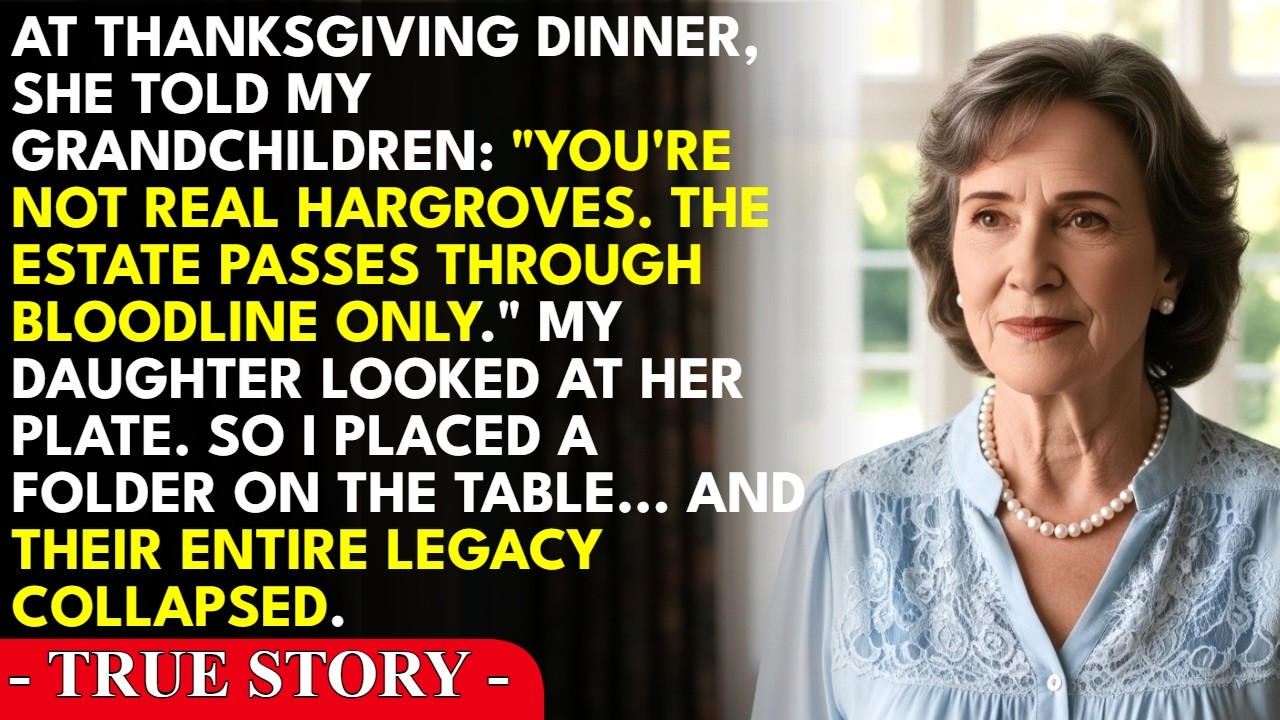
Then she looked down the table at her grandchildren, her sons’ children, and said that the future of the Hargrove name rested with them. She said it directly. The estate, the company, the shares, the properties would be structured to pass through the Hargrove bloodline. I set down my fork.
She did not look at my grandchildren when she said it. She did not have to. My grandson was nine years old, cutting his pie very carefully the way he always did, and I watched his hands pause for just a moment. My granddaughter was looking at her mother.
My daughter was looking at her plate. My son-in-law sat at the middle of the table and said nothing. His mother continued. She said she loved all the grandchildren, of course, would always care for all of them, but a family business required clarity.
She said the word clarity the way some people say obviously. Then she smiled at my daughter, a specific kind of smile, and said, “I’m sure you understand. This isn’t about anything personal. This is about what the Hargroves have built.
”
My daughter nodded. She said, “Of course. ” Her voice was completely steady. I looked at her.
She would not look at me. The table moved on. Someone passed the whipped cream. My son-in-law’s brother cleared his throat and said something about the pie.
The housekeeper refilled glasses. The children started talking again. I sat very still. There is a kind of anger that does not feel like heat.
It feels like cold clarity. Everything gets very quiet and very sharp, and you can see all the edges of things. I have felt it only a few times in my life. I felt it when a doctor spoke to me like I was simple after my husband’s diagnosis.
I felt it once when my daughter was twelve and a teacher told her she was not the type to go to college. I felt it now, sitting at a Thanksgiving table in a house I had never been invited to decorate, watching my daughter absorb the information that her children were somehow less, and say of course, and nod. I picked up my napkin, folded it once neatly, and set it beside my plate. I said, “I need to get something from my car.
Please excuse me. ”
My son-in-law’s mother glanced up and said of course, her tone the kind of gracious that is actually dismissive. I walked through the entry hall, opened the front door, and stepped into the cold night air that smelled like wood smoke from somewhere down the street. I walked to my car, opened the passenger door, and reached into my bag.
My hands were completely steady. They have been steady my whole life. I raised a daughter alone for part of it, worked a full career in the county records office for thirty-one years, survived things I will not catalog here. I know what my hands feel like when I am certain.
I stood beside my car in the dark for a moment. I thought about all the Thanksgivings, all the Christmas dinners, all the times my daughter had nodded and said of course and carried something home she should not have had to carry. I thought about my grandson’s hands pausing over his pie. I went back inside.
I walked through the entry hall into the dining room and sat down in my chair. I placed the folder on the table beside my plate. Nobody had noticed I had brought it in. They were talking about a renovation the older brother was doing on a house in Vermont.
The whipped cream was still going around. My son-in-law’s mother looked at the folder with the particular expression of someone who does not want to appear curious. She said, “Did you forget something, dear? ”
I said, “No.
I remembered something. I’d like to share it when you have a moment. ”
She smiled. She said, “Of course.
” She turned back to the table and picked up the thread of the Vermont conversation as if I had said nothing interesting. She was very good at that. I waited. I am patient.
Thirty-one years in the county records office teaches you patience. People bring you impossible problems, and you sit with them, and you work through them, and you do not rush, because rushing is how you miss things. About ten minutes later, there was a natural pause in the conversation. My son-in-law’s mother reached for her wine.
I said her name, not a title. Her name. She looked at me. I said, “You mentioned legacy tonight.
The Hargrove legacy. Building something and passing it forward. ”
She said, “Yes. ” Slowly, with the tone of someone wondering where this was going.
I said, “I worked in the county records office for thirty-one years. Deeds, property transfers, corporate filings, estate documents, all of it. Some people find that kind of work dry. I always found it fascinating.
You can learn everything about a family from the paper trail they leave. ”
She was very still now. The table was very quiet. I said, “I’ve had something in my files for a long time.
Nineteen years. I want to be clear—I never went looking for it. It came to me through my work years before my daughter married into your family. I kept it because I didn’t know what else to do with it.
I never intended to use it. I hoped I would never need to. ”
I opened the folder. Inside were copies.
The originals were at my house, filed properly, dated and signed. Three documents. I had looked at them so many times I could describe them from memory. The first was a property transfer record from 1987.
It showed the transfer of four commercial lots in the county from a land development company to a private individual. The private individual was the maiden name of my son-in-law’s mother. The land development company was one her husband had been in business with for approximately eight months. The recorded transfer price was one dollar.
Not a gift notation, not an estate transfer. One dollar for four lots worth, in 1987, approximately $260,000. I placed the document in front of her. She looked at it.
She went very still in the specific way people go still when they recognize something they thought was buried. I said, “The Hargrove company’s first real assets. I know the story. Your husband found a partner, built a small portfolio, made his first real money.
What the family history leaves out is that the starting capital was those four lots transferred from a partnership before it dissolved under complicated circumstances. ”
I placed the second document beside the first. This one was a civil filing from 1989. A former business partner had initiated a dispute over the dissolution of the land company.
The filing described very specifically how assets had been redirected before the dissolution was formalized. The case had been settled privately in 1990 under a confidentiality agreement for a payment that was, according to the settlement summary, substantial. The table was completely silent. My son-in-law’s mother said my name, just my name, quietly.
I said, “I’m not finished. ”
The third document was older than the others and more personal. It was a birth record. I had found it in a county two states away, filed under a name I hadn’t recognized at first.
It had taken time to connect the pieces, the way records work sometimes, threads leading from one drawer to another. When I connected them, I understood something the Hargrove family had apparently never been told. I set it down. My son-in-law’s mother looked at it and made a sound that was very small and very human.
The first entirely unguarded sound I had ever heard from her. I said, “Your husband was not the man he told you he was when you met him. I don’t mean his character. I mean his background.
The story he gave you about his family, the name, the heritage, the bloodline you’ve built thirty years of identity around—the records don’t support it. He came from a very ordinary family in western Pennsylvania. His father worked at a mill. His mother was the daughter of immigrants.
He built himself into something else before he met you, which I honestly think says something admirable about him. But it does complicate the conversation about legacy and bloodline you were having thirty minutes ago. ”
I looked at her carefully. I said, “The Hargrove name is a name he chose.
He built something real with it. You helped build it too. I am not diminishing that. But I would ask you to consider what it means to tell my grandchildren they are not Hargrove enough when the Hargrove legacy itself was built by a man who understood, better than most, that where you come from does not determine what you become.
”
The room was absolutely still. My son-in-law was looking at his hands. His brother’s wife was looking at her plate. The children, I was grateful, were absorbed in whispered conversation at the far end, unaware.
My daughter was looking at me. Her eyes were full. She was pressing her lips together the way she did when trying very hard not to cry. My son-in-law’s mother sat for a long moment.
She is a strong woman. I have always known that. She breathed in slowly, breathed out, looked at the documents in front of her, and stayed quiet for a long time. Then she said, “Where did you get these?
”
I said, “County records are public documents. I told you where I worked. ”
She said, “Nineteen years. ”
I said, “Nineteen years.
”
She said, “You could have used these at any time. ”
I said, “I could have. I didn’t want to. I want to be very clear.
I am not here to threaten you or damage you or take anything from you. Those documents are copies. The originals are in my filing cabinet at home, and they will stay there. I have no intention of showing them to anyone else.
What’s in the past is in the past. Your husband is gone. I see no point in disturbing his memory over things that were settled decades ago. ”
I folded my hands on the table.
I said, “What I am asking you, simply and directly, is this. My daughter has sat at this table for eleven years. She has shown up every holiday, every birthday, every family occasion, and she has been gracious and generous. She has loved your son and raised two children who are bright, kind, and good.
And tonight she sat here and heard you say, in front of those children, that they are less than. I am asking you to consider what that costs. Not to me. To her.
To them. ”
I picked up my coffee cup. My hands were still steady. I said, “That’s all I wanted to say.
”
Nobody spoke for what felt like a very long time. My son-in-law looked up from his hands. He looked at his mother first, then at my daughter. Whatever he saw in her face seemed to settle something in him that had been unsettled for a long time.
He reached across the table and took her hand. She looked at him. He said, quietly, “I should have said something a long time ago. I’m sorry.
”
She put her other hand over his and said nothing. His brother cleared his throat and said, in a careful voice, that perhaps the estate arrangements were something that should be revisited. He said it in the neutral tone of a man who had spent his life navigating his mother and had just watched the navigation chart change. My son-in-law’s mother sat very still for another long moment.
She was looking at the birth record. Then she closed the folder and pushed it toward me slowly, like returning something borrowed. She said nothing for a long time. Then she said, “I didn’t know.
” Her voice was different. Smaller. Not weak, but stripped of something. “About his family.
He never told me. ”
I said, “I know. ”
She said, “He was ashamed. He thought I wouldn’t—” She stopped.
She picked up her wine glass and set it back down without drinking. She said, “He worked very hard. ”
I said, “I know that too. ”
The table had become something different from what it had been an hour ago.
The formal arrangement, the performance of it, had gone quiet. What was left was just people sitting together in a room with food getting cold and difficult things acknowledged. My granddaughter slipped off her chair, came to me, and climbed into my lap the way she still did even though she was almost too big for it. She had no idea what had happened.
She just wanted to be near me. I put my arms around her, and she leaned her head back against my shoulder. I looked across the table at my daughter. She was watching me.
She had tears on her face now, and she wasn’t trying to hide them anymore. She looked like she did when she was small and something hard had passed and she was deciding whether to cry or laugh, landing somewhere between both. I smiled at her. She shook her head slowly, the way you do when you don’t have words.
The rest of the evening was quieter and stranger and more honest than any Thanksgiving we had spent in that house. My son-in-law’s mother did not become a different person. That is not how people work. But something had shifted in the room’s gravity.
She spoke to my daughter differently. Not warmly, not immediately, but without the particular armor she usually wore. She asked about the hospital. A genuine question.
My daughter answered it. It was small. It was a beginning of something, or maybe just the end of something else. I was not sure which, and I decided it was not mine to determine.
My son-in-law helped clear the table. He didn’t disappear into his brother’s conversation the way he usually did. He stayed near my daughter. He poured her coffee without being asked.
I sat with my grandchildren while the adults moved to the living room. We played a game on the floor with cards my grandson found in a drawer, something with complicated rules that changed every three turns based on his own invention. My granddaughter declared herself the winner twice before the game was officially over. I let her.
My grandson protested with great dignity and then laughed and gave up. They were fine. They were completely, entirely fine, and I sat with them on the floor and felt the November coat lift from my shoulders for the first time all month. I left around nine.
My daughter walked me to my car. The night was cold, the street quiet, our breath making small clouds in the dark. She said, “You had those for nineteen years. ”
I said, “I had them.
”
She said, “You never told me. ”
I said, “You didn’t need to know. I hoped you’d never need to know. ”
She was quiet for a moment.
Then she said, “How did you know tonight was the time? ”
I thought about it honestly. I said, “I didn’t, when I put the folder in my bag this morning. But when I watched you nod and say ‘of course’ and look at your plate, and I looked at your son’s hands, I knew.
Some things you can carry quietly for a long time, and that’s the right thing to do. And then there comes a moment when carrying it quietly isn’t grace anymore. It’s just silence. ”
She hugged me.
She held on for a long time, the way she did when she was very young and something had frightened her and she needed to be certain I was solid. I am sixty-three years old, and my knees ache in the cold, and I am not as strong as I used to be. But I held my daughter, and I was solid for her. When she let go, she wiped her face with the back of her hand.
She laughed a little. She said, “You scared me, you know, when you went to get something from the car. I thought you were leaving. ”
I said, “I would never leave.
”
She said, “I know. ”
I said, “That’s the thing. You’ve always known. That’s why you’ve been able to be so gentle with everyone else.
Because you knew someone was behind you. ”
She looked at me for a moment. Then she looked down and nodded once, very slowly, like something had just settled into place. I got in the car and drove home through the November dark, the road familiar and quiet, the folder on the passenger seat.
When I got home, I put it back in the filing cabinet where it had lived for nineteen years. I did not know if I would ever need it again. I thought probably not. I made myself a cup of tea and sat at the kitchen table.
The same table where my daughter had sat so many times on her days off, telling me about the good things. I sat with the quiet and the warm cup and thought about all the things we carry. The things we carry because we have to. The things we carry because we are protecting someone.
The things we set down finally, not with anger but with clarity, when the time comes and we understand that silence has done all the good it can do. There are people who will tell you that keeping the peace is always the right choice. I spent a long time believing that. I am older now, and I have changed my mind.
Not entirely. But in this one specific way. Keeping the peace is right until it becomes the price someone else pays. Until the person you love most sits at a table and says “of course” and looks at her plate, and you watch something in her face go just slightly smaller.
That is the moment. You will know it when it comes. You will feel it before you understand it. In your hands.
In the particular quality of the quiet around you. I am not a dramatic woman. I have lived a careful life. But I have learned at sixty-three that the truth does not require drama to be powerful.
It only requires the willingness to say it out loud at the right time, to the people who need to hear it. My phone buzzed just before I went to bed. It was my daughter. She had sent a photo.
My two grandchildren asleep on the couch in the Hargrove living room. My grandson’s head on his sister’s shoulder. Her arm thrown around him. Both of them completely and entirely at peace.
She had written just one line underneath it: “They are everything. ”
I set down my phone. I turned off the kitchen light. I went to bed.
I slept the way you sleep when something that has been held tight for a very long time has finally, gently, let go.