Researchers studying crow communication with artificial intelligence have uncovered a level of linguistic complexity that challenges long-held assumptions about animal intelligence. The analysis suggests crows use a form of syntax, assign specific names to individual humans, and engage in forward planning through structured vocal exchanges. The discoveries were made after a research team in Spain attached tiny microphones near crow nests and fitted birds with biologgers to record their sounds throughout the day. The effort produced hundreds of thousands of vocalizations, most of which were nearly inaudible to human ears and had been largely ignored by previous studies.
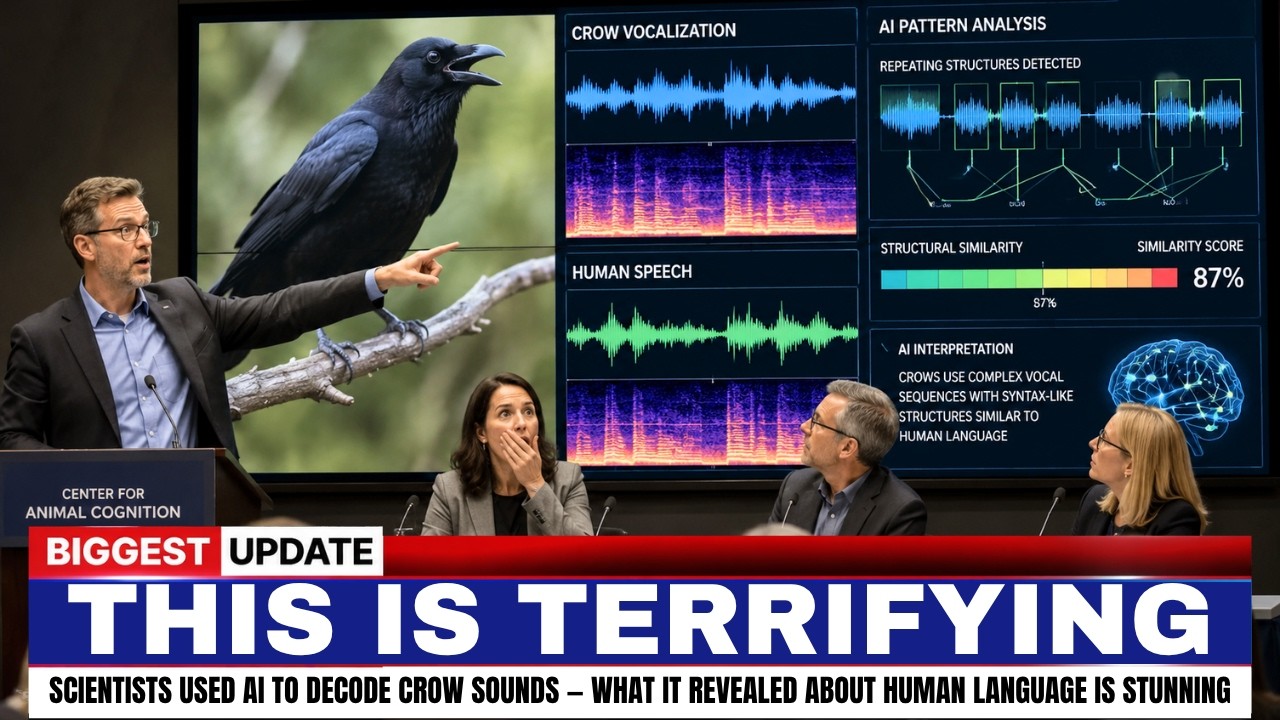
In 2024, the Earth Species Project, a nonprofit specializing in the application of AI to animal communication, partnered with the Spanish researchers to process the massive data set. The AI was designed to detect patterns in the sounds, something no human team could achieve manually. Instead of the simple set of alarm calls researchers expected, the AI identified a complex system of sounds combined and ordered according to specific rules, a structural feature known in human language as syntaxista. This finding suggests that crow vocal communication operates on a linguistic level previously unknown in birds, challenging the century-old belief that complex cognition and syntax require a mammalian cerebral cortexova.
Crows have a different brain structure called the palium, which performs similar high-level processing with densely packed neurons, giving them cognitive abilities comparable to chimpanzees for their body weight. The analysis also detected that crows assign specific, consistent sound sequences to individual humans, functioning like proper names. These names are shared across a group, meaning even crows that were not present at an initial encounter use the same vocal label for that person. Acoustic markers attached to these names convey how the crows perceive the individual, whether as a threat, a neutral presence, or a provider of food, allowing the entire group to respond appropriately.
Researchers also observed that crows produce complex sequences of vocalizations before events, rather than in response to them. These pre-event gatherings, described as planning sequences, suggest the birds coordinate actions and discuss future intentions among themselves. This forward-thinking communication was previously thought to be rare in the animal kingdom, and the AI findings indicate crows may discuss upcoming actions such as hunting or mobbing predators before any direct stimulus occurs. These exchanges frequently include references to humans, showing that people are central to their social discourse even during periods of low activity.
Another significant discovery involves the behavior observed around dead crows, often called crow funerals. When a crow discovers a dead member of its community, it produces a specific call that draws others to the site. The vocal exchanges during these gatherings are among the most acoustically complex in crow communication, functioning as investigations where the flock assesses what caused the death and what dangers might still be present. The crows effectively use these gatherings to mark danger zones and broadcast warnings to the wider community, updating their collective understanding of threats requires.
The AI study has also revealed that new vocal patterns began appearing near the study sites as the research progressed. These novel sequences spread quickly through local crow populations and into neighboring groups, moving like a viral wave across territories. The AI’s confidence scores dropped sharply as it encountered these unfamiliar sounds, leading researchers to propose the bold hypothesis that crows might be deliberately altering their communication in response to being recorded and monitored. While it remains unproven whether crows intentionally modified their calls to confuse watchers, the possibility highlights their extraordinary cognitive flexibilityand adaptability.
The ongoing study continues to process new data, searching for patterns in the unfamiliar calls. What is clear is that crow communication is not static, but adapts in real time, shaped by social needs, environmental changes, and possibly the presence of human observers. The findings challenge the assumption that animal vocalizations are fixed or purely instinctual, revealing crows as thoughtful communities engaging in organized, purposeful dialogue about the world around them.
As science inches closer to decoding this language, it forces a reconsideration of what language means and how far the reach of non-human intelligence extends.