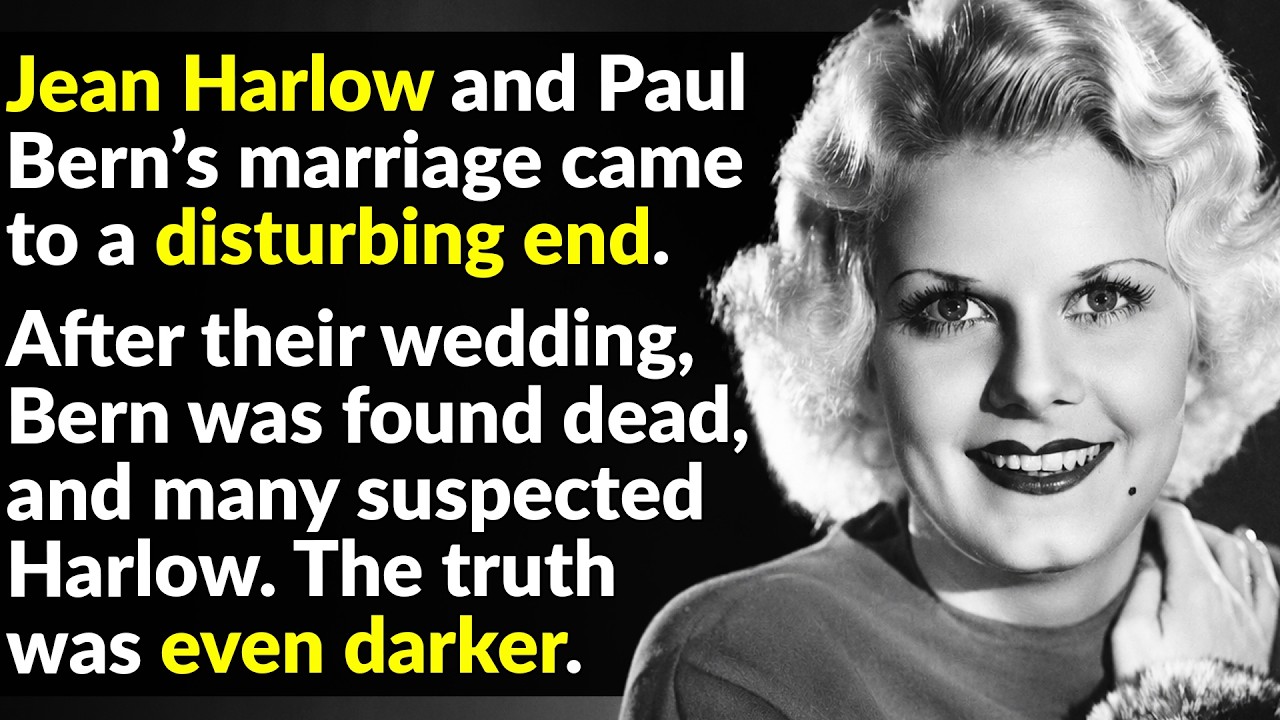
The shimmering platinum hair, the defiant smirk, the gowns that clung to every curve—Jean Harlow was the original “Blonde Bombshell,” a woman whose very image defined an era of Hollywood excess. Yet beneath the surface of her public triumph lay a private life so riddled with tragedy, manipulation, and despair that it nearly eclipsed her cinematic achievements. By the time she died at the tragic age of 26, Harlow had survived a suicide, a forced marriage, and two secret pregnancies, all while churning out more than 30 films.
The story that has emerged from the shadows of her short life reveals a star who was less a seductress and more a victim of the brutal, predatory machinery of the studio system.
 Born Harlean Harlow Carpenter on March 3, 1911, in Kansas City, Missouri, her path was never ordinary. Her mother, also named Jean Poe Harlow, was a fiercely ambitious woman who had married while still a minor herself. From her earliest days, the girl was simply called “Baby,” and she reportedly did not even realize she had a legal name until she enrolled in the exclusive Miss Barstow’s Finishing School for Girls.
This blurring of identity was the first sign of a life controlled by external forces. She was not meant to be her own person; she was meant to be a vessel for her mother’s unfulfilled dreams of status and fame.
When the marriage of her parents dissolved, young Jean moved with her mother to the Chicago area, where she was enrolled in the Ferry Hall School. There, the strikingly beautiful teenager caught the eye of a fellow student named Charles Fremont McGrew III, a young man from a family that was conspicuously loaded. The courtship was swift.
In 1927, when she was just 16 years old, the couple married, with McGrew on the verge of inheriting his massive share of the family fortune. For any other woman, this would have been the pinnacle of success, but for Harlow, it was simply the beginning of a gilded cage.
Two months after the wedding, the newlyweds relocated to Beverly Hills, California. Harlow was still just a teenager, but her financial status was already secured. She could have lived an easy life of simplistic indulgence.
Yet, a seemingly innocuous bet would derail her trajectory. A friend, an aspiring actress, challenged Harlow, suggesting she was too shy to audition for a movie. Eager to prove her bravado, Jean went, and in a move of whimsical secrecy, she signed her mother’s maiden name, “Harlow,” on the papers.
The cinematic world was about to be turned upside down.
Soon, Harlow was being offered minor work as an extra in silent films. She did not need the money, but she found it amusing. The driving force behind these early moves, however, wasn’t her own desire for fame—it was her mother, who had remarried and moved to Los Angeles to manage her daughter’s career.
The tension with her husband, McGrew, escalated as he expressed disdain for his wife’s new “hobby.” Unaccustomed to being the center of attention, the two separated by 1929, and Harlow pushed forward with her sporadic film appearances. Her husband’s life quickly faded from the narrative.
She got her first speaking role in The Saturday Night Kid in 1929, a film featuring the Marx Brothers. It wasn’t, though, until the eccentric billionaire Howard Hughes entered the scene that Harlow’s life took a volatile turn. Hughes was in a bind filming his epic war film Hell’s Angels.
The silent film had a leading lady with a thick Norwegian accent, a disaster waiting to happen for a “talkie.” Looking for a replacement, Hughes gave Harlow a screen test and hired her on the spot. The premiere was a massive spectacle, and though the aircraft scenes were heavily praised, Harlow’s performance was eviscerated.
Critics lambasted her delivery. One noted that when she appeared on screen, the movie degraded into “a most mediocre piece of work.” A more cynical critic, however, pointed out the secret to her success that would keep her famous for a decade: “It didn’t matter if she could act.
Nobody ever starved possessing what she’s got.” This double-edged sword would define her career. She would never be truly respected as an artist in her own time.
 She was often mocked, seen only as the studio’s sexualized property. The Hollywood machine saw her star power, not her talent, but the public was about to go wild for her.
In 1931, Howard Hughes began loaning Harlow out to other studios. She appeared in The Secret Six, The Iron Man, and The Public Enemy. Though the critics remained cold to her acting, audiences loved her, and the films were successful.
It was during these early days that she met a charismatic actor named Clark Gable, who shared her frantic rise to fame. No one could have predicted it, but these two, a former lumberjack and a sarcastic bombshell, would develop one of the most durable and cherished partnerships in Hollywood history.
Her next significant romance was not with a movie star but with a real-life mobster. Abner “Longy” Zwillman was a bootlegger, and his interests appealed to the excitement Harlow craved. When a wiretap allegedly caught him making disparaging, denigrating remarks about her, the affair soured instantly.
Harlow realized that the men in her life, regardless of their wealth or status, were viewing her with the same poisonous chauvinism as the paymasters in Hollywood. She was raw material to be bought, used, and thrown away.
Then came the matter of her hair. The prefectorian studio system, led by MGM, began to define her public image through her “platinum blonde” locks. She denied that she bleached her hair, a blatant lie, but the image took hold, and directors began casting her in roles solely to emphasize this marketing concept.
Director Frank Capra had her star in a movie initially called Gallagher; the film was later re-titled Platinum Blonde to capitalize on her hair. It was a strategic move based on a distinctly un-artistic charisma, and it worked in the mainstream.
Finally, Harlow was granted her first starring role and top billing in Three Wise Girls in 1932. The film was a steam vehicle designed to keep her on the silver screen. The possibility of playing a pure, good girl was tested, but one critic from Variety famously surmised that Harlow, with her overly apparent “contours and manner of displaying them,” could simply not be believed as an innocent young woman.
The industry was caught in a paradox: they wanted her to be the sultry, illicit glamour girl, but they visibly distrusted her for it.
Meanwhile, a powerful producer at MGM, Paul Bern, was entering the scene. He had been watching Harlow’s career trajectory with different eyes. Boldly, Bern asked to borrow her from Howard Hughes for an MGM film, The Beast of the City.
While working together, he saw past the smolder to an actual performer, which was a breathtaking relief to Harlow. He believed in her, and that was a dangerous thing because he also fell in love with her. Bern offered her exit conversation: he wanted Harlow under contract at MGM, the pinnacle studio.
The MGM head, Louis B. Mayer, reportedly balked. He had Greta Garbo and Norma Shearer, women who exuded an “elegant” European romance; he thought Harlow was “definitely not” that.
 Bern was relentless, organizing a meeting with Mayer’s right-hand man, Irving Thalberg. After endless begging, Thalberg gave in. On her 21st birthday, Jean Harlow officially joined the MGM roster.
The first thing they did was aesthetically change her. Her iconic trait, the platinum hair, was covered with a red wig for her film Red-Headed Woman.
This film was a massive hit. Critics said she had finally “connected” with the audience, appearing to be a man-eating temptress with a life endorsable. The production, however, ran afoul of the censors, who demanded 17 cuts due to her “too forward” behavior in romantic scenes.
Yet the movie caused an outcry, the very scandal lending credence to her on-screen persona. She was frustratingly stuck in this loop of performance and public distrust, yet still she went on. Her next major project was Red Dust, a jungle romance that brought her back into the money orbit of Clark Gable.
And it was at this moment, during the pinnacle of her professional life, that the quiet darkness of her personal life exploded. While filming Red Dust in the summer of 1932, Harlow received the devastating news that police had found Paul Bern dead in their home, a gunshot wound to the head. Initially, she was a suspect, but police quickly concluded Bern had taken his own life.
The circumstances were hushed up, but a note was left that Harlow was never able to fully recover from. It read, “Dearest Dear, unfortunately this is the only’s an only thing to do. If I had not been a cripple, I would have.”
Or was he a cripple? Reports surfaced that Bern had a physical condition that either angered him or made him unable to consummate the marriage. The truth remains murky.
When scandal shook the core of Hollywood, it had to be clean up quickly. Production on Red Dust stopped. Harlow took just ten days to grieve, then returned to the set.
The studio, in a gesture of awkward respect, gave her high-neck dresses for the duration of filming. The magazine stories spun a fairy tale, but the verdict on the Hollywood floor was brutal: the show must go on, even if the cost is a person’s soul.
Within months, Harlow was involved in a torrid affair with the professional boxer Max Baer. He left his actress wife, Dorothy Dunbar, for Harlow. When Harlow became pregnant, she faced a terrible, secret decision.
She chose termination. Outrage from Dunbar painted Harlow as a homewrecker, and finally, the studio had enough grave embarrassment. So they did what they always did—they decided to bride Harlow to a marriage of convenience to smooth over the narrative.
The intended groom was cinematographer Harold Rosson.
 They were friendly, but there was no love. Regardless, in September 1933, they were married. The wedding was a studio maneuver to scrub her image.
Eight months later, the union was annulled. She had become a piece of property, married to please the moguls, and divorced to protect their bottom line. Her liaisons with Clark Gable on screen were becoming more and more visible, making them a studio’s favorites.
Yet, the true comfort of her private life had completely vanished. She was a star, but she was groaning.
The same year, Harlow took a risk and starred in Bombshell, a satire about Clara Bow’s life. The reviews were finally, unanswervingly positive. But the winds of Hollywood changed again with the strict implementation of the Hays Code, which quashed on the “immoral” content that did define her character.
She adapted, becoming one of the highest-paid actresses in the nation, but her personal life was still a quagmire.
She then met including William Powell, the elegant actor known for The Thin Man*. Their chemistry was undeniable, and they announced an engagement, but the constant breaking time for the marriage was disturbing. The studio, nervous about her image, meddled even more, casting her against her will in a film called Reckless.
The catastrophe was that the film’s plotting mirrored her own personal history. It involved a woman whose husband kills himself after marrying her. Despite her trauma, she was forced to film it.
By 1937, after two failed marriages and the shadow of motherhood in secret, the beautiful star was exhausted. She had been experiencing complications— something benign at first. A tooth extraction had caused an infected molar, which led to a compromised blood infection called sepsis.
The studio ignored her complaints; they had film schedules to keep. She was filming Saratoga with Clark Gable, and she looked ill, but she was forced to continue. The decision was fatal.
Finally, her long-term partner William Powell intervened. He took her home and called doctors. The diagnosis was devastating, a consequence of the sepsis and damage to her kidneys, an organ failure.
She was rushed to Good Samaritan Hospital in Los Angeles, fell into a coma, and died on June 7, 1937. She was twenty-six years old. The great irony of Jean Harlow is that the woman who set the stage for Marilyn Monroe’s blonde seductress wasn’t seduced by the money—she was already rich.
She wanted the love she was denied. The system never allowed her to have it. She is evidence that in early Hollywood, the machine consumed the merchandise.