The chestburster was a hydraulic rig that failed on camera, the alien’s skull inside its translucent dome was purchased from an Indian medical supplier in Calcutta, and the studio that funded the film spent the better part of a decade telling the world the picture had actually lost money.
These are the details that have emerged in a re-examination of the 1979 Ridley Scott masterpiece, a film that initially opened to mixed and sometimes openly dismissive reviews, only to be selected for the National Film Registry 23 years after its debut. It was Scott’s second feature and it put the commercial towing vessel Nostromo on a slow route back to Earth with riders it could not possibly anticipate. The crew, anchored by Sigourney Weaver’s flatly competent Ripley, helped the film capture the Academy Award for Best Visual Effects, but the spectacle reportedly managed to teach four decades of directors that a monster works best when it is half seen.
 The saga that unfolded behind the dripping jaws and the low humming corridors was, by all accounts, a saga of butchery and real anatomy. When the script was initially pitched, it was pitched under the working title Starbeast, but writer Dan Oannon grew frustrated with the limitations of the promise a monster movie seemed to offer. The word Alien, used to describe the planetoid, the ship, and the biology of the creature, eventually clicked as a noun and a descriptor, replacing the Starbeast title that had been rejected for its lack of meeting.
The earlier version lives on in a Dark Horse five-issue comic titled Alien: The Original Screenplay, in which the crew still fly a ship called the Snark.
Greenlighting the project itself was something of an inventory decision. Fox had no appetite for science fiction until Star Wars broke records. Producer Gordon Carol noted that once Star Wars turned into the hit it turned into, science fiction was suddenly the hot genre.
Oannon’s account was less flattering and probably more accurate: it was the only spaceship script Fox had lying around on a desk.
The studio’s hand was forced after Fox previewed Star Wars at a screening that Ridley Scott attended. At the time, Scott was seriously planning to make Tristan and Isolde, but that ambition went back in the drawer when Fox greenlit the project, initially at a cost of 4. 2 million dollars.
The budget would later be raised to 8. 4 million. It proved to be a bargain for the studio, which had asked at least six other directors—including Walter Hill, Peter Yates, John Borman, and Robert Alman—all of whom said no.
First reaching deeper into the process, Oannon and his collaborators worried that these directors would treat the story as a bee movie. One candidate, Robert Aldrich, got closest, but his description of how he would film a facehugger—specifically, that he would get a liver and throw it in the guy’s face—ended the conversation immediately.
In the principal casting, the role of Ripley wasnt written for a woman at all. The script carried a note that intentionally kept the crew unisex, insisting that all parts were interchangeable for men or women. The note survived eight drafts of revisions.
 Scott himself had pictured Ripley as a man until Alan Lad Jr. , the president of Fox, asked why she couldn’t be a woman. Scott’s memory was a long pause and then the realization there was no reason at all.
Weaver was the last cast and did most of her screen tests while the Nostromo was still being built around her.
Veronica Cartwright, however, did not have the same luck. Cartwright was told the part of Ripley was hers, flew across the Atlantic to be measured for the costume, and then discovered during the fitting that the part was actually Lambert, the navigator. Her line since is that the production convinced her she was playing the audience’s fears, reflecting back what the audience was feeling, which was consistent with the dynamic seen in the film.
Lambert is the one who wants to leave, sees danger first, and then comes apart under it.
The creature itself was found in a Soho pub. Bulaji Badejo, a Nigerian graphic design student, was drinking when casting director Peter Archer approached him. He was 6’10” and in the suit stood just over seven feet with impossibly long arms and legs.
He was sent to mime and taichi classes and kept apart from the rest of the cast between setups. The creature’s design came from Swiss artist HR Giger, whose precise airbrush work actually led to a customs debacle. A shipment of his original paintings to reach Dutch customs was refused clearance, with officers convinced they were photographs of subjects that couldn’t exist.
Colin Giger’s angry reply was the most quoted he ever said: “Where on earth did they think I could photograph my subjects? In hell, perhaps?”
 There was even a modification for the Catholics. Giger’s egg opened along a single slit meant to be vulvic, but producers were concerned the film would be banned in Catholic countries. They worried the image was too specific.
His solution was a four point opening, in his words, “seen from above would form the cross that people in Catholic countries are so fond of,” while retaining its actual function. The most recognizable egg in the projector actually never appears in the film at all, being a common hen’s egg capture in early test footage that ended up on the poster.
The set built for the ship was also responsible for punishing claustrophobia. Each deck had a flight of rooms connected by corridors, with no real way off-set. Director Scott kept ceilings low and riots aimed successfully and ending to build the Nostromo’s landing leg to roughly fifty feet.
The leg built on stage cast impresentation. He then had three small spacesuits made. Two were of his own sons, and one for the movie’s cinematographer, Derek Van Trammedon.
Those children rode an elevator down alongside the leg to trick the eye, suddenly presenting the existing leg of 80 feet. The adults wore thicker suits without venting, during a heat wave, and near-collapsed.
The horrors of the practical set were just as 𝓈𝒽𝓸𝒸𝓀𝒾𝓃𝑔. The facehugger was a mix of a cow’s stomach and tripe, adhered to a fiberglass egg, and the small intestine was fired on high pressure hoses. For the medical scene, the body was dressed by Scott himself with oysters, clams, and muscles.
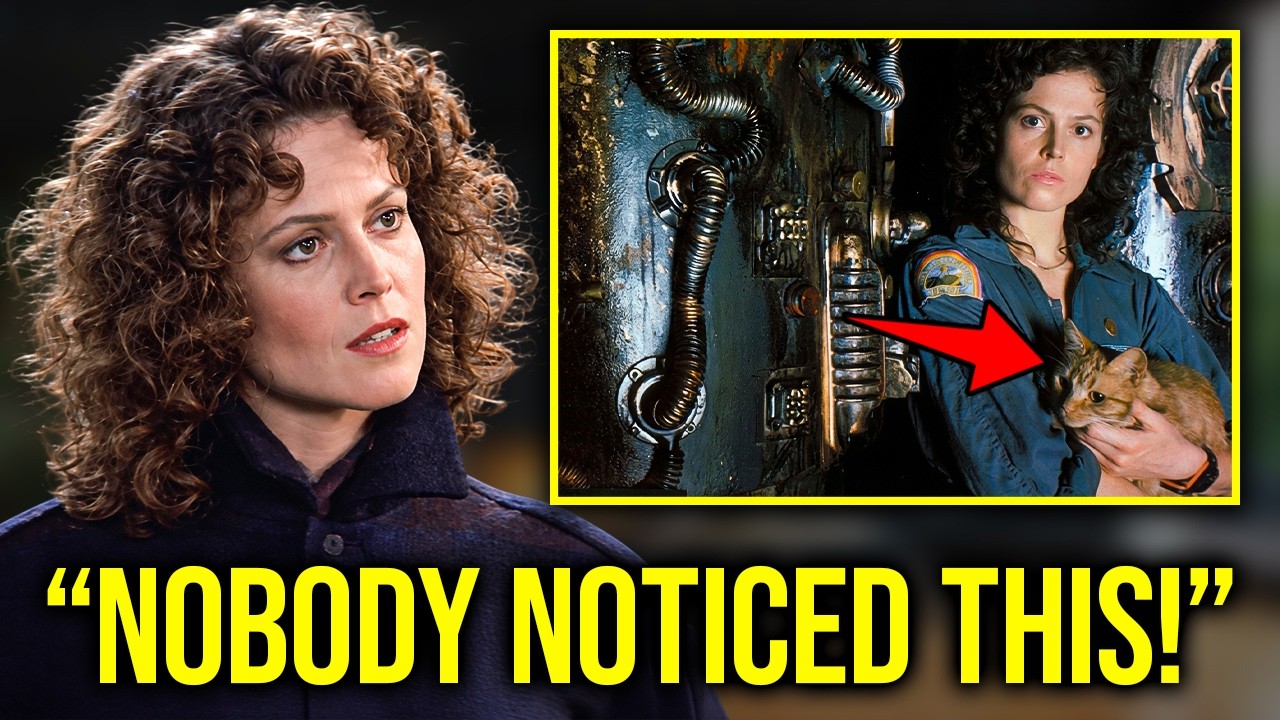
Two of those four cats played Jones the cat. The first film required at least four cats, each cast for a specific behavior: one to be carried, one to run, one to sit still, and one to hiss. Production had to get a German Shepherd to make the hissing cat react in a close up.
 The chestburster rig was a disaster. It failed to come through on a camera operator, breaking the first shirt. They weakened the liners with acid and went again, to the special effect blood catching the actress in the face and sending her over backward.
Whether she passed out rests on who’s telling it. The tests were done with a fish and other organ meat, but director made certain to sanitize it with formaldehyde. It was done by a test that looked like the cast was in a dry cleaning shop.
But the most macabre detail remained the skull. The famous predator, by contractor Rambaldi, was built specifically was built with nearly 900 moving parts. The creature’s head was designed to be translucent, and Taylor Giger rejected a plastic model.
He asked for real skulls. Three of them were purchased for roughly $700 each. The skull was riveted into the front of the head, the jawbone cut and extended by about six inches.
The 4th floor of the creature’s face was built out from there. The Plasticine trees that glow show the skulls. You have to imagine those viewers, in the age of early dental x-rays, looking at that intact tooth.
India was supplying Medical schools with skeletons, and the trade started to deliver real people and flesh.
Now the home segment of the collection. The movie released on 90 screens, over Memorial Day weekend in 1979, took $3,527,881 in four days, setting 51 new house records. Eleven months later, the studio claims it lost $2 million, the same studio that would then revise the print to an industry accounting picture.
The case went far from course. The studio’s answer to sequel was that the film had not been a financial success, and Brandy Wine sued. The suit finally funded Aliens as a direct result of that legal settlement, and the box office totals in the billions went off the books, at least for the reported balance sheet.
Style it up.


