Three bedrooms, two bathrooms, a stone fireplace, and a screened porch facing the water. But to me, it was worth more than any luxury home could have been. Frank and I had found it thirty years ago, a fixer-upper that needed more love than money. We poured both into it until the walls held our memories.
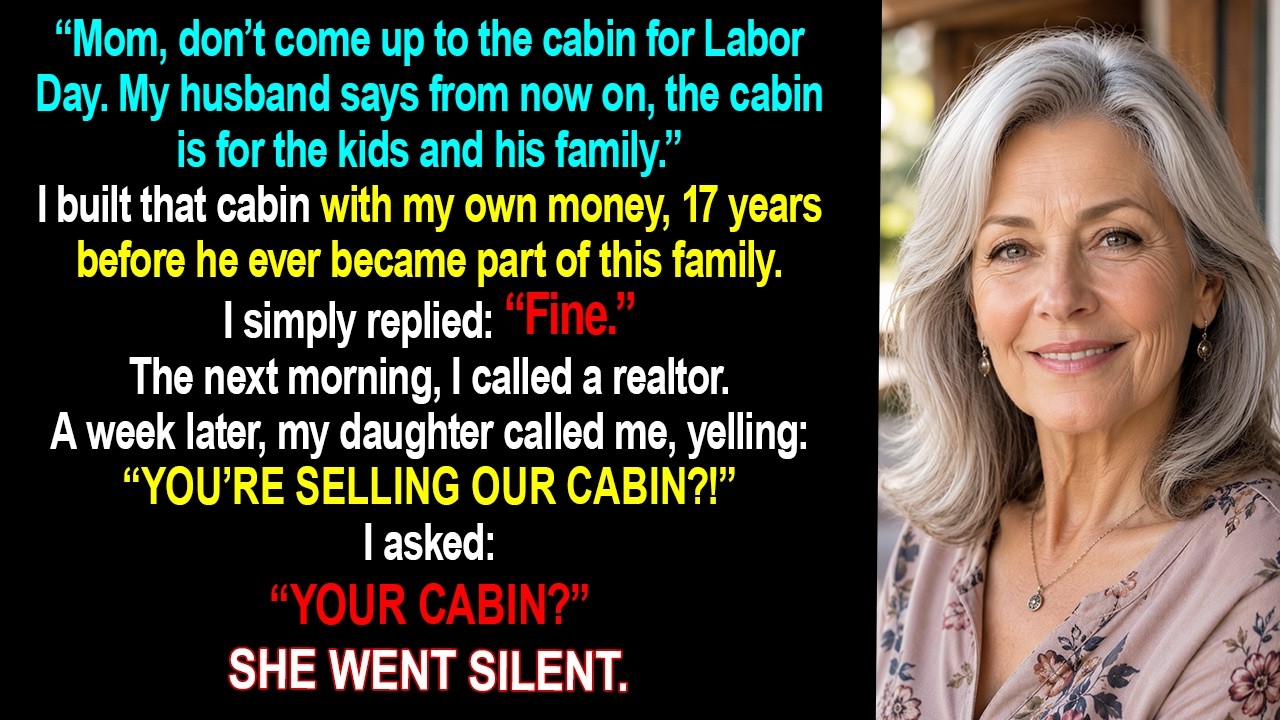
Then, before construction ever started on the addition, Frank died of a heart attack. A heart attack that stole the future we had planned and left me with a cabin full of his ghost. I never charged Emily and Kevin a dime to stay there. Even when they started bringing the kids every summer, even when the dock needed new boards, even when I paid for the roof replacement myself.
I watched Noah catch his first fish from that dock. I watched Lily learn to swim in that water. And for most of those years, I genuinely liked my son-in-law. He was good to Emily, good to the children.
He was the kind of man who would fix a squeaky step without being asked. I told myself the trade was fair. I gave them the cabin, and they gave me the family I had always wanted. The Tuesday before Labor Day, Emily called while I was folding laundry.
Her voice carried that particular brightness that meant she had already made up her mind about something. She asked how I was, asked about the garden, asked about my neighbor Susan’s hip. Then she said, with the casualness of someone proposing a harmless idea, that Kevin’s brother Ryan had started looking at lake property. His family really enjoyed the lake, she said.
They were thinking long-term. I remember the pause stretching too thin. I asked what she meant by long-term. She said she and Kevin had been talking, not about selling anything, just about the future.
About what would make the most sense for everyone. She said they thought the cabin was too much for me to manage alone. She said maybe it was time to think about passing it on to the next generation. I asked where exactly I was supposed to go.
She laughed, a little too quickly, and said, “Mom, you can still visit whenever you want. ”
That sentence hurt more than I expected. Not because she said it cruelly, but because she said it without thinking. Because somewhere along the way, the cabin had stopped being my home in her mind and had become a place she was letting me visit.
I stayed quiet for a moment. Then I asked her who filed the taxes last year, who paid for the new water heater, who had written the check for the winterization. She went silent. I said, “Did you talk to me before deciding I shouldn’t use it anymore?
” She said they hadn’t decided anything. They had only discussed options. I told her the difference between discussing and deciding mattered, and then I said I had to go. After we hung up, I sat on the porch with my coffee for a long time.
The lake was calm, the same calm it had been the summer Frank died. I realized I wasn’t angry because they had plans. I was angry because nobody had invited me into the conversation about my own property. I was hurt because they had built plans around a future in which I was absent, then allowed those plans to influence how they treated me while I was still sitting right in front of them.
That night, I opened the wooden chest at the foot of my bed. Frank’s handwriting was on the envelope, neat and firm: “For Maggie. ” Inside was the deed. And a letter I had never shown anyone.
I read it twice, then put it back. I slept better than I had in weeks. The next morning, I called Emily. I didn’t yell.
I didn’t accuse. I simply told her I wasn’t ready to give up the cabin, but I was ready to have a real conversation. She asked if she could come over. I said yes, and she arrived within the hour.
We sat across from each other at the kitchen table. At first, she was angry. She said I was being stubborn. She said I was acting like she had tried to steal something.
I reminded her that the deed was in my name, the bills were in my name, and the decision was mine. She said, “But Mom, the kids love it there. We use it more than you do. ” I let her finish.
Then I said, “And that gives you the right to make plans without asking me? ” She went quiet. Then she said, “Why is this so hard for you? ” I told her the truth.
“When your father died, I thought I lost everything that mattered. Then I discovered that this cabin still held him. Every time I walk through the door, I can still smell his pipe smoke. Every time I sit on the porch, I can still hear his laugh.
I didn’t keep it because I wanted to inconvenience anyone. I kept it because it’s the last place on earth where I can still feel like his wife. And I’m not ready to give that up just because you and Kevin decided it was your turn. ”
Emily’s face changed.
She didn’t say anything for a long time. Then she said, quietly, “I never thought about it that way. I never asked how you felt after Dad died. I just assumed you wanted us to take over.
” I told her I did want them to be part of it. I just wanted to be part of the decision. She nodded slowly. Then she said, “I’m sorry, Mom.
I should have asked. ”
That evening, I drove to the cabin alone. I walked through every room, letting the memories wash over me. I ran my fingers over the pencil marks on the trim where Noah’s height had been recorded every summer.
I sat on the dock until the stars came out. And I made a decision. The next morning, I called Kevin. I asked him to meet me at the cabin.
He sounded nervous, and I let him be nervous. When he arrived, we walked down to the dock together. He started apologizing before I could speak, telling me he had never meant to overstep, that he just wanted his family to have the same memories his kids were making. I listened.
Then I said, “Tell me the truth. Do you think of this place as mine, or do you think of it as ours? ”
He looked at the water for a long time. Then he said, “If I’m being honest, I stopped thinking of it as yours a few years ago.
Not because I wanted to take it from you. Because you gave so freely, I started believing it didn’t matter whose name was on the deed. ” I asked him what made him realize he was wrong. He said his dad had asked him how he would feel if Noah grew up and walked into Kevin’s house and told him he couldn’t use something he had paid for because he had already made plans for it.
Kevin shook his head. “I heard it in my father’s voice and I felt sick. ”
I told him I appreciated his honesty. Then I said, “I’m not going to sell it.
Not yet. But I want to make sure that when I do, you and Emily are part of the conversation. Not because I owe you anything, but because I love you. ” Kevin nodded.
Then he said, “I don’t deserve that. ” I told him he did. And for the first time in weeks, we talked about the future without tension. Emily and I started meeting once a month for coffee.
We talked about the cabin, about the kids, about her father, about the guilt she had carried for years. She told me she had always worried she was disappointing me by getting married young. I told her she had never disappointed me. She cried.
I held her hand. And slowly, the distance between us began to close. That Labor Day, we all went to the cabin together. Not because they asked, but because I invited them.
I made pancakes with Lily while Kevin taught Noah how to skip stones. Susan came over for dinner, and we laughed until the sun went down. Nobody mentioned the deed. Nobody mentioned the future.
We just lived in the moment, the way Frank would have wanted. In the months that followed, I started thinking about what Frank’s letter had said. He had written that he hoped I would never let the cabin become a burden. He had written that if I ever decided to sell it, I should do it for myself, not for anyone else.
And he had written that he trusted me to make the right choice. I decided the right choice was to sell. Not because I was angry, not because somebody hurt my feelings, but because I realized I didn’t need a building to hold Frank’s memory. I carried him with me.
The cabin had served its purpose, and now it was time for someone else to make their own memories there. Before I listed it, I sat down with Emily and Kevin. We talked about everything, about the memories, about the future, about what they would want if they ever bought a place of their own. They listened.
And when I told them I was selling, Emily didn’t argue. She simply asked if she could have the wooden picture frame from the mantel. I told her she could have the whole cabin if she wanted, but she laughed and said the frame was enough. The cabin sold quickly.
The proceeds went into savings, secured for my retirement. And I began to say yes to things I had always put off. I joined a hiking group. I took a painting class.
I went on a trip with Susan to the coast, where we watched the sunset and I cried because it was beautiful, not because it reminded me of something I had lost. Kevin called me a few months after the sale to say he and Emily had started looking at lake properties for themselves. I asked how it was going. He said, with a chuckle, that he was learning the difference between assuming and asking.
I told him that was a lesson worth paying for. That Thanksgiving, I hosted dinner. My house, not the cabin, not anyone else’s. After the meal, Emily pulled me aside.
She said she had found something in her father’s old toolbox, and she handed me a small envelope. Inside was a handwritten note from Frank. It said, “Maggie, if you’re reading this, it means you finally let go. I’m proud of you.
Now go make new memories. ”
I carried that note in my pocket for the rest of the winter. Spring came, and with it, an invitation. Emily and Kevin had found a small lake property of their own.
They asked me to come see it, not to help them move, not to bring anything, just to come. So I did. I stood on their porch, looking out over their water, and I felt something I hadn’t felt in years. Not loss.
Not grief. Just peace. Noah ran up with a fishing rod, Lily trailing behind him. I turned to Emily and said, “You did good, kiddo.
” She smiled so wide it reached her eyes. She said, “I learned from the best. ”
That night, sitting beside a fire in their new fireplace, Kevin raised his glass and said, “To learning things before we’re too old to learn them. ” We all raised our glasses.
The flames crackled. The kids fell asleep on the couch. And I thought about Frank, about the letter, about the cabin that was no longer mine. I didn’t miss it.
I missed him. But missing him had become a quiet thing, something I could carry without it weighing me down. I went home that night, walked into my quiet house, and took down the wooden picture frame Emily had left on my kitchen counter. Inside, tucked behind the photo, was a new note in Emily’s handwriting: “Mom, the lake will always be yours too.
We’re just keeping it warm for you. ”
Two words that once might have started an argument now simply told the truth: “Thank you. “