When Elvis Presley bought Graceland in 1957, he was already a global phenomenon. At just 22 years old, the breakout star of 1956 used his sudden wealth to purchase a 10,000-square-foot colonial mansion on 13. 8 acres in Memphis, Tennessee. It quickly became far more than a home.
Elvis lived there with his parents, entertained friends, kept an astonishing collection of animals, and built a private world that reflected his personality in every corner. He remained there until his death in 1977, with the estate eventually expanding to 17,552 square feet, complete with 23 rooms, eight bedrooms, eight bathrooms, and five staircases. The property had its own history before Elvis arrived. The land had once been part of a 500-acre farm owned by the S.
E. Toof family. In 1939, Ruth Brown Moore and her husband, Dr. Thomas Brown Moore, built the home and named it Graceland after Ruth’s aunt, Grace Toof Ward.
Once Elvis moved in, the house took on an unmistakably eccentric character. An avid animal lover, he filled the estate with horses, dogs, a turkey named Bow Tie, a mynah bird that could reportedly chirp “Elvis isn’t here,” a chimpanzee named Scatter, two wallabies gifted by Australian fans, peacocks, and a squirrel monkey named Jayhu. At one point, Elvis reportedly even kept donkeys in the kidney-shaped swimming pool before it was filled. The Jungle Room became the clearest example of Elvis turning Graceland into a world of his own.
With green shag carpeting covering both floor and ceiling, faux wood walls, carved furniture, rainbow lighting, and an artificial waterfall, the room was unlike anything else in the mansion. It eventually became a recording studio where 16 songs from Elvis’s final two albums were recorded. He installed wrought iron gates featuring guitar-playing figures of himself, added stained glass peacock panels to the living room in 1974, and built a racquetball building in 1975 containing a court, pinball machine, piano, and a trophy hall packed with memorabilia. The basement reflected his larger-than-life personality as well.
Inspired by President Lyndon Johnson, Elvis had three televisions installed so he could watch all three major networks at once, while the billiards room was wrapped in more than 350 yards of pleated fabric. Yet for all the extravagance, daily life at Graceland could be surprisingly ordinary. The kitchen was kept stocked with everything Elvis might suddenly want, from ground round steak and biscuits to Pepsi, orange drink, pickles, peanut butter, banana pudding, brownies, and fudge cookies. Cigars, cigarettes, and gum were also kept available at all times.
While much of Graceland has since been opened, documented, and preserved for fans, one part of the mansion remained out of sight for decades. High above the rooms everyone knew, something sat sealed away. When that long-untouched space was finally opened after 48 years, the discovery revealed yet another side of the private world Elvis left behind. Elvis died suddenly on August 16, 1977, at just 42 years old.
The news seemed to stop the world. With no internet or social media, people learned through television reports, newspapers, radio bulletins, and word of mouth. The reaction was remarkably similar everywhere. By the following day, enormous crowds of mourners had gathered outside Graceland.
Radio stations were flooded with calls, and his songs began climbing the charts again as fans turned to the music that had made him a legend. Behind the public mourning was another story unfolding quietly inside Graceland. In the months before his death, Elvis was reportedly struggling with serious health problems and had become increasingly isolated. Former bodyguard and author Ted Prior later described him as being extremely heavy and uncomfortable with being touched because he was constantly hot and perspiring.
His personal struggles, declining health, and career difficulties had created a very different picture from the energetic performer audiences remembered. Following a public viewing at Graceland that reportedly drew around 25,000 mourners, Elvis’s funeral was held the next day. He was initially buried beside his mother Gladys at a nearby mausoleum, but after an alleged plot to steal his body was uncovered, their remains were moved to Graceland’s Meditation Garden. Today, Elvis rests there alongside his parents, grandmother, daughter Lisa Marie, and grandson Benjamin Keough, while a memorial also honors his stillborn twin brother.
A few years after Elvis’s death, Graceland opened its doors to the public in 1982, allowing fans from around the world to finally step inside the home where the king had lived for two decades. But there was one part of the mansion they could not see. From the very beginning, the second floor remained firmly behind closed doors. The reason was simple.
The upstairs contained Elvis’s master suite, a deeply personal area that had been restricted even while he was alive. This was his private refuge, accessible only to the people closest to him. There was also a much more difficult reason for keeping the upstairs closed. Elvis died in the bathroom connected to his master suite, and according to long-standing accounts, the area has remained largely untouched.
Only a very small number of people, including his former wife Priscilla, daughter Lisa Marie, and the property’s curator, were permitted access. For the family, turning the space into a tourist attraction would have crossed a line. Even high-ranking officials and presidents who visited Graceland were reportedly denied access to the private quarters. There was one famous exception.
Nicolas Cage, one of Elvis’s most devoted admirers, was once married to Lisa Marie Presley. During their marriage, he was given the rare opportunity to enter the upstairs area and see the private world that almost every other visitor had been forbidden from entering. Graceland has consistently defended the decision to keep the space private. The official estate explains that the portions shown on tours are essentially the same areas Elvis himself would have opened to visitors.
The upstairs, by contrast, was his private area, and after his death, Priscilla and Lisa Marie believed it should remain that way. Graceland does not publish photographs of the upstairs, citing privacy and respect, although selected objects from the private quarters can occasionally be brought downstairs for exhibitions. In the days leading up to Elvis’s death, the man once known for electrifying crowds was living a very different reality. At only 42, he was struggling with serious health problems, prescription drug dependence, and a body that had changed dramatically.
By the summer of 1977, Elvis was still performing, but his health had deteriorated badly. He had gained significant weight, suffered from several medical conditions, and was relying heavily on prescription medications. His schedule remained demanding, and despite his declining condition, there was still pressure to perform. His prescription drug use had become one of the most serious problems in his life.
Elvis was taking medications that included painkillers, sedatives, and other drugs. His personal physician, George Nichopoulos, known as Dr. Nick, had been treating him since the 1960s and eventually became deeply involved in managing his enormous collection of prescriptions. Nichopoulos later acknowledged that he had prescribed thousands of doses of various medications to Elvis.
He argued that he sometimes substituted placebos and gave Elvis what he requested because he feared Presley would obtain drugs elsewhere. Then, on August 16th, everything changed. Elvis was at Graceland when his girlfriend, Ginger Alden, found him unresponsive in the bathroom connected to his upstairs master suite. An ambulance rushed him to Baptist Memorial Hospital, where doctors attempted to revive him.
Their efforts were unsuccessful, and Elvis Presley was pronounced dead at 3:30 p. m. An autopsy was conducted that afternoon by pathologists Eric Muirhead, Jerry Francisco, and Noel Florendo. Initially, Dr.
Francisco announced that preliminary findings pointed to cardiac arrhythmia and suggested that drugs had not played a role. Weeks later, toxicology results revealed multiple prescription drugs in Elvis’s system, including several powerful painkillers and sedatives. The pathologists also identified evidence of serious underlying health problems, including diabetes and other chronic conditions. The precise cause of Elvis’s death has remained the subject of debate.
Cardiac arrhythmia was the official conclusion, while later interpretations have pointed to the combined effects of heart disease, obesity, prescription drugs, and other medical problems. Some researchers have even suggested an underlying heart condition may have made him especially vulnerable to sudden cardiac death. When Elvis died in 1977, he left behind far more than music and one of the most famous homes in America. He also left an estate that would become the center of nearly five decades of financial disputes, legal battles, and family conflicts.
By the time his father, Vernon Presley, died in 1979, the family was facing serious financial problems. Elvis had earned an enormous amount of money during his lifetime, but lavish spending, expensive upkeep, and years of questionable business decisions had taken their toll. Colonel Tom Parker, Elvis’s long-time manager, had controlled much of his business affairs and had taken commissions that could reach extraordinarily high levels. Years after Elvis’s death, the estate accused Parker of fraud and mismanagement, eventually leading to a lawsuit and an out-of-court settlement.
With Graceland becoming increasingly expensive to maintain, Priscilla and her advisers came up with a plan that would ultimately save the estate. In 1982, Graceland opened to the public, transforming Elvis’s private home into a major tourist attraction. The decision proved remarkably successful. Hundreds of thousands of visitors began arriving each year, turning the mansion into one of the most visited private homes in America.
When Lisa Marie inherited control of the trust on her 25th birthday in 1993, the estate was in far better shape. But the family’s financial battles were far from over. In 2018, Lisa Marie sued her former business manager Barry Siegel, alleging that his mismanagement had left her trust with only a small amount of money and substantial debt. Siegel denied the accusations and argued that Lisa Marie’s own spending was responsible for her financial difficulties.
Then came another devastating blow. Lisa Marie died suddenly in January 2023, leaving behind a new dispute over who would control her estate. Her mother, Priscilla, challenged an amendment to Lisa Marie’s trust that removed her as trustee and placed control in the hands of Lisa Marie’s daughter, actress Riley Keough. Priscilla’s lawyers questioned the authenticity of the amendment, but the dispute was eventually settled.
Keough became the sole trustee while Priscilla received other financial and estate arrangements as part of the settlement. Another battle was already developing around Priscilla herself. In 2021, Priscilla met auctioneer Brigitte Kruse, who specialized in celebrity memorabilia and high-profile auctions. The two eventually entered into business arrangements centered on Priscilla’s name, image, and connection to Elvis.
The relationship eventually collapsed, and the allegations that followed were explosive. Priscilla accused Kruse and her associates of taking control of parts of her financial and business affairs and alleged that she had been manipulated into signing agreements she did not fully understand. Her lawsuit accused Kruse of fraud and elder abuse. Kruse disputed those allegations and presented herself in court filings as someone who had helped Priscilla avoid financial trouble.
The legal battle quickly became part of a much larger fight over Elvis memorabilia. Graceland’s owners began questioning some items connected to GWS Auctions, Kruse’s company, claiming that certain pieces being offered for sale belonged to the Presley estate. The estate alleged that documents connected to Colonel Parker, including telegrams, contracts, and handwritten material, had been improperly taken. GWS denied wrongdoing and disputed the estate’s claims of ownership.
Just when it seemed the estate had enough legal problems, another bizarre threat appeared. A company called Naussany Investments and Private Lending produced documents claiming that Lisa Marie had borrowed millions of dollars and used Graceland as collateral. The claim suggested that the iconic mansion could potentially be lost over an unpaid loan. But investigators determined that the alleged loan was part of an elaborate fraud.
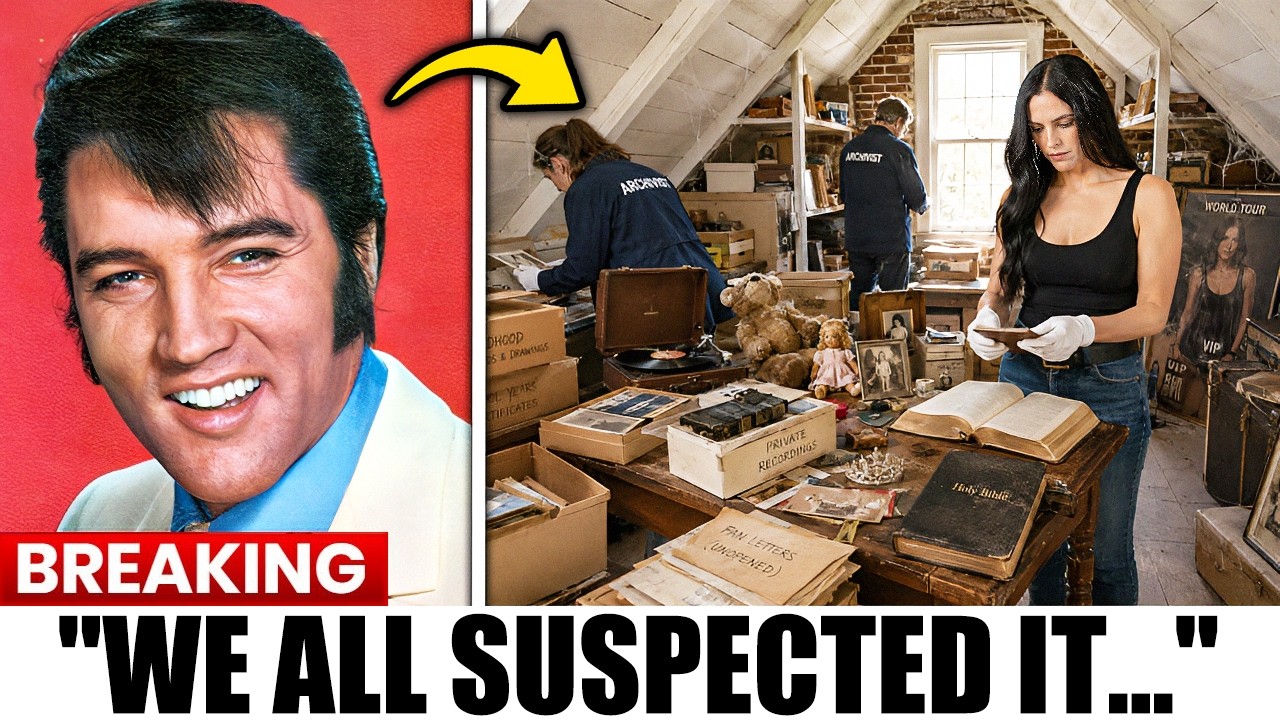
Federal authorities accused Missouri woman Lisa Jeanine Findley of using forged documents in an attempt to seize the family’s ownership interest in Graceland and arrange its sale. Findley later pleaded guilty to mail fraud. Nearly 50 years after Elvis’s death, the fight over what he left behind is still unfolding. But there is one part of the mansion that has remained hidden from public view: the attic.
So what exactly did Elvis keep up there? The answer reveals a quieter Presley family life filled with old clothes, military memories, childhood possessions, and items too meaningful to throw away. During a virtual tour of Graceland, archivist Angie Marchese offered a rare glimpse into the roof space. According to Marchese, the attic contained a mixture of family belongings and items Elvis no longer used.
Among them were belongings that had belonged to his mother, Gladys Presley, his army equipment, some of Lisa Marie’s baby clothes, and old furnishings and drapes. The attic was less like a secret room filled with glamorous treasures and more like a family storage space preserving pieces of the Presley family’s life. Some of those objects carried enormous emotional weight. Gladys Presley died in 1958 at only 46 years old while Elvis was beginning the military chapter of his life.
Her belongings remained part of Graceland, and some of her clothes can still be seen in her bedroom during the public tour. Even after Elvis became wealthy, Gladys was known for repairing her simple clothing rather than replacing it, making those preserved garments an especially intimate reminder of the woman who raised him. Elvis’s military belongings eventually found another home. His army gear is now displayed across the street from Graceland at Elvis Presley’s Memphis.
But the fact that some of those possessions were once stored in the attic gives the hidden space a deeper significance. It was not simply a place for forgotten furniture. It held fragments of the life Elvis had lived before he became an icon. In 2024, Riley Keough offered an even more intimate look at the Presley family’s history during her interview with Oprah Winfrey.
After Lisa Marie died in 2023 at 54, Riley became the sole owner of the 13-acre Graceland estate and has worked to preserve the property and her family’s legacy. During the tour, Riley opened up about memories her mother connected to Graceland, including the aftermath of Elvis’s death. She explained that Lisa Marie struggled deeply with losing her father and would sometimes listen to his music alone while grieving. Riley also showed Oprah some of Elvis’s most personal possessions, including a family Bible dating to 1957, Lisa Marie’s old golf cart key, and a battered black box Elvis reportedly carried everywhere.
Inside were objects he considered deeply personal, including an American Express card that expired in 1972 and an old comb associated with his famous hairstyle. Those objects may seem ordinary, but that makes them fascinating. The same man whose costumes, cars, and stage memorabilia became priceless pieces of entertainment history also kept everyday items close to him. Today, the public can see only a fraction of what Elvis and his family left behind.
The attic remains off-limits while many of its contents have been moved into the archives for preservation. But thanks to Marchese and Keough’s rare revelations, fans now know that behind the locked doors are personal reminders of the people Elvis loved, the life he lived before fame, and the childhood of the daughter who grew up watching her legendary father disappear from her life far too soon. The attic does not contain one sensational secret.
Instead, it holds something much more valuable: pieces of the Presley family’s private life that fame could not erase.