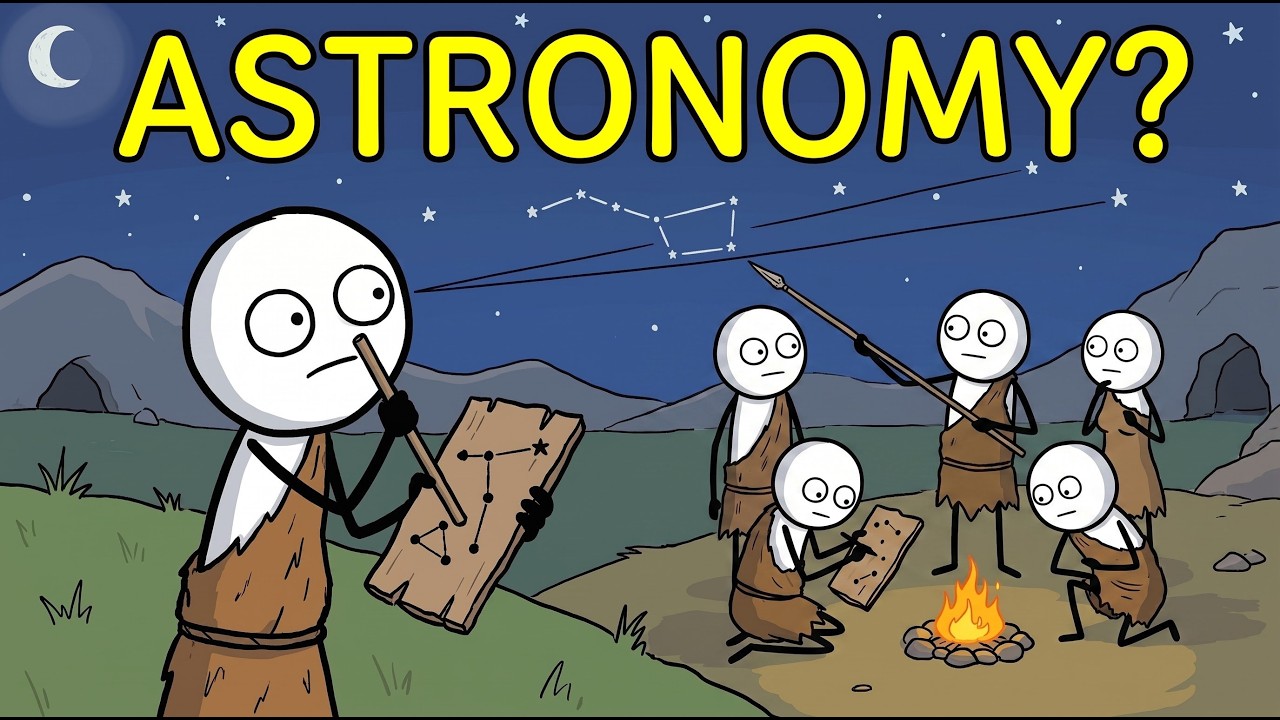
Long before telescopes, laboratories, or even written language, human beings were doing astronomy. Around 30,000 years ago, someone looked up at a night sky with roughly 4,000 visible stars, noticed that one point of light appeared in the same place at the same time night after night, remembered it, returned to check it, and scratched a mark into a bone to keep track. That mark is considered the earliest known step toward astronomy. The story of how that scratch evolved into the Hubble Space Telescope and modern cosmology is the longest continuous intellectual project in human history, and it began in prehistory, before anyone on Earth could record a single word.
The only evidence that prehistoric people watched the sky comes from deliberate marks left on durable objects. In 1950, Belgian geologist Jean de Heinzelin was excavating near Lake Edward in the Congo when he pulled a baboon fibula, roughly the size of a pencil, out of volcanic ash. The bone, later known as the Ishango bone, contained 168 notches arranged in three distinct columns. The markings sat in the Royal Belgian Institute of Natural Sciences in Brussels for two decades before researcher Alexander Marshack proposed in 1972 that they tracked the phases of the moon over roughly six months.
The bone is about 20,000 years old. Marshack’s lunar interpretation is debated, with some scholars suggesting mathematical sequences or menstrual cycle tracking, but nobody disputes that the marks were intentional, grouped, and followed a pattern. The most obvious natural cycle that fits is the moon. An even older carved bone from Abri Blanchard in France, roughly30,000 years old, features 69 pitted marks that Marshack argued tracked the waxing and waning of the moon across two lunar months.
If correct, humans were systematically recording lunar phases more than25,000 years before writing was invented. The sky was the first thing humans studied because it was brutally practical. For hunter-gatherers, knowing when rivers would flood, herds would migrate, or cold months were coming required a clock, and the only clock available was the sky. The moon changes shape on a 29.
5-day cycle; certain stars appear and disappear seasonally. Those who decoded the pattern survived, making astronomy survival infrastructure rather than a hobby
The oldest continuous astronomical tradition belongs to Aboriginal Australians, who have watched the sky for at least50,000 years. Astrophysicist Duane Hamacher, author of The First Astronomers, has documented that Aboriginal Australians recognized dark constellations, shapes formed by dust lanes in the Milky Way rather than bright stars. The most famous, the Emu in the sky, uses the Coalsack Nebula as its head and the dark clouds of the Milky Way as its body.
Its position signals real ground events: when it rises after sunset in April and May, emu breeding season begins; when it tilts in August and September, chicks are hatching. This is applied science, not mythology, older than every pyramid and written word
Evidence of early sky mapping appears across the ancient world. In France, the Lascaux Cave paintings, roughly17,000 years old, contain a cluster of dots above pyrrole bull that German researcher Michael Rappenglück proposed represents the Pleiades star cluster, though archaeologists debate whether such interpretations selectively pick dots from larger scenes. In Scotland, a site called Warren Field, excavated starting in2004, contains 12 pits arranged in an arc aligned with the phases of the moon and the midwinter sunrise.
Roughly10,000 years old, it is considered the oldest known lunar calendar architecture. In Egypt’s Western Desert at Nabta Playa, discovered in1973, a stone circle of upright slabs aligns with the summer solstice sunrise. Roughly7,000 years old, it predates Stonehenge by at least2,000 years, built by cattle herders who needed to know when monsoon rains were coming. Stonehenge itself, roughly5,000 years old, was analyzed by astronomer Gerald Hawkins in1963 using an early IBM computer, which demonstrated significant alignments with the summer solstice sunrise and winter solstice sunset, later published in Stonehenge Decoded
The unifying thread across these sites, from a baboon bone in the Congo to a stone circle in the Egyptian desert, is the same: track the sky, predict the seasons, stay alive
Around3200 BC, humans invented writing in Mesopotamia, and one of the first things they recorded wasthe sky.
The Venus tablet of Ammisaduqa, containing observations made during the reign of King Ammisaduqa of Babylon, roughly1646 to1626 BC, tracks the rising and setting of Venus over 21 years, making it the oldest known record of systematic planetary observation. Someone watched a single bright point of light night after night for more than two decades and wrote down its movements, treating the sky like a research dataset. Babylonian astronomy grew more sophisticated from there. The Enuma Anu Enlil, compiled between roughly1600 and150 BC, comprised nearly70 clay tablets of celestial omens.
The Mul Apin tablets, dating to roughly1000 to686 BC, cataloged stars and constellations. Though the omens look like superstition. , they required centuries of systematic observation to make predictions, and the observational method, rightondo, was science. Babylonian astronomers eventually discovered the Saros cycle, a period of223 synodic months, roughly18 years,11 days,8 hours, after which eclipses repeat in nearly the same sequence, allowing them to predict lunar eclipses without telescopes or calculators.
By around400 BC, they had divided the ecliptic into 12 equal segments of30 degrees, inventing the zodiac as a coordinate system for tracking planetary positions. They even had named professional astronomers: Nabu-rimannu developed a mathematical model called system A to calculate the sun and moon’s motion, while Kidinnu refined it into system B using zigzag functions, early approximations of continuous change, to model the moon’s varying speed with accuracy that would not be surpassed for centuries. These were named individuals solving problems functionally equivalent to differential equations on clay tablets, roughly2,400 years ago
Meanwhile, in Egypt, the calendar itself was engineered around the sky. The Egyptians established a365-day year, 12 months of30 days plus five extra days, as early as roughly2700 to2500 BC, within a few hundred years of the pyramids at Giza.
The Great Pyramid aligns to true north with an accuracy of roughly0. 05 degrees, achieved with the naked eye and a plumb line using circumpolar stars. They divided the night sky into36 groups called decans, each marking a10-day period as it rose before dawn, serving as a clock for the night. They tracked Sirius, which they called Sopdet: when it appeared on the eastern horizon just before sunrise after70 days of invisibility, the Nile was about to flood.
The entire agricultural economy of ancient Egypt was timed to the appearance of a single star, astronomy as national infrastructure
The Greeks then took what they learned from Babylonians and Egyptians and asked a different question: not just what does the sky do, but why. In585 BC, Thales of Miletus reportedly predicted a total solar eclipse, an event allegedly halting a battle between the Lydians and Medes; whether the prediction was precise or a lucky estimate based on Babylonian data remains debated. Aristarchus of Samos, around280 BC, proposed the Earth orbits the Sun, a correct idea ignored for roughly1,800 years. Around240 BC, librarian Eratosthenes in Alexandria calculated the Earth’s circumference using a stick and a shadow: knowing the sun was directly overhead in Syene at noon on the summer solstice, while a vertical stick in Alexandria, roughly800 km north, cast a7.
2-degree shadow, he reasoned the Earth’s circumference was roughly50 times that distance, coming within a few percent of the actual value. Hipparchus, working around150 to120 BC, compiled the Western world’s first comprehensive star catalog and discovered the precession of the equinoxes, the slow wobble of Earth’s axis shifting star positions over a26,000-year cycle, by comparing his own observations to centuries-old records, demonstrating cumulative knowledge in action
The Antikythera mechanism, recovered from a shipwreck in1901 and dating to roughly150 to100 BC, is a bronze gear work device roughly the size of a shoebox that calculated the positions of the sun and moon, predicted eclipses, and tracked the cycles of the ancient Olympic games, making it the oldest known analog computer. Ptolemy, writing around150 AD, formalized the geocentric model in the Almagest, placing Earth at the center with planets moving in epicycles, a model wrong but so mathematically precise it dominated astronomy for1,400 years, showing that being useful and being correct are not the same thing
The history of astronomy is not just a Mediterranean story. Independent traditions elsewhere reached equally extraordinary conclusions.
In China, oracle bones from the late Shang Dynasty, dating between roughly1250 and1050 BC, contain the oldest verified records of eclipses anywhere on Earth, actual observations scratched into turtle shells and ox bones, accompanied by divination superstition but real data. By the4th century BC, astronomer Shi Shen compiled one of the world’s earliest star catalogs during the Warring States period. Between78 and139 AD, Zhang Heng built the first water-powered armillary sphere, a mechanical model of the sky rotating with the Earth, and proposed that the moon shone by reflected sunlight and explained lunar eclipses as the Earth’s shadow falling on the moon, without a telescope. In1054 AD, Chinese astronomers recorded a guest star so bright it was visible in daylight for23 days, a supernova whose remnant is the Crab Nebula, one of the most studied objects in modern astrophysics, known partly because someone in Song Dynasty China wrote down what they saw nearly1,000 years ago
In India, mathematician Aryabhata published the Aryabhatiya in499 AD, correctly stating that the Earth rotates on its own axis daily and that eclipses are caused by shadows, not by demons.
In Mesoamerica, the Maya tracked Venus with precision that modern astronomers have confirmed, as recorded in the Dresden Codex, a bark paper manuscript created between roughly the11th and14th centuries AD but copying far older material, which predicted the planet’s584-day synodic cycleand built entire cities with architectural alignments to Venus, without telescopes or written mathematics. Across thousands of kilometers and years, separated cultures all independently figured out how to predict the sky, because the sky does the same thing everywhere, and human brains respond to its patterns the same way: see it, remember it, predict it. Astronomy was a convergent invention, developed over and over again
During the Islamic Golden Age, scholars in Baghdad, Maragheh, and Samarkand did not just preserve Greek and Babylonian knowledge, they corrected it. In964 AD, Persian astronomer Al-Sufi published the Book of Fixed Stars, fixing errors in Ptolemy’s catalog and making the first recorded observation of the Andromeda Galaxy, described as a small cloud, a thousand years before telescopes resolved it into individual stars.
In the13th century, Nasir al-Din al-Tusi built an observatory at Maragheh in modern-day Iran and invented the Tusi couple, a mathematical tool converting circular motion to linear. In the14th century, Ibn al-Shatir in Damascus created planetary models eliminating the flawed equant from Ptolemy’s system. When Copernicus published De revolutionibus in1543 AD, his mathematical models for the moon and Mercury were nearly identical to Ibn al-Shatir’s, leading historians to strongly suspect Copernicus had access to these Islamic frameworks. The Copernican revolution, often presented as a European breakthrough, was built on centuries of Islamic astronomy that is largely unknown to the public
In1608 AD, Dutch spectacle maker Hans Lippershey applied for a patent on a device he called a kijker, a looker, that magnified objects by about three times.
The idea reached Italian professor Galileo Galilei, who built an improved version achieving roughly20 times magnification and pointed it at the sky in the winter of1609 to1610. In a few months, he saw craters and mountains on the moon, proving celestial bodies were not perfect spheres as Aristotle insisted, four moons orbiting Jupiter, proving not everything orbited Earth, and phases of Venus, proving Venus orbited the Sun, each observation undermining the geocentric model. For30,000 years, every advancein astronomy had used the human eye alone; the telescope changed that equation overnight, making the universe bigger the moment we built a better eye
Kepler, using Tycho Brahe’s decades of the most precise naked-eye planetary observations ever made, figured out planets move in ellipses, not perfect circles. Newton, publishing the Principia in1687 AD, gave us gravity, the force explaining why it all worked, turning the sky from chaos or divine will into physics
In the1920s, Edwin Hubble discovered galaxies beyond the Milky Way and that they were all moving away, meaning the universe was expanding.
In1964, Arno Penzias and Robert Wilson stumbled onto the cosmic microwave background radiation while eliminating a hiss from a radio antenna at Bell Labs, accidentally finding the afterglow of the Big Bang. In1995, Michel Mayor and Didier Queloz discovered the first exoplanet orbiting a sun-like star,51 Pegasi b. In2021, the James Webb Space Telescope launched to observe light from the first galaxies that formed over13 billion years ago
Astronomy was not invented once, in one place, or by a single flash of genius. It was invented independently by cultures that never heard of each other, across tens of thousands of years, on every inhabited continent.
Aboriginal Australians tracked dark spaces between stars at least50,000 years ago; someone in Ice Age France carved lunar phases into bone30,000 years ago; Babylonians predicted eclipses with clay tablets; Egyptians timed harvests to a star; Greeks measured the planet with a shadow; Chinese recorded a supernova; Maya tracked Venus with naked-eye precision; Islamic scholars corrected, preserved, and transmitted the knowledge that fueled the European Renaissance. Each tradition built its own foundation, and eventually, through trade routes and translations, they merged into the single global science we have today. The probability that astronomy was a single invention from one source that spread outward, based on archaeological and anthropological evidence, is effectively zero, less than1 percent. The sky is visible everywhere, the practical need to know when to plant cand migrate is universal, and once the human brain developed pattern recognition across long time scales, it could not help but look up and start counting.
Astronomy was a convergent invention because the sky was the only clock, calendar, and map available for most of human existence. The phenomena were discovered;,the discipline was invented;,and it was invented everywhere
Tonight, the same moon tracked with scratches on a baboon bone20,000 years ago still cycles through its phases every29. 5 days. The same stars the Babylonians cataloged on clay tablets still rise and set on schedule.
The same sky an Aboriginal elder read like a seasonal calendar50,000 years ago is still up there, doing exactly what it has always done. The sky has not changed, but we have, going from scratching bones to building instruments that see13 billion years into the past, every step of that journey, from a bone in the Congo to a telescope at the second Lagrange point, starting with the same thing: a human being lying in the dark, looking up, and refusing to believe the lights were random