Around 20,000 years ago, during the height of the last Ice Age, glaciers more than a mile thick buried much of North America, northern Europe, and huge stretches of Asia. The seas pulled back so much water was locked in ice that coastlines we recognize today didn’t exist. In that frozen world, humans were small, soft, slow animals—and yet they survived, night after night, for thousands of years, without modern heating, insulated homes, or rescue teams. The question of exactly how they managed to sleep through such deadly cold has long puzzled scientists, and the answer that emerged from archaeological digs is far more complex—and more human—than the old caveman myth suggests.
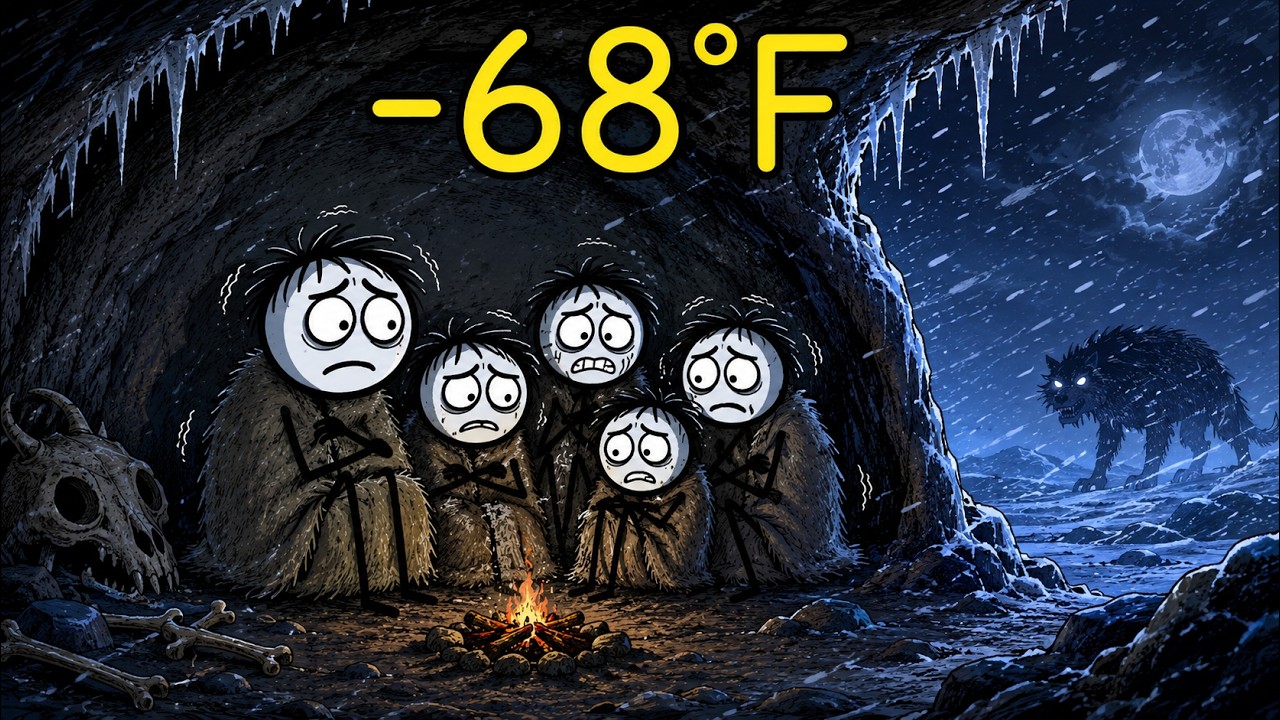
The ground itself was the first killer. Cold earth pulls heat from a warm body far faster than freezing air does, which is why modern survival instructors hammer one rule into every student: never sleep directly on the cold ground. Ice age humans had already learned that lesson the hard way. Archaeologists found prepared sleeping areas inside ancient shelters, not scattered dirt, but designed beds.
Layers of dry grass cut and carried, animal hides stacked one on another, moss packed for softness,and bundles of reeds woven flat—bedding built on purpose, before farming, before writing, before cities existed. Wind was the second killer no fire could fully touch. Wind strips heat from bare skin at a speed that can end a human life in minutes. So our ancestors didn’t just look for shelter; they built it.
Camps were placed with real intelligence—tucked behind rock walls, pressed against slopes, hidden inside terrain that broke the wind before it arrived. On the cold steppe of what is now Ukraine, archaeologists found huts made of mammoth bones, with skulls stacked for walls, tusks curved into doorways,and jawbones fitted together like brickwork. Hides were almost certainly stretched over the tops. Some of these dwellings took the bones of more than 90 animals, requiring enormous planning andeffort.
This was not a desperate animal hiding from the weather; it was a builder engineering survival against the sky. Clothing was far more advanced than long assumed. Archaeologists found bone sewing needles tens of thousands of years old, with holes drilled for thread—proof that people were stitching hides into fitted garments that sealed heat against the body, unlike loose draped skins that let the wind in. At a site in what is now the Czech Republic, researchers found impressions of woven fabric pressed into ancient clay, dating back 27,000 years—the oldest evidence of weaving found on Earth.
Some famous Venus figurines even appear to show woven hats and string skirts carved onto them, suggesting fashion existed in the Ice Age, 20,000 years before the pyramids were built
But even the best clothing couldn’t solve the final problem. Today, sleeping alone feels normal, but for almost all of human history, it was anything but. In the Ice Age, sleeping alone could simply kill you. Every human body produces heat constantly, even at rest.
One body in a freezing shelter barely warms the air around it, but add a second, a third, then dozen of people in one shelter,and something remarkable happens—shared heat turns a deadly space into a survivable one. Scientists call this social thermoregulation, and it’s the oldest survival trick there is. Other animals use it, too: emperor penguins huddle by the thousands and rotate so the freezing ones on the outside shuffle to the warm center; bats cluster densely to warm whole cave roofs; wolves sleep in one breathing pile against the snow. Our ancestors did the same, pressing their bodies close insider shelters, sharing every degree they made.
The warmest thing in the Ice Age was never fire; it was each other
This closeness didn’t just keep people alive; it reshaped human nature. Warmth and bonding became the same act. The body next to you wasn’t just heat; it was trust—your bloodline kept alive by sharing your own. Many scientists believe this is part of why humans became so deeply social: not because we simply enjoyed company, but because the cold made closeness a matter of life and death.
The groups that bonded tightly survived the winter; the ones that fractured drifted apart—and did not. A lone human in the cold was a dead human; a bonded group was something the Ice Age couldn’t kill
The huddle also provided silent protection. The Ice Age night was crowded with predators: cave lions larger than any lion alive today, cave bears taller than a man on their hind legs, cave hyenas with jaws that crushed bone, and wolves that hunted in coordinated packs. Humans cannot see in the dark well, and at night, alone, asleep, a human was meat.
But in a huddle of 20 bodies, not everyone slept at the same depth anesthe same moment. Someone always stirred, heard snow crunch where it shouldn’t, woke and fed the fire back to life, or screamed a warning before the dark could take a second person. Sleeping together didn’t only share warmth; it posted guards nobody had to assign. A wall of light, heat, and watching eyes stood between the group and the things in the snow
Fire was essential, but not mainly for the reason people assume.
In a world with no street lights or any glow on any horizon, sunset brought true darkness—a darkness almost no modern person has ever stood inside. Fire created a circle of warmth and light, allowing people to see threats coming,and predators hesitated at flames because fire moves unpredictably, crackles,and spits—one risk too many for an animal with easier prey elsewhere. For the first time in human history, we owned a piece of the night. Fire also changed human biology through cooking.
Raw food is hard to chew and digest, burning energy just to unlock calories. Cooking breaks down tough fibers, kills parasites,and unlocks energy that raw food keeps locked away. Many scientists believe this flood of easy calories helped fuel the growth of the human brain, which burns a fifth of the body’s energy while doing nothing visible at all. And fire stole hours back from the night.
The day no longer had to end when the sun did. People sat in the light, awake, together, fed—and they talked, not just about the next meal, but about ideas, the dead, the future, stories, and how to survive winters that hadn’t arrived yet. The fire became the first classroom, theater,and library humanity ever built, passing knowledge from old mouths to young ears, night after night, winter after winter. A fire burns out, a shelter collapses,and a fur coat wears out, but a lesson can outlive the person who learned it.
That single fact changed everything
The old image of grunting, filthy cavemen barely clinging to life collapses under the evidence. Across Europe and Asia, archaeologists keep finding camps used again and again, sometimes for generations of the same family line. People returned to the same valleys and river bends because they understood those spots completely: which ridge killed the worst of the wind, where the herds would pass and when, where water still ran beneath the ice,and which ground would shelter a family through the killing months. They did all of this with no maps, no writing, no way to store information except memory and each other.
Everything had to be remembered and taught, parent to child, grandparent to grandchild, elder to entire camp. Every winter they survived made the next one easier,and good ideas spread from camp to camp; bad ideas died quietly with the people who trusted them. Over thousands of years, the group built a library no single human mind could ever hold. A mammoth couldn’t redesign its own shelter, a cave lion couldn’t invent a warmer coat,and a bear couldn’t teach its cubs a better way to survive.
Humans could—and did—and we never stopped
The human body itself also fought the cold with ancient machinery. When cold comes, blood vessels near the skin clamp shut, retreating warmth inward to guard the heart and brain, sacrificing fingers and toes to protect the core. Muscles begin to fire on their own, causing shivering—thousands of tiny movements each producing heat. Some people carry an even older trick: brown fat, a special kind of fat that doesn’t store energy but burns it purely to make warmth.
Babies are packed with it,and populations whose ancestors lived in deep cold often keep more of it as adults. Every modern human still carries this survival machinery, holding a manual written by the Ice Age
But biology alone was never enough. A mammoth had biology, too,and the mammoth is gone. What saved humans was the body plus the bed, plus the wall, plus the coat, plus the fire, plus the knowledge, and above all, the people you survived beside.
Staying warm also had a hidden cost: fuel. The body burns food to make heat, and in deep cold, a modern human can need thousands of extra calories a day just to hold core temperature at 37°. With no farms, no stored grain,and no shops, every calorie had to be hunted, gathered, or dug out of a frozen world—a brutal trap, as the cold forced energy expenditure while hiding the food needed to replace it. That is why fat was life in this world: it served as insulation under the skin and stored fuel for nights the hunt failed.
And in that world, the group mattered most of all, because the huddle was never only the strong. It included the old, the sick, the pregnant,and the newborns who couldn’t make enough heat to save themselves. A baby loses warmth terrifyingly fast; left alone for an hour in that cold, a newborn simply doesn’t survive. But a baby buried in the warm center of a sleeping huddle, wrapped in hide against its mother, surrounded by an entire family’s body heat, does.
The strong didn’t survive by leaving the weak behind; they survived by caring them. Some scientists believe the cold didn’t just make humans social—it may have made us kind, because kindness in that world was simply survival with a longer memory
The Ice Age was one of the harshest tests in the history of life. Whole species vanished, giants disappeared,and great predators went extinct one after another. Yet the weak, slow, soft human walked out the other side, not just alive but spreading across continents.
We didn’t win by being superior animals; we had no claws, no fangs, no great speed or size. A mammoth outweighed us many times over, a cave bear could break us with one swing,and a cave lion could run us down without effort. The difference wasn’t strength—it was the ability to solve problems and then teach the answers. Too cold?
Build a better coat. Too windy? Build a better wall. Too dark?
Take the night with fire. Too dangerous? Sleep close and post the watch. Humans never had to become stronger than the cold; they only had to become smarter than the problem—together.
Every solution stacked on the one before it; every generation started where the last one stopped. Knowledge compounded and skills sharpened. The species rewrote itself faster than the world could throw new threats at it. That is the real story of human survival: not domination through muscle, but adaptation and through each other
When we circle back to the original question—how did humans sleep through the Ice Age without freezing to death—the answer was never one single thing.
Fire held the dark and predators at bay. Sewn fitted clothing sealed warmth against the skin. Shelters of bone and stone broke the killing wind. Layered bedding lifted bodies off the hungry ground.
The body’s own ancient machinery fought cold from the inside. And in the center of it all, a knot of human bodies shared warmth no fire could ever match. A mammoth was stronger,and the mammoth lost. A lion was faster,andthe lion is gone.
Humans beat the cold by being together, by solving the same deadly problem every single night as one. Every warm bed in a heated room today is the inherited answer to a question your ancestors faced every night of their lives: how do we make it to morning? They answered it in the freezing dark, pressed against the people they loved, over thousands and thousands of years.
And that, more than anything else, is the reason you exist at all


