The ancestors of every person living outside Africa today began their journey as small, unremarkable groups moving through a dry landscape in search of water. They had no cities, no maps, no written language, and no idea that a world their descendants would one day inhabit stretched far beyond their horizon. Behind them was the continent where our species evolved. Ahead lay environments no human had ever seen.
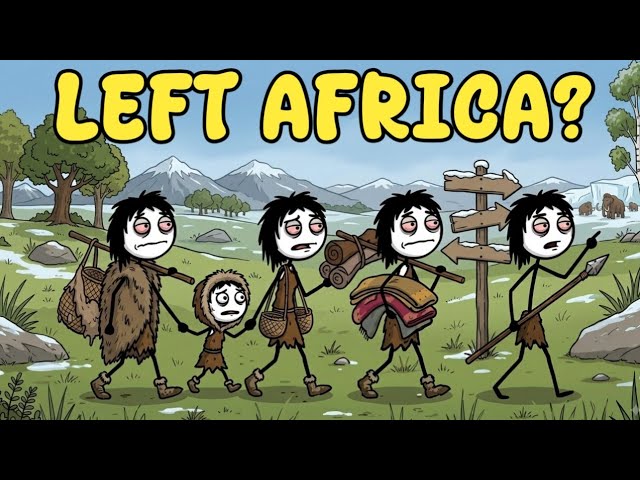
The global human presence we take for granted—on every major landmass, in deserts, islands, and polar regions—did not begin with one dramatic expedition. It was a long, uneven sequence of movements driven by environmental shifts, population pressures, and survival. Some groups left and thrived. Others vanished without leaving descendants among living humans.
The successful expansion that gave rise to most non-African populations is commonly placed around 60,000 years ago, though the exact timing and pattern remain active areas of scientific research. For hundreds of thousands of years, Africa was the only home humans knew. Survival depended on intimate knowledge of the landscape: where water could be found, which animals moved with the seasons, which plants were edible. That knowledge functioned as an internal map, passed down through generations.
But Africa was never a static environment. Climate shifted repeatedly. Rainfall expanded and contracted, grasslands changed, lakes appeared and disappeared, and deserts advanced and retreated. When the environment changed, the distribution of food and water changed with it.
A group facing a shrinking water source or thinning grass had a simple choice: stay and compete for dwindling resources, or move. At first, movement might follow a familiar route. But if conditions kept changing, the route grew longer, and eventually a population found itself living somewhere its ancestors had rarely, if ever, occupied. The first humans outside Africa may not have consciously decided to explore the world.
They were likely following opportunity—animals, water, plants, favorable climate—and the line between migration and survival was very thin. Leaving Africa did not happen only once. Archaeological evidence shows that members of the genus Homo reached parts of Eurasia hundreds of thousands of years ago, and possibly earlier. Many of these early dispersals led nowhere, or left only traces of genes in later populations.
The expansion that links to most people living outside Africa today came much later. The first challenge beyond Africa was not distance but environment. A group that knew exactly where to find water in one landscape could not carry that knowledge into another. Different plants, animals, temperatures, seasons, and terrain all demanded new solutions.
Humans met that challenge through behavioral flexibility: changing diets, making different tools, using fire, cooperating, and passing knowledge from one generation to the next. That cumulative knowledge was an invisible technology, and it allowed humans to survive in places their biology alone never equipped them for. Climate made the journey even harder. The Pleistocene era was marked by repeated fluctuations.
Glacial periods expanded ice sheets and lowered sea levels, exposing land bridges and coastal plains that no longer exist. Warmer periods melted ice and raised the seas. A route possible in one period could become impossible in another. The world these travelers crossed looked different from the world we see today, with different coastlines, rivers, and distances between landmasses.
Even with favorable geography, survival was not guaranteed. Genetics reveals that the population that ultimately gave rise to most non-African humans passed through bottlenecks—meaning it was surprisingly small at certain points. A single period of environmental stress could have enormous consequences for such a group. Every member mattered.
Every skill mattered. And some early dispersals likely failed entirely. The humans leaving Africa were not entering an empty world. Neanderthals occupied large parts of Eurasia, and other archaic human populations lived in Asia.
These groups had spent generations adapting to their environments. The newcomers were not just competing against nature—they entered a world already inhabited by other humans. And yet they survived. Genetics shows that modern populations outside Africa carry small amounts of Neanderthal ancestry, evidence that the expansion was not a simple replacement.
There was contact, and sometimes interbreeding, between different human populations sharing a landscape. Why humans kept moving farther is a question with no single answer. Population pressure, climate, available animals, changing coastlines, or the movements of other groups all could have played a role. Sometimes movement happened simply because humans could follow resources into new environments.
No one needed to understand a final destination. A group only needed to survive the next season, then the next. That is how enormous historical change begins: a short movement becomes a settlement, a settlement becomes a population, and a population expands. Thousands of years later, descendants live on another continent.
Fire, already used long before the major expansion, became crucial in colder environments. It provided warmth, light, and a way to process food. It could not make winter disappear or create food, but it expanded the range of environments humans could tolerate. The solution was not one invention but a package of adaptations: clothing, shelter, fire, tools, hunting strategies, food processing, social cooperation, and knowledge of seasonal landscapes.
Human culture made unfamiliar environments survivable. This is the hidden story of human expansion. The human body did not suddenly become capable of surviving everywhere. Technology changed where humans could live, and once that happened, the geographic limits of our species began to move.
Humans entered Europe, moved deeper into Asia, reached Australia, and much later, the Americas. Each expansion required solving new environmental problems, and each success created a new starting point for the next. The people involved were not heroic explorers with maps. They were families, small communities, and generations—people following animals, searching for water, learning new plants, and teaching children how to survive in places their own parents may never have seen.
The real technology was cumulative knowledge. One generation learned something, the next improved it, and the next carried it farther. Ancient humans were not simply primitive versions of us. They had no modern science and could not explain the world in abstract terms.
But they could observe, remember, compare, and teach. Practical knowledge with real consequences accumulated over time. The humans who left Africa were not necessarily the strongest or physically superior to every population they encountered. They survived because their behavior was flexible, and flexibility became one of humanity’s greatest evolutionary advantages.
After the first successful expansion, humans did not stop. Some populations stayed near coastlines, others moved inland, some followed rivers, and others crossed open landscapes. They adapted to deserts, forests, grasslands, mountains, and cold regions. Eventually, humans lived in environments separated by thousands of kilometers, yet they remained one species.
There is no monument marking the first step outside Africa. The transition was probably almost impossible to notice while it was happening. A group moved a little farther, some settled, some disappeared, and another population followed. Generations passed, the boundary moved, and one day descendants were living thousands of kilometers from where their ancestors began.
The story is not a completed journey. Humans never stopped moving. We continue to cross oceans, build settlements in deserts, and live in environments more extreme than anything our ancestors encountered. The tools, environments, and risks have changed, but the pattern remains familiar: a problem appears, humans adapt, the new environment creates another problem, and humans adapt again.
That pattern began long before civilization, agriculture, writing, or cities, with small groups trying to survive changing landscapes. Humanity did not conquer the world through a perfect plan. We spread because, again and again, people found ways to live somewhere new. The journey out of Africa was not a single moment of courage but a long experiment.
Some attempts failed, some populations disappeared, and others endured. Eventually, one branch of that ancient movement became the ancestry of billions of people living outside Africa today. The world we recognize—its cities, roads, farms, ships, and interconnected populations—traces back through an almost unimaginable chain of consequences. Near the beginning of that chain was a small human group facing an unfamiliar landscape, moving forward not because they knew the future, but because survival demanded the next step.
Over thousands of generations, those small decisions became the greatest journey in human history.