In August 2012, a spacecraft launched during the Carter administration achieved something no human-made object had ever done before. Voyager 1 crossed the heliopause—the invisible boundary where the influence of our Sun begins to give way to the vast environment between the stars. It was a milestone that scientists had anticipated for decades, and they believed they knew exactly what the crossing would look like.
For years, researchers had predicted three unmistakable signs. First, the solar wind—charged particles streaming outward from the Sun—would suddenly weaken. Second, cosmic rays arriving from interstellar space would surge. Third, and most importantly, the magnetic field surrounding the spacecraft would rotate dramatically, shifting from a direction controlled by the Sun to one aligned with the broader Milky Way galaxy.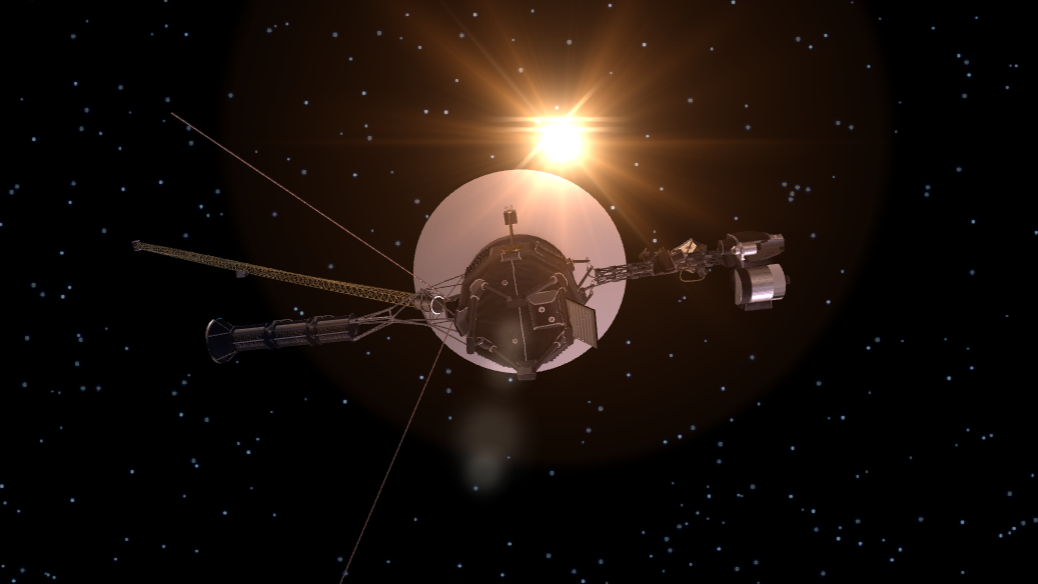
When the data arrived, two of those predictions proved perfectly correct.
Voyager’s instruments recorded a sudden collapse in solar wind particles. At the same time, detectors registered a sharp increase in galactic cosmic rays, exactly as scientists expected if the spacecraft had entered interstellar space. Everything seemed to confirm that humanity’s most distant explorer had finally crossed the boundary.
But the third prediction never happened.
The magnetic field barely changed at all.
That single observation transformed what should have been a straightforward scientific milestone into one of the most fascinating mysteries in modern space physics. According to existing models, the magnetic field beyond the heliopause should have pointed in a significantly different direction. Instead, Voyager measured a field that remained remarkably similar on both sides of the boundary.
The contradiction was so significant that it delayed official confirmation of the crossing itself. Some researchers wondered whether Voyager had truly left the heliosphere. Others suggested the spacecraft might be passing through a temporary disturbance or an unusual pocket of space. Yet as more data arrived, those explanations became increasingly difficult to support.
More than thirteen years later, Voyager 1 has traveled over sixteen astronomical units beyond the heliopause. That is billions of kilometers deeper into interstellar space. If the magnetic field discrepancy were caused by a temporary instability, scientists expected it would have disappeared long ago.
It never did.
Instead, the magnetic field orientation has remained surprisingly consistent, forcing researchers to rethink their understanding of the very edge of the solar system.
One of the most compelling explanations comes from studies led by researchers including Dr. Merav Opher, Dr. James Drake, and Dr. Nathan Schwadron. Their work suggests that the interstellar magnetic field does not simply begin where the Sun’s magnetic field ends. Rather, the two interact in a far more complex way.
Imagine stretching a rubber band around a beach ball.
As the interstellar magnetic field approaches the heliopause, it may wrap, bend, and drape itself around the boundary created by the Sun. Instead of encountering a clean transition from one magnetic environment to another, Voyager could be traveling through a distorted region where the Sun’s influence continues to reshape the surrounding interstellar field long after the official boundary has been crossed.
Computer simulations support this idea. They show that the heliopause may act less like a wall and more like a zone of interaction, where magnetic fields become twisted together rather than abruptly separated.
Additional evidence comes from an entirely different NASA mission known as the Interstellar Boundary Explorer, or IBEX.
In 2009, IBEX discovered a mysterious structure called the IBEX Ribbon—a vast arc of energetic particles stretching across the sky. Scientists believe this ribbon traces the direction of the undisturbed interstellar magnetic field. When researchers compared that direction to Voyager 1’s measurements, they found a discrepancy of more than 40 degrees.
Remarkably, that difference is almost exactly what the magnetic draping model predicts.
In other words, Voyager may not be measuring an anomaly at all. It may be measuring a region where the Sun’s influence still reaches into interstellar space, bending the local magnetic environment before the pristine galactic field fully takes over.
This possibility has major implications.
For decades, scientists imagined the heliopause as a relatively sharp boundary separating two distinct domains. Voyager’s observations suggest reality may be much more complicated. The edge of the solar system could be an extended transition zone where solar and interstellar forces overlap, interact, and reshape one another across enormous distances.
Even today, researchers cannot say with certainty how far that transitional region extends.
NASA’s Voyager project scientist, Dr. Linda Spilker, has noted that the persistence of the Sun’s magnetic influence remains one of the mission’s most intriguing unresolved questions. Voyager 1 crossed the heliopause in 2012. Voyager 2 followed in 2018. Yet both spacecraft continue to provide evidence that the boundary is far more complex than anyone expected.
What makes the mystery especially remarkable is that Voyager 1 is the only spacecraft currently capable of studying it directly.
Launched in 1977 with technology far less powerful than a modern smartwatch, the spacecraft now operates more than 25 billion kilometers from Earth. Its signals take nearly a full day to reach us. Engineers have gradually shut down instruments to conserve power, yet Voyager continues sending back measurements from a region no other probe has ever visited.
The most extraordinary possibility is that Voyager has revealed an entirely new layer of cosmic geography—an intermediate zone between the heliosphere and true undisturbed interstellar space. Such a region was not predicted by many earlier models, yet the data increasingly suggest it exists.
If that interpretation is correct, then Voyager 1 has not merely crossed the edge of the solar system.
It has discovered that the edge itself is far stranger than anyone imagined.
And after nearly fifty years in space, humanity’s oldest explorer may still be teaching us our most important lessons about the unknown.