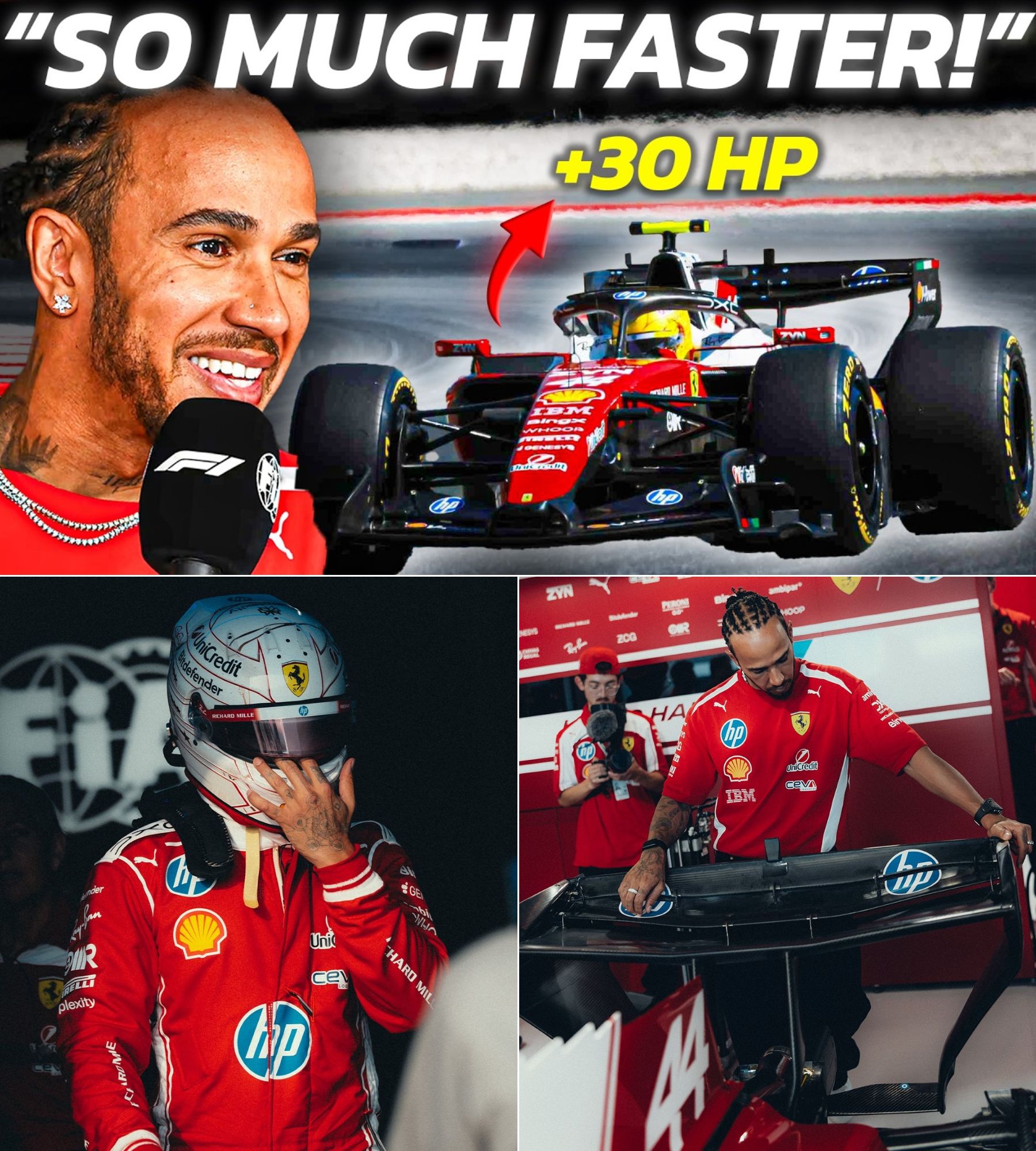
Ferrari is gearing up to unleash a game-changing upgrade just in time for the Austrian Grand Prix, and fans are buzzing with anticipation. After Lewis Hamilton’s impressive victory in Barcelona, where Ferrari finally showcased its potential against Mercedes, the Scuderia is ready to add a crucial missing piece: raw power.

At the Red Bull Ring, Ferrari will debut a new engine alongside a specially formulated Shell fuel, marking the third iteration of their power unit this season. This upgrade is not just a minor enhancement; it represents a significant overhaul of the engine’s core, featuring an innovative steel alloy cylinder head designed to withstand higher combustion temperatures. This change is expected to yield a remarkable boost of approximately 30 horsepower, a critical advantage on a power-demanding track like Austria.
Ferrari’s journey this season has been a rollercoaster. For the first six races, they found themselves trailing behind the dominant Mercedes, who claimed victory in every event. The team struggled with a basic aerodynamic package and a power deficit estimated at around 10 horsepower, which hampered their competitiveness. However, the tide began to turn in Barcelona when Ferrari introduced a major aerodynamic upgrade that improved tire management and cornering speed, allowing them to finally challenge Mercedes.

Despite this progress, Ferrari’s power issues persisted, as evidenced by GPS data showing their energy deployment lagging behind Mercedes on straightaways. Recognizing the need to address this weakness, Ferrari is now making a bold move in Austria.
The engine upgrade is a noteworthy innovation. By utilizing a steel alloy cylinder head, Ferrari can achieve higher combustion chamber temperatures, which, when combined with increased pressure, allows for better energy extraction from fuel. This is particularly crucial under the 2026 regulations, where fuel flow is limited, and efficiency is paramount. The new fuel developed by Shell complements this engine upgrade, ensuring optimal performance under the revised combustion conditions.

Ferrari’s ability to implement this upgrade stems from the FIA’s “adduo mechanism,” which permits struggling manufacturers to make necessary changes if their performance falls below a certain threshold. This regulatory provision allows Ferrari to enhance their engine’s internal components significantly, a strategic move that could redefine their season.

Looking ahead, Ferrari has a calculated development plan in place. The Austrian Grand Prix marks the first step, with another engine update scheduled for their home race in Monza in September. This timing is intentional, as the upcoming circuits in Austria, Great Britain, and Belgium are known for their demanding power requirements. With their chassis already proven in Barcelona, adding horsepower now could be a game-changer.
The implications for the championship are substantial. Before Barcelona, it seemed like a Mercedes-dominated season, but recent developments have shifted the narrative. With Ferrari’s aerodynamic advancements and Mercedes facing reliability issues, the championship landscape is evolving. Kimi Antonelli currently leads the standings, but his recent DNF in Barcelona has narrowed his lead over Hamilton to just 41 points.
As Ferrari prepares to unleash its new engine, the question looms: will this upgrade propel them to the forefront of the championship race? With the potential to close the gap and challenge for victories, fans are eager to see if Ferrari can become the team to beat in the upcoming power circuits. What are your thoughts on Ferrari’s chances?