A discovery buried beneath the desert floor has forced archaeologists to rethink how the ancient Egyptians moved some of the most massive stones in human history. In 2018, a team from the French Institute for Oriental Archaeology and the University of Liverpool returned to Hatnub, an alabaster quarry about 65 kilometers southeast of Minya in Egypt’s eastern desert. There they found a steep central ramp flanked by two staircases lined with deep post holes — evidence of a hauling system far more advanced than anything previously documented. The ramp’s incline was at least 20 percent, roughly the angle of a steep ski slope, far steeper than experts had believed possible without machinery.
The post holes, some nearly half a meter across, held thick wooden anchors. Ropes attached to a stone-loaded sledge would have been looped around those posts, allowing workers on the staircases to pull downward, using their own body weight as leverage to drag enormous blocks uphill. Two crews pulling from opposite sides redirected the force through the posts, functioning like a primitive pulley system. Tool marks and two inscriptions at the site link the ramp directly to the reign of Pharaoh Khufu, the same king who ordered the construction of the Great Pyramid at Giza.
The implication was immediate and significant: at the exact moment Egypt was building one of the largest structures ever attempted, its engineers already knew how to move colossal stones up slopes considered too steep to try. That discovery sits at the center of a much older question. Long before engines, steel, cranes, or hydraulics, human beings moved objects of staggering weight across vast distances. They quarried stone blocks the size of cars, floated granite columns across the open ocean, and raised structures that modern machinery would struggle to replicate.
They did it with ropes, wood, water, and coordinated human effort. The solutions began with the most basic problem: carrying. Early humans learned that shifting a load from the arms to the shoulders and spine allowed them to travel much farther before fatigue set in. This observation led to tumplines worn across the forehead, shoulder yokes used across ancient China, Egypt, and Africa, and baskets slung from poles carried by two people.
None of these required formal mechanics. They emerged through generations of trial and error — what ached less became standard practice. The next barrier was sheer weight. A single person can carry roughly 80 kilograms for a short distance, but stones weighed tons.
Combining effort required coordination. Ancient tomb paintings show a figure standing beside a moving sledge clapping time, synchronizing hundreds of workers into a single pull. The rhythmic shout or clap functioned as an external clock, locking separate bodies into one mechanical act. Work songs on plantations and sea shanties on tall ships served the same engineering purpose.
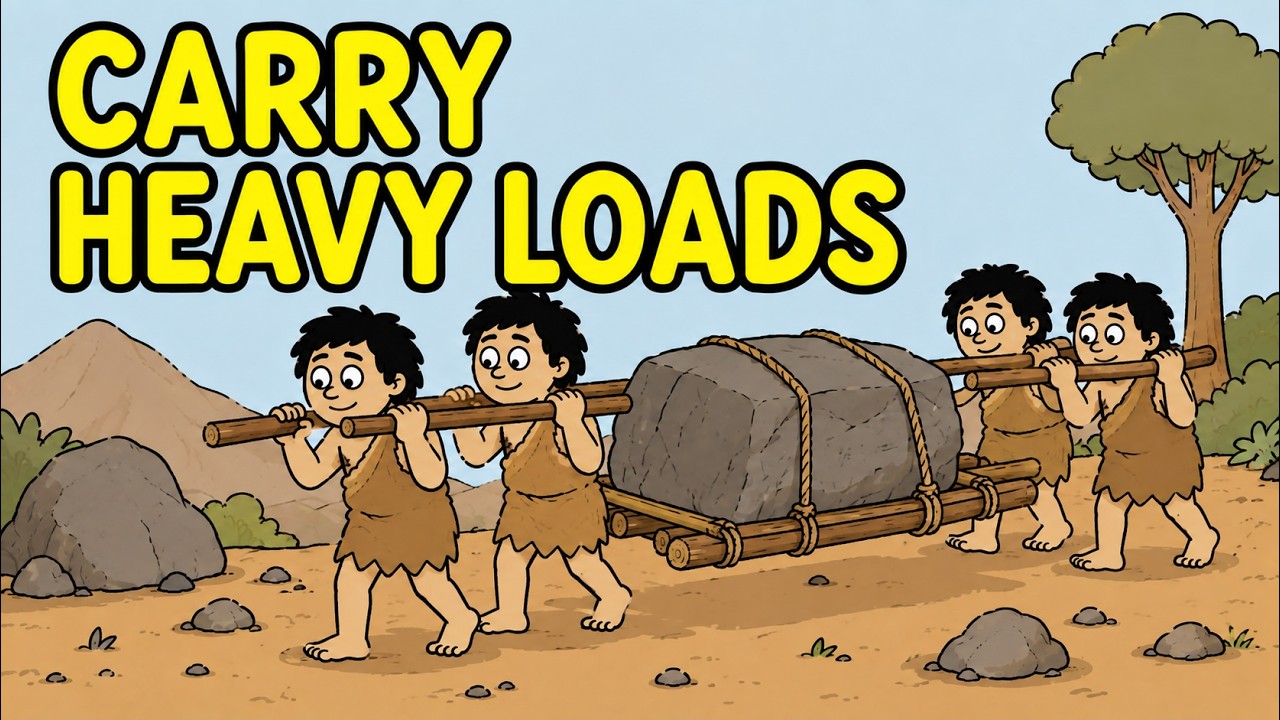
Load distribution also helped. Poles placed beneath a heavy object and carried on many shoulders spread the weight evenly across the group. Ten workers carrying a pole with a stone hanging from its center each bore roughly one-tenth of the total. A hundred could carry what one person could not budge.
But the biggest obstacle was friction. Dragging a 2. 5-ton stone block across dry desert sand required a pulling force nearly equal to the weight of the stone itself. At some point in the deep past, someone noticed that logs rolled across the ground barely resisted movement at all.
Placing logs under a heavy stone changed everything. Workers continuously moved the logs from back to front while others pulled, dramatically reducing the force required. The rolling log was, in effect, the first wheel. The actual wheel appeared around 5,500 years ago in Mesopotamia, but it introduced its own problem: sliding friction where the axle spins inside the hub.
Ancient builders smeared axles with animal fat, an early form of lubrication. Wheels also sank into soft ground under heavy loads, creating ruts that required enormous force to drag through. Flat sledges spread weight across a much larger surface, which is why Egyptian builders dragged stones on sledges across sand even though the wheel existed. The sand itself behaved like a fluid under the sledge runners, piling into small mounds that created a continuously rebuilding wall of resistance.
Then someone discovered what water does to sand. A tomb carved for a governor named Djehutihotep around 1880 BCE at Deir el-Bersha in Middle Egypt shows a massive statue on a wooden sledge pulled by 172 workers, with a single figure at the front pouring liquid onto the sand. For over a century, scholars assumed it was a ritual. In 2014, physicist Daniel Bonn at the University of Amsterdam tested the technique literally.
Bonn’s team built a small laboratory sledge and measured the force needed to pull it across sand at varying moisture levels. The results, published in Physical Review Letters, showed that adding between 2 and 5 percent water transformed the loose, fluid-like sand into a firm surface. The mounds stopped forming, and the pulling force required dropped by approximately half. The man pouring water in the tomb painting was not performing a ceremony.
He was optimizing friction more than 3,000 years before the word entered the scientific vocabulary. Notably, Bonn noted that modern physics still does not fully understand granular materials like sand, meaning the Egyptians mastered an optimization that scientists are still working to explain. Moving weight horizontally was only half the problem. Raising a 2.
5-ton block 40 meters high without a crane required the inclined plane. A ramp does not reduce the total work needed; it spreads that work over a longer distance, reducing the force required at any single moment. Builders had to balance gentleness against the massive size of the ramp itself. The Hatnub ramp solved this with its 20 percent slope and side staircases.
Ropes looped around the posts allowed workers pulling downward to assist the upward pull, effectively doubling the workforce without crowding the central track. Yannis Gourdon, co-director of the excavation, said the system allowed Egyptians to pull alabaster blocks out of the quarry on very steep slopes of 20 percent or more. Roland Enmarch, the other co-director, noted that this kind of system had never been discovered anywhere else. Once blocks reached the construction site, precise placement required the lever.
A beam resting on a pivot with the pivot close to the load end gives a large mechanical advantage. Workers used levers to tilt stones a few centimeters at a time, inserting wooden shims to hold each gain, then moving to the next edge. Specialized pinch bars nudged blocks sideways by fractions of a centimeter until joints were perfect. Many of the interlocking joints in the pyramids were adjusted into place on site using this iterative technique.
The scale of the enterprise is staggering. The Great Pyramid contains approximately 2. 3 million stone blocks averaging 2. 5 tons each, a total mass of about 5.
75 million tons. The structure was likely completed in around 20 years, meaning workers quarried, transported, and set between 800 and 1,000 blocks per day. The granite blocks in the King’s Chamber came from Aswan, about 800 kilometers south, and weigh between 25 and 80 tons each. The Nile provided the most efficient transport environment before the steam engine.
Floating objects face no ground friction, only the gentle drag of water. A boat that would strain on land could be moved by a handful of oarsmen. A papyrus scroll discovered in 2013 at Wadi el-Jarf, the oldest ever found, appears to be the diary of an overseer named Merer. It describes transporting limestone blocks from the Tura quarries across the Nile to Giza using wooden boats and a canal system connecting the river to an inland port near the construction site.
Water eliminated the hardest part of the overland journey. Egypt was not alone. Roman engineers shipped marble columns weighing 30 to 40 tons across the Mediterranean from Turkey to Rome, North Africa, and the Levant using specially reinforced vessels. Some ships were loaded by flooding a basin beneath the stone so the rising hull took the weight without any vertical lifting.
The risks were severe — a marble column could not be thrown overboard in a storm, and a slight shift in cargo could capsize the ship. The Kizilburun shipwreck off the Aegean coast of Turkey, dated to the 1st century BCE, carried eight granite column drums totaling roughly 50 to 100 tons and never reached its destination. Animals multiplied the force available. An ox can sustain a pulling force of roughly 3,000 to 5,000 newtons, compared to 600 to 800 newtons for a human worker.
A pair of draft oxen could outperform six to eight workers. But harnessing animals correctly took engineering. Early horse harnesses wrapped around the throat, strangling the animal under heavy load. The rigid collar that transferred weight to the shoulders and breastbone was developed in China and spread westward.
Oxen, naturally suited to the wooden yoke, were preferred for the heaviest loads. Elephants in South and Southeast Asia pushed timber through forests impassable for wheeled vehicles, exerting roughly the force of 15 to 20 human workers. The identity of the pyramid builders has been clarified by archaeology. For generations, the assumption reinforced by ancient writers like Herodotus was that slaves built the pyramids.
Excavations of a workers’ village at Giza since the 1990s contradict this. The workers ate well — beef and fish — and their bones show healed fractures and surgical procedures, evidence of medical care. Graffiti refers to crews by team names like “friends of Khufu” and “drunkards of Menkaure,” suggesting identity and pride. The workforce was most likely a combination of permanent skilled craftsmen and seasonal laborers recruited during the annual Nile flood, when fields were underwater and farm work was impossible.
The pyramid was a monument to administration, not cruelty. Other civilizations reached the same solutions independently. The builders of Stonehenge transported 25-ton sarsen blocks from Marlborough Downs, 25 kilometers away, using wooden sledges and organized hauling parties. The bluestones came from the Preseli Hills in Wales, over 200 kilometers away, likely floated by raft along the coast.
On Easter Island, the population moved hundreds of moai statues weighing over 70 tons from a single quarry. Experiments demonstrated the statues could be “walked” upright using ropes to tilt them back and forth, like moving a heavy refrigerator. A small crew with ropes could move a multi-ton statue across flat ground. The goal was never strength.
The goal was to minimize the force required at any single moment using every available principle: friction reduction, rolling, inclined planes, levers, and buoyancy. Those principles did not disappear with modern machinery. Every ball bearing is a direct descendant of the rolling log. The hydraulic jack is a lever in a different form.
The cargo ramp is an inclined plane. Lubricants descend from the animal fats smeared on ancient axles. What changed is not the physics, but the energy source. Remove modern motors and you are left with ancient engineering principles that still work.
The Great Pyramid was the tallest human-built structure on Earth for approximately 3,800 years, until Lincoln Cathedral was completed in 1311 CE. It held that record not because Egyptians had technology modern builders could not replicate, but because no subsequent civilization for nearly four millennia had the organizational capacity to match it. There is also a dimension of failure rarely mentioned. Every technique was refined through catastrophic trial and error.
A 30-ton block rolling off improperly positioned logs could kill multiple workers instantly. A sledge losing control on a steep ramp could slide into workers below. A Nile barge loaded beyond its limits could split and sink. Ancient construction was extraordinarily dangerous.
But the knowledge did not die with the workers who paid for it with injuries or lives. It accumulated in the collective practice of construction teams, passed down through direct apprenticeship and observation. This is why the same techniques developed independently worldwide. The Olmec civilization in modern Mexico moved 17-ton basalt heads from the Tuxtla Mountains to sites over 60 kilometers away without draft animals, using human labor, wooden rollers, and river transport.
The same physical constraints produce the same solutions because physics allows only so many answers. Every civilization that seriously attempted large-scale construction discovered most of them. Daniel Bonn, the physicist who confirmed the wet sand technique, noted that granular materials like sand, gravel, and coal account for about 10 percent of worldwide energy consumption in their processing and transport, and their behavior is still not fully modeled by modern physics. The optimization exists in a 4,000-year-old tomb painting.
The explanation is still being worked out. The Hatnub ramp matters beyond its immediate archaeological interest because it demonstrates that the people building Khufu’s pyramid were engaged in active engineering problem-solving, testing methods on terrain previously considered impossible. They were doing what engineers do, but without the theoretical frameworks modern engineers take for granted. They arrived at correct solutions through the only method available: careful observation of what the world actually did when force was applied to it.
The stones have not moved in 4,000 years. The principles that moved them have never stopped.