The average human body appears laughably ill-equipped for combat with wild animals. We lack claws, our teeth are unimpressive, and our skin tears easily. Yet, across much of the world, wildlife flees at the mere sound of our voice, often treating the threat of a human as greater than that of a lion. In one modern South African experiment, recordings of humans speaking calmly at water holes caused savanna mammals like elephants, giraffes, leopards, and antelope to flee more readily than recordings of lion vocalizations.
This reaction is a learned ecological response, not an innate one, demonstrating how our species has rewritten the rules of predation. Animals are not born fearing us. Historical records show that species on remote islands, which evolved without human-like predators, often displayed a fatal curiosity toward newcomers, proving that fear is a costly behavior that must be learned. Where animals have survived alongside humans, they have adapted to recognize signals—like footsteps or smoke—as precursors to danger.
This fear is rooted in human hunting techniques that diverged from other predators. While an animal relies on speed or strength, early humans practiced persistence hunting, using efficient upright walking and extensive sweating to track prey in the heat until the animal overheated. This was not the single heroic tactic of human evolution, as ambushes and traps were also crucial, but it revealed a key shift: the contest had moved beyond raw physical ability. Humans also externalized their weapons, shaping stones, wood, and fiber into tools that extended their reach, effectively moving danger outside the confines of their fragile bodies.
Cooperation further complicated prey’s ability to read us. Unlike a lion stalking with visible intent, humans could coordinate group ambushes, drive herds toward cliffs, or set traps that remained dangerous even after the hunter left. This created a landscape of fear where the environment itself became suspect. Crucially, humans broke the biological constraint of a predator being limited by its prey’s population.
We often targeted large, healthy adults—the reproductively most valuable members of a herd—a practice that can impact populations differently than a typical carnivore. This “super predator” pattern has contributed to extinctions, though it must be noted that human hunting often interacted with climate change and other environmental pressures. This reputation wasn’t established overnight. Early hominins were prey and scavengers, learning the ways of large carnivores to survive.
But unlike lions, when a human hunt failed, the hunter survived to remember and adapt. Language allowed them to share this knowledge, meaning a single individual’s success could be transmitted across a landscape. This cultural evolution gave humans a speed of adaptation that biological evolution could not match. A prey species might adapt genetically to wolves over thousands of years, but the humans it encountered next year could carry weapons their grandparents never possessed, shifting the safe distance once again.
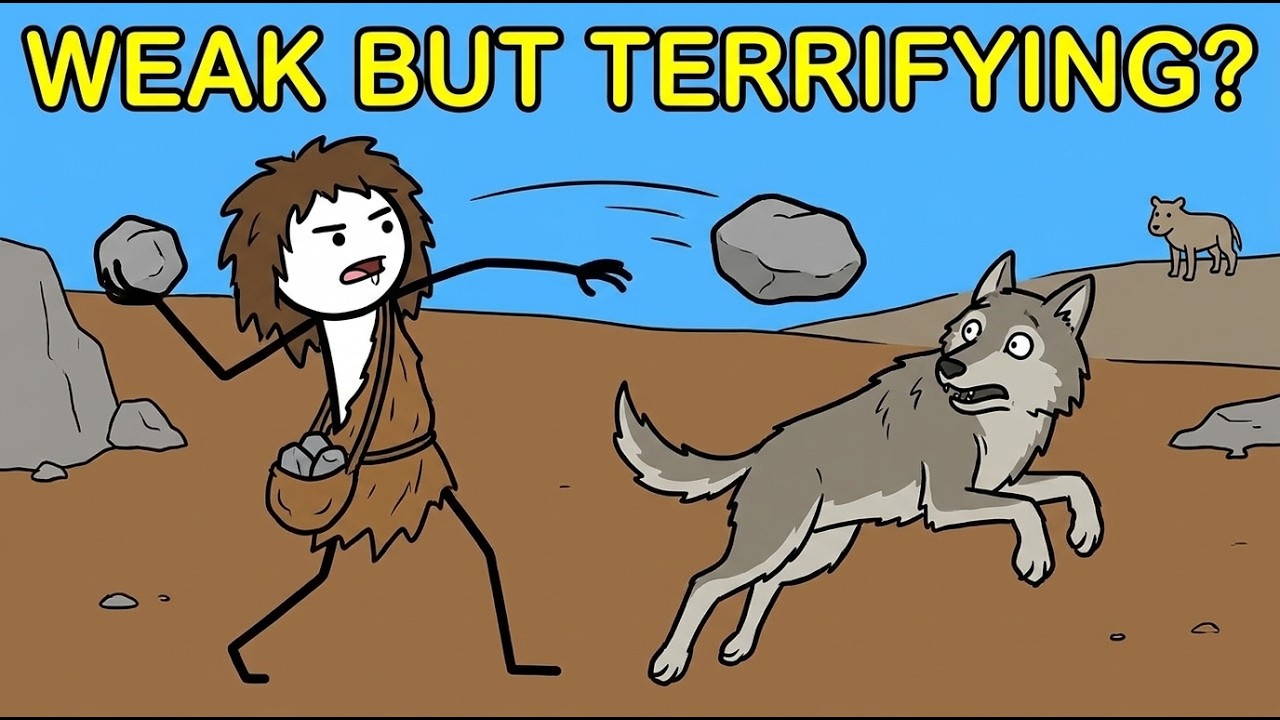
This extended to the very way we used our bodies. Our shoulders and wrists evolved for accurate throwing, turning our “weak” upper bodies into deceptive launch mechanisms for projectiles. Our large brains enabled planning, flexible cooperation, and the creation of tools that are arguably as much a part of our ecological niche as a beaver’s dam. In this view, human technology and culture are an extended phenotype.
Judging a human without tools is like judging a spider without its web. The fear animals display is not always a judgment of muscle mass, but a calculation based on an ecological history of humans killing at extraordinary rates through extraordinary methods. It is also a calculation that still fails. Crocodiles still take people near water, elephants charge, and bears learn to associate us with food.
Our reputation never made our skin thicker; it made dangerous encounters happen less often, providing access to resources without direct combat. By moving strength from the body and into culture, humans created a threat that was incredibly difficult to estimate, making the safest response for animals to simply leave while the human is still far away.