DNA testing on royal mummies confirmed that King Tutankhamun’s parents were full brother and sister, a revelation that only emerged because researchers swabbed a 3,300-year-old corpse. But that family arrangement was not an anomaly in Egyptian history, nor was it even the worst example on record. Egypt’s roughly 3,000-year civilization left ample time for unusual customs to become normalized. Across most of the kingdom’s most famous centuries, rulers in the palace married people they were already related to.
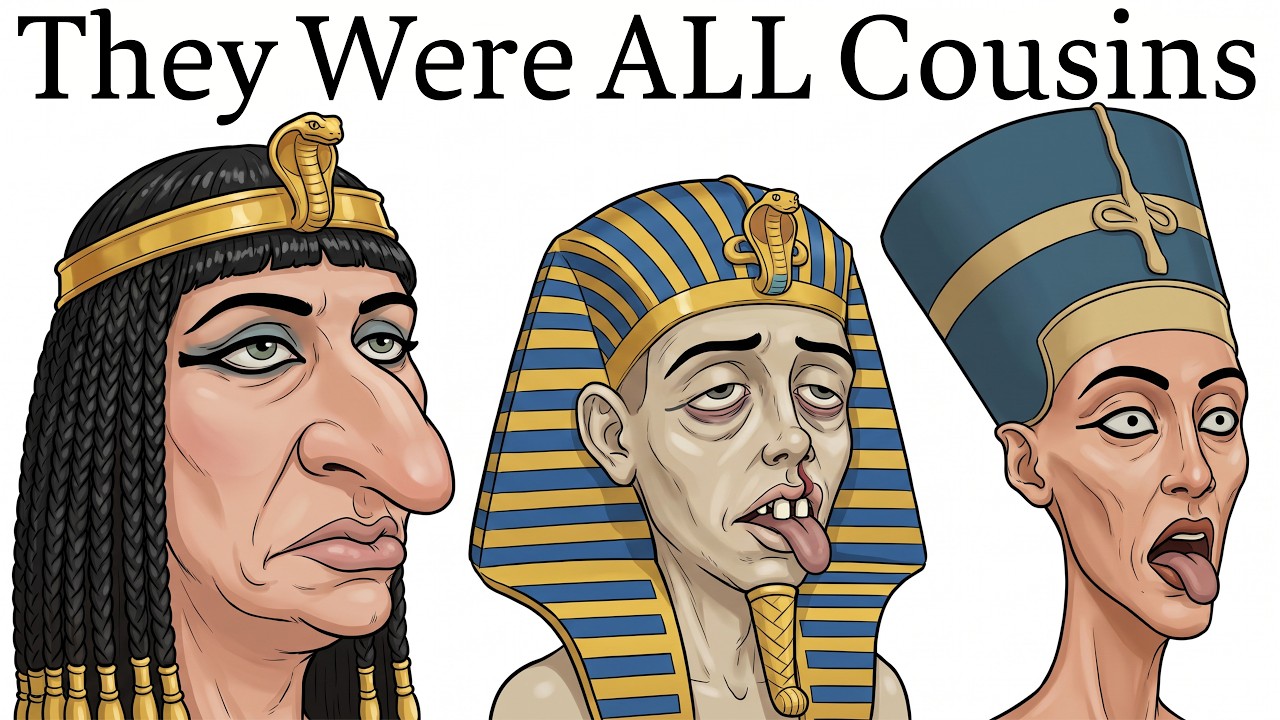
Two dynasties in particular stand out: the 18th Dynasty, which produced Hatshepsut, Akhenaten, and Tutankhamun, and the Ptolemies, a Greek-Macedonian family that ruled Egypt over 1,000 years later and gave history Cleopatra. As Egyptologist Sheila Ager explains, royal sibling marriage was not seen as breaking a taboo but as fulfilling one. In Egyptian theology, the gods themselves married their siblings. Osiris married his sister Isis; their parents and grandparents were also siblings.
Because the pharaoh was considered a living god, marrying a sister was a religious obligation reserved for the divine king and off-limits to everyone else. A common misconception arises from ancient Egyptian love poetry, where partners are called “my sister” and “my brother. ” Egyptologists clarify these were affectionate pet names, not evidence that all Egyptians married relatives. For much of the 20th century, historians promoted the “royal heiress theory,” which claimed princes could only take the throne by marrying the senior royal daughter.
However, Egyptologist Gay Robins dismantled this idea in 1983. Kings inherited from their fathers, and several pharaohs, including Amenhotep III, married non-royal women without constitutional issues. The real reasons for royal incest were practical: mirroring the gods, keeping wealth and status inside the family, and preventing outsider princes from creating rival branches with legitimate claims. The 18th Dynasty opened with a sibling marriage around 1550 BC.
Ahmose drove out the Hyksos rulers and founded the dynasty with his sister-wife Ahmose-Nefertari. She outlived him, helped rule during their son’s reign, and was worshipped as a goddess by tomb workers 400 years after her death. Their son later married his own sister, cementing the pattern as family default. Generations later, Hatshepsut, daughter of Thutmose I, married her half-brother Thutmose II.
After his early death, she upgraded herself from regent to pharaoh and ruled for roughly two decades. Her daughter Neferure may have married Thutmose III, though evidence is thin. Amenhotep III, who ruled about 38 years from around 1386 BC, presided over the wealthiest stretch of the New Kingdom. He married Tiye, a non-royal woman, as his great royal wife, plus several foreign princesses as diplomatic alliances.
In year 30 of his reign, he married his own daughter Sitamun, and four years later another daughter, Iset. Some scholars argue these were ceremonial roles tied to Jubilee festivals rather than physical marriages, but historians cannot prove what happened inside the palace walls. Amenhotep III’s son took the throne as Akhenaten and transformed Egyptian religion, abandoning the traditional gods for worship of the sun disk Aten. He built a new capital at Amarna and changed royal art radically, depicting himself with an elongated face, heavy hips, and a soft belly.
For decades, doctors diagnosed these images as evidence of genetic syndromes, but DNA testing in 2010 found no Marfan syndrome markers. Most art historians concluded the depictions were a deliberate theological style, not a medical chart. Akhenaten’s great royal wife was Nefertiti, whose parents are unknown. They had six daughters and no surviving sons.
After Akhenaten died around 1336 BC, a boy about nine years old took the throne. The boy was Tutankhaten, renamed Tutankhamun within a few years as Akhenaten’s religious revolution was reversed. He reigned about 10 years, died around age 18 or 19, and was buried in a small tomb that may not have been intended for him. His name was later scrubbed from king lists, which helped his tomb survive undiscovered until Howard Carter found it nearly intact in November 1922.
Between 2007 and 2009, a team led by Zahi Hawass ran DNA analysis and CT scans on 16 royal mummies. Results published in February 2010 in the Journal of the American Medical Association identified two previously unknown mummies as children of Amenhotep III and Tiye, making them full brother and sister. The same testing identified them as Tutankhamun’s parents. Geneticist Yehia Gad summarized that they turned out to be brother and sister, which surprised the team.
The identity of Tutankhamun’s mother remains unknown. The mummy known as the Younger Lady is not Nefertiti under this reading. One of the most famous humans who ever lived, and his mother’s name is lost to history. Full sibling marriage carries significant genetic risk.
Full siblings share about 50% of their DNA, and their children have an inbreeding coefficient of 0. 25, meaning roughly a quarter of the genome is expected to be identical on both sides. Generations of close-kin marriage cause pedigree collapse, where family trees fold in on themselves. This exposes harmful recessive mutations.
Inbreeding does not create disease; it exposes what is already present in the family gene pool. For Tutankhamun, the genetic cost was visible. CT scans found he had a clubfoot, a degenerative bone disorder in that same foot likely Kohler disease, and a partial cleft palate. He also had multiple malarial infections, the oldest genetic evidence of that parasite ever found at the time.
Howard Carter cataloged around 130 walking sticks in the tomb, several showing wear at the ends. The golden mask shows a serene face, but the young king inside needed canes to walk. The 2010 team proposed his death resulted from a badly broken left leg that had not healed, combined with a severe malaria infection. That reconstruction has been disputed, with some suggesting the break happened during mummification or Carter’s handling of the body.
Almost nobody disputes the general picture: Tutankhamun was a sick teenager, most likely because his parents were brother and sister. Tutankhamun married his half-sister Ankhesenamun, daughter of Akhenaten and Nefertiti. They shared the same father but had different mothers. The art from their marriage is notably affectionate, unusual for Egyptian royal depictions.
In a tomb treasure chamber, Carter found a plain wooden box containing two miniature coffins holding two mummified infant girls. CT studies put one at roughly 5 to 6 months gestation and the other at or near full term, both properly mummified with full royal treatment. DNA testing indicated with very high probability that Tutankhamun was the father of both girls. After Tutankhamun died around 1327 BC with no heir, his widow was left facing palace rivals.
A letter found in Hittite archives records an Egyptian queen named Dahamunzu, likely Ankhesenamun, asking the Hittite king for one of his sons to marry. She wrote she would never take one of her own servants as husband, understood as a reference to the elderly courtier Ay. The Hittite king was suspicious, sent an envoy to check, then sent a son who died en route, reportedly murdered. The king retaliated with war, and prisoners brought back a plague that eventually killed him.
Ankhesenamun then appears on a ring alongside Ay’s name, suggesting she married him after all, then disappeared from history. The 2010 DNA study has critics. Geneticists Éline Lorenzen and Eske Willerslev questioned the reliability of the data due to ancient DNA degradation and contamination risks, asking for raw data. Study leader Albert Zink was reluctant to release it.
French Egyptologist Marc Gabolde offered an alternative interpretation: Tutankhamun’s mother may have been Nefertiti, who he believes was Akhenaten’s first cousin. Three consecutive generations of cousin marriage, he argues, can statistically resemble a single sibling pairing. Zahi Hawass rejected this, noting no evidence Nefertiti was a daughter of Amenhotep III. The safest conclusion is that Tutankhamun’s parents were very closely related, whether full siblings or the product of repeated cousin marriages, with similar genetic consequences.
Later dynasties did not learn from the 18th Dynasty’s fate. Ramesses II ruled for 66 years and married at least four of his own daughters as great royal wives. The 19th Dynasty collapsed not from genetics but from having roughly 50 sons and a succession crisis. The Ptolemies, Greek-speaking Macedonians who ruled Egypt for nearly 300 years, adopted sibling marriage within one generation despite starting with Greek horror of incest.
Ptolemy II married his full sister Arsinoe II, and the court proudly gave them the epithet “Philadelphus,” meaning sibling lover. A poet who mocked the marriage was reportedly sealed in a lead jar and thrown into the sea. That marriage produced no children, but it set the pattern. Of roughly 15 marriages in the dynasty’s main line, 10 or 11 were to a full sibling.
The dynasty’s worst figure was Ptolemy VIII, nicknamed Physkon, meaning pot belly. On the day of his wedding to his sister Cleopatra II, he killed her son in her arms. He later fathered a child on her daughter Cleopatra III, then married her. Civil war followed.
Ptolemy VIII then had his own son by Cleopatra II killed, dismembered, packed into a box, and delivered to the mother as a birthday present. Despite his famously grotesque appearance, Ptolemy VIII was not himself inbred, and scholars note his lifestyle of extreme luxury is the more likely explanation for his body shape. By 80 BC, the dynasty was nearly finished. Berenice III ruled alone and was popular, but Rome sent Ptolemy XI to co-rule.
They married, and 19 days later he murdered her. The Alexandrians killed him in response, ending the legitimate Ptolemaic line. Cleopatra VII was born in 69 BC. Her father was Ptolemy XII, who married his half or full sister, whose identity after Cleopatra’s birth is undocumented.
Cleopatra’s family tree folds dramatically; some genealogists argue she had as few as eight or 10 distinct great-great-grandparents where she should have had 16. Despite the heavy inbreeding, every surviving account describes her as brilliant, fluent in multiple languages, and personally compelling. She married two of her brothers, both children, both of whom died conveniently. She had a sister executed and watched another executed by their father.
She never had a child with a relative, and all four of her children were fathered by outsiders. Roman propaganda used the Ptolemaic family tree to frame Egypt as decadent and corrupt. Modern historians have debated whether inbreeding damaged the Ptolemies mentally or physically. Sheila Ager argues there is no gene for murdering a brother; the dynasty’s behavior came from a court culture where such acts were standard career advancement.
There is no physical evidence of inbreeding damage for the Ptolemies because their royal tombs have never been found. Unlike the Ptolemies, evidence for the 18th Dynasty is stronger: a documented full sibling marriage, a son with congenital disorders, and two grandchildren who died before birth. The dynasty ended a decade after Tutankhamun’s death for lack of an heir. Perhaps the most surprising finding comes from Roman-era Egypt.
Census records from roughly AD 19 through the 250s show that between 15% and 21% of marriages in the province were between full brothers and sisters. In the city of Arsinoe, the figure reached about 37%. This was not a royal practice but common among ordinary people, the only well-documented case in history of widespread close-kin marriage outside a ruling class. The explanation appears to be economic: Egyptian law gave daughters inheritance rights, so marrying a sister kept property inside the family and avoided dowries.
The practice ended by paperwork. In AD 212, Emperor Caracalla granted Roman citizenship to nearly all free people in the empire, which bundled in Roman law forbidding sibling marriage. Within decades, the census records show the practice had essentially vanished. The Spanish Habsburgs later repeated the same experiment in Europe, with Charles II of Spain reaching an inbreeding coefficient equivalent to a sibling pairing.
He could not chew properly, could not father children, and his death in 1700 triggered a 13-year continental war. The Egyptians got Tutankhamun; the Spanish got Charles II. The mechanism was identical across 3,000 years, a structural feature of any system where inherited power convinces its holders that the rules do not apply to them.