For decades, the prevailing assumption among researchers was that early human societies functioned like chimpanzee troops, organized around a single dominant male who ruled through strength and aggression. But when anthropologists actually studied surviving hunter-gatherer societies across the globe, they found something remarkably consistent: these groups were fiercely egalitarian, actively suppressing anyone who tried to dominate the rest. Anthropologist Christopher Boehm spent his career documenting what he called a “reverse dominance hierarchy. ” Rather than one alpha dominating everyone else, the entire group banded together to dominate anyone who tried to set himself up as an alpha.
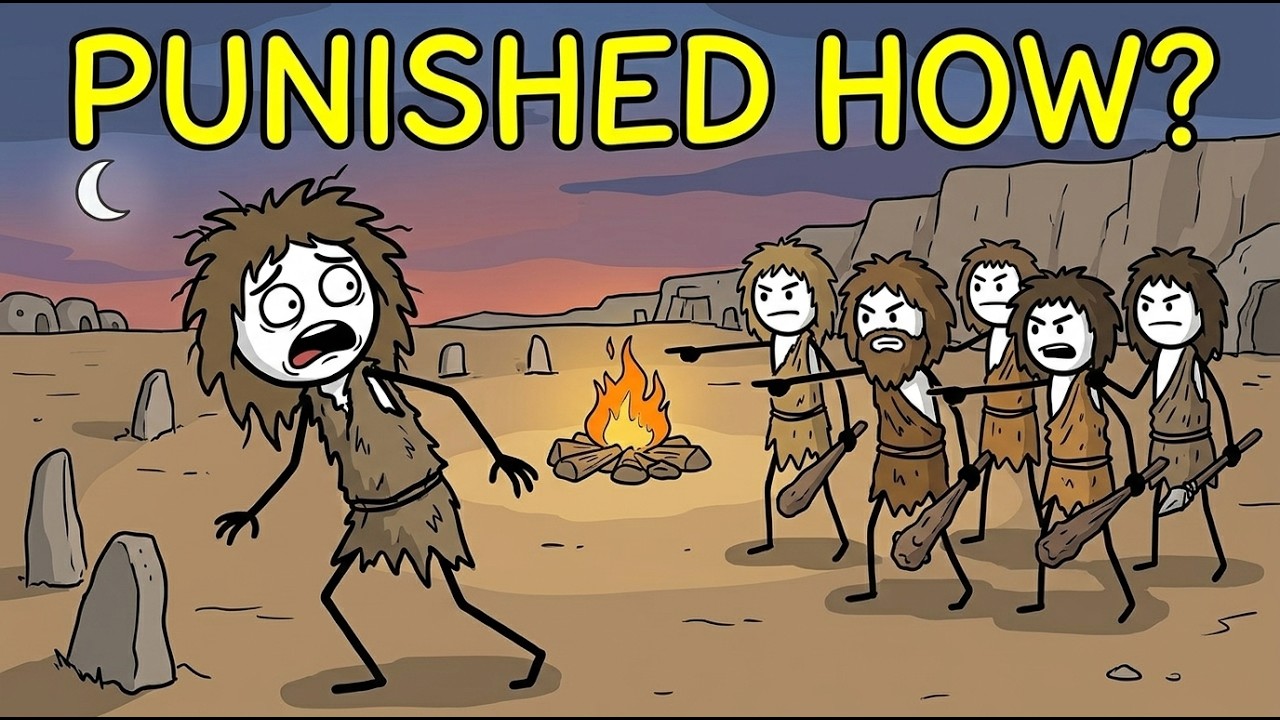
This system required real enforcement mechanisms, and Boehm discovered a remarkably consistent, escalating ladder of punishments used independently across dozens of unrelated cultures. The first and most frequently used tool was gossip. In a small band of roughly 30 people, where privacy and anonymity did not exist, reputation was everything. A band member whose reputation collapsed could find themselves excluded from hunting parties, denied resources, or steadily avoided by everyone whose cooperation they needed to survive.
If gossip failed, the next rung was public mockery and ridicule. Among groups like the Ju/’Hoansi of the Kalahari, a successful hunter who brought down a large animal was often met not with praise but with pointed jokes about how scrawny and worthless his kill was. This wasn’t jealousy; it was preventative social medicine designed to stop a talented individual from thinking his success entitled him to dominate others. If ridicule still failed, bands moved to open refusal to cooperate with the offender, and then to outright shunning, where the individual was frozen out entirely and denied the social warmth and connection that everyone in a tightly knit band depends on.
Sometimes, however, none of this worked. For a true repeat offender, someone violent or dangerous who simply did not respond to social pressure, the ladder moved to exile and ostracism. In the modern world, being ostracized is unpleasant but survivable. In a hunter-gatherer band, survival depended entirely on group cooperation, shared knowledge, and mutual protection.
A single individual cast out alone into an unfamiliar or hostile landscape faced a severe and very real risk of death from starvation, exposure, predation, or simple bad luck. Banishment effectively functioned as a slow, indirect death sentence. At the top of the ladder was the final solution: capital punishment. Boehm found that execution had the single widest geographic distribution of any punishment method he studied, appearing independently in every major world region, across societies with no writing, no courts, no police, and no contact with one another.
What offenses triggered this ultimate response? Boehm’s research identifies a consistent list: serial murder, sorcery believed to give someone dangerous power over others, persistent theft and cheating, willful refusal to cooperate with the group’s survival needs, and the breaking of deep cultural taboos, with incest appearing with near-universal consistency. But the single category of offender most likely to be executed was what Boehm called the “antisocial dominator” — a violent, unrepentant bully who refused to reform no matter how much pressure the band applied. Gossip, ridicule, and shunning were built on the currency of social approval, but these individuals often did not care about social approval.
Boehm noted that some of these figures likely resembled what we would today recognize as psychopaths. In nearly every documented case, this final punishment was not the spontaneous eruption of an enraged mob. It was the carefully considered product of sustained group consensus, only reached after every lesser option had been tried and failed. The system was fundamentally procedural: gossip to surface the problem, ridicule to apply pressure, shunning to withdraw support, exile to physically remove the threat, and execution only as a last resort against a continuing, genuine threat to the group’s survival.
One complication runs through this picture. Boehm’s research notes that the reverse dominance hierarchy was generally and primarily enforced among adult males. The degree to which women in these communities were protected by or excluded from this egalitarian system varied considerably from one culture to the next, and in some documented cases, the systems built to prevent male domination over other males did little to prevent male domination over women. Long before any human society invented writing, courts, judges, or formal law, our species had already independently discovered something closely resembling due process: a graduated, consensus-based escalation of consequences, carefully calibrated to match the severity of the threat.
The tools we use today look different on the surface — police forces, formal courts, prisons, written legal codes — but the underlying logic, from gossip and social pressure to exclusion and permanent removal, was built into the very foundation of how humans organize themselves, long before anyone could write a single word of it down.


