Sleepwalking is far more common than most people realize, affecting up to 30 percent of children at some point and between 1 and 7 percent of adults, yet the phenomenon remains deeply misunderstood. Despite decades of scientific study, popular myths continue to shape how people react to the strange sight of someone moving through the world while their conscious mind appears to be offline. One of the most persistent myths claims that waking a sleepwalker is dangerous and could cause a heart attack or severe psychological damage. Medical experts say this is entirely false.
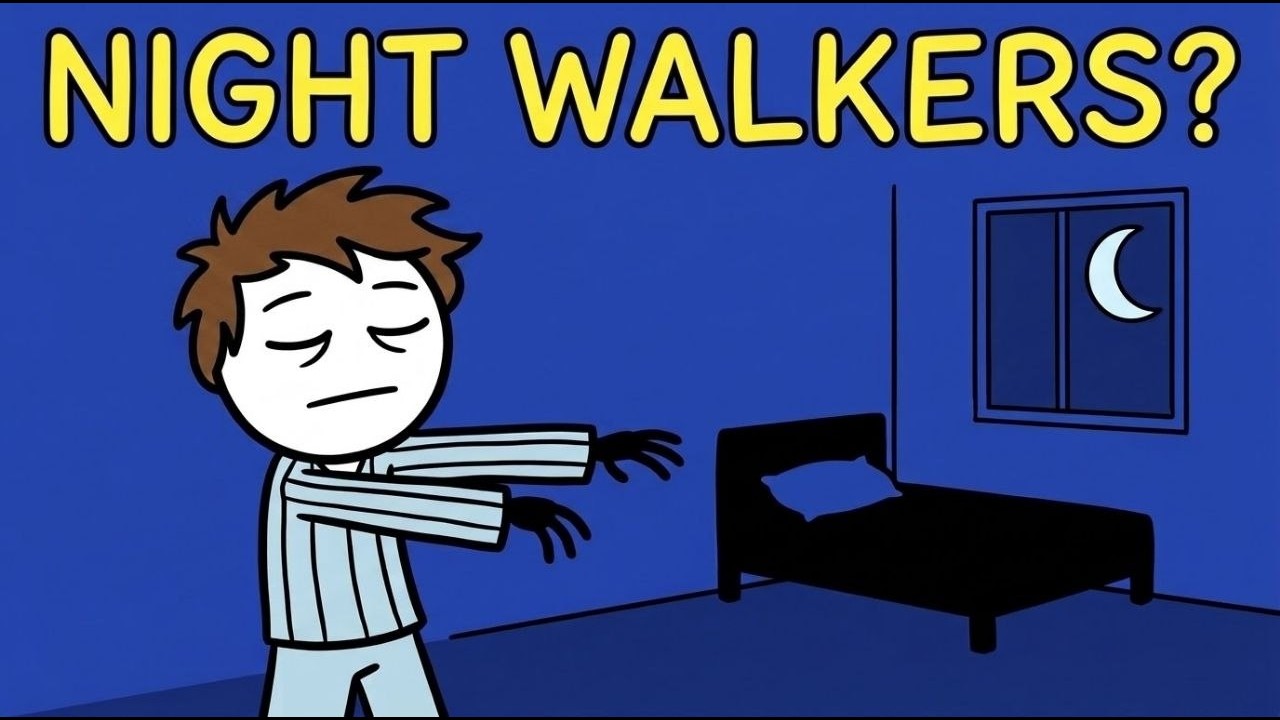
Waking a sleepwalker carries no medical risk, though it can be difficult because sleepwalkers are often confused and disoriented when roused. The practical guidance is simpler: gently redirecting the person back to bed is usually easier, but waking them for their own safety is perfectly acceptable. Another common misconception is that sleepwalkers navigate obstacles with supernatural precision. In reality, they move competently through familiar environments because the route is stored in motor memory and requires no conscious navigation.
In unfamiliar surroundings, their abilities deteriorate quickly. The competence comes from environmental familiarity, not enhanced awareness. Sleep was long understood as a uniform state of unconsciousness, a model that began to collapse in 1953 when researchers Eugene Aserinsky and Nathaniel Kleitman at the University of Chicago discovered REM sleep using electrophysiology to record brain activity and electrooculography to track eye movements. They found that sleeping subjects periodically entered a state characterized by rapid eye movements, muscle paralysis, and brain activity resembling wakefulness.
Sleep was not uniform at all, but structured. A typical night’s sleep cycles through multiple stages four to six times. The cycle begins with light non-REM sleep, deepens into slow-wave sleep, also called deep sleep, during which brain activity slows to its minimum and physical restoration is most active, then reverses and eventually enters REM sleep before restarting. Sleepwalking occurs almost exclusively in slow-wave sleep, during or immediately after its deepest phase.
During slow-wave sleep, neurons across the cortex alternate between active up states and near-silent down states. This is when the brain performs critical maintenance, consolidating memories, clearing metabolic waste, and resetting neural sensitivity. The thalamus, which normally relays sensory information to the cortex, suppresses its function, reducing access to external input. Conscious awareness is minimal.
The brain is about as offline as it gets. Brain imaging studies of spontaneous sleepwalking episodes have revealed something that should not be possible under that model. During an episode, parts of the brain remain in deep sleep while other regions activate. The regions responsible for conscious awareness and self-reflection stay in sleep-like states, but the regions involved in locomotion, spatial navigation, and automatic behaviors show activation patterns typical of wakefulness.
The brain is not fully awake. It is selectively, incompletely awake. The motor systems have come online. The conscious observer has not.
The result is a person moving, navigating, and executing behaviors in the physical world while the part of the brain that would normally observe and record that experience remains in deep sleep. They are asleep and in motion at the same time. The behavioral machinery is running without its usual supervisor. The mechanism behind this partial arousal is still not completely understood, but several contributing factors are well established.
Genetics plays a substantial role. Sleepwalking runs strongly in families, and twin studies show significantly higher concordance in identical twins than fraternal twins. Children with two sleepwalking parents have roughly a 60 percent chance of sleepwalking themselves, while the risk drops to around 22 percent for children with no sleepwalking parents. Sleep deprivation dramatically increases sleepwalking frequency in susceptible individuals.
When the brain is sleep-deprived, it compensates by driving deeper into slow-wave sleep, and this more intense deep sleep increases the probability of partial arousal events. Fever, stress, and anxiety are also recognized triggers, as are certain medications that affect sleep architecture. Alcohol is a particularly interesting case: it initially increases slow-wave sleep but causes disrupted, fragmented sleep as it metabolizes during the night, creating conditions favorable to episodes. Children sleepwalk far more commonly than adults, with peak prevalence between ages 4 and 8.
They spend considerably more time in slow-wave sleep, both in absolute terms and as a proportion of total sleep time. A young child’s sleep might consist of 40 to 50 percent slow-wave sleep, while mature adults spend considerably less. More slow-wave sleep means more time in the state from which sleepwalking can emerge. The developing brain also runs less fully integrated sleep-wake regulation systems, which may make partial arousal events more likely.
The range of behaviors sleepwalkers can execute is far broader than the simple image of someone wandering a hallway. Basic episodes involve sitting up, standing, walking around, or mumbling. But more complex forms can involve cooking complete meals, leaving the home and walking significant distances, driving vehicles, sending text messages, making phone calls, and engaging in sexual behavior, none of which the person later remembers. Sleep-related eating disorder is a recognized variant in which people eat during episodes, sometimes consuming foods they would never eat while awake.
Sexomnia, sexual behavior during sleep, has been documented in both men and women and has been presented as a legal defense in allegations of assault. At the most dramatic end of the spectrum are rare but medically established cases of sleepwalking-related violence. Individuals have injured themselves and others during episodes with no waking memory of the event and no apparent waking-state motivation. These cases raise difficult questions about moral and legal responsibility for behavior executed while the part of the brain responsible for conscious agency was demonstrably inactive.
Courts have wrestled with these questions with inconsistent outcomes, reflecting the difficulty of applying legal frameworks built on assumptions of unified conscious agency to situations where consciousness was selectively absent. Popular understanding also conflates sleepwalking with dreaming, but the two are fundamentally different. Sleepwalking occurs in non-REM slow-wave sleep, where the brain regions associated with complex dreaming are largely inactive. Sleepwalkers are not typically acting out dreams.
When awakened during an episode and asked what they were experiencing, they usually report complete mental blankness or extremely fragmentary non-narrative content, a vague sense of needing to do something without context. The behavior is driven by something like a motor impulse emerging from a brain without conscious oversight. REM sleep behavior disorder, in which people do act out vivid dreams because normal muscle paralysis fails, is a different condition with a different mechanism. Some researchers have proposed an evolutionary angle, suggesting that partial arousal phenomena like sleepwalking may be a vestigial remnant of an ancestral sleep pattern.
The idea is that early humans sleeping in environments with predator threats may have benefited from the capacity for partial activation during deep sleep without requiring a full transition to wakefulness. This is speculative, but it connects to the broader observation that sleep is not passive unconsciousness. Many prey animals sleep with one hemisphere of the brain at a time, maintaining environmental monitoring even while sleeping. The human sleep system reflects millions of years of evolutionary pressure balancing restoration with responsiveness.
Treatment for sleepwalking, when warranted, reflects how much remains unknown about the underlying mechanics. For most people, episodes are infrequent, brief, and pose no safety risk, so the appropriate response is environmental: securing the sleeping environment, using door alarms and stair gates, removing sharp objects and trip hazards, and ensuring windows and exterior doors cannot be easily opened. For people with frequent, complex, or dangerous episodes, clinical options exist. Scheduled awakening, deliberately waking the person 15 to 20 minutes before episodes typically occur, can reduce frequency.
Benzodiazepine medications that suppress slow-wave sleep have been used with some success but carry risks. Addressing underlying contributors such as sleep deprivation, stress, alcohol use, and medication side effects can significantly reduce episode frequency. Cognitive behavioral therapy for insomnia can improve overall sleep architecture. But a treatment that precisely targets the partial arousal mechanism while leaving restorative slow-wave sleep intact does not yet exist.
There is something philosophically unsettling about sleepwalking that lingers after the neuroscience is understood. The version of a person that walks through the house at 2 a. m. , navigates around furniture, and responds to a name with a blank look executed all those behaviors using the same brain, muscles, motor memory, and spatial knowledge of the home.
It wore their face and moved with their gait. But the part of the brain that generates the continuous first-person narrative called consciousness, the part that registers and records experience, was absent. Was that person really themselves? The question touches on legal debates around sleepwalking behavior, medical definitions of consciousness and agency, and the deepest assumptions people hold about what it means to be a self.
People tend to assume the self is continuous, unified, and present whenever the body is active. Sleepwalking is a reminder that the body can be active without the self showing up. The behavioral machinery can run without the observer in the booth. Sleepwalking is not possession, not supernatural, and not entirely sleep.
It is a brain caught mid-transition, a system that runs on multiple partially independent subsystems and occasionally allows some to activate while others remain in deep maintenance mode. The human brain never actually turns fully off. It is always doing multiple things at once. It is not a light switch.
Sleepwalking is the proof. And if a roommate is making a sandwich in the kitchen at 2 a. m.
with the lights off and their eyes open but unseeing, pointing them gently back toward the bedroom is probably the most reasonable response available.