Salt was once used as currency, armies were paid in it, cities were built to control its supply, and wars were fought over access to it. Today, the same substance sits in a small shaker on kitchen tables worldwide, often overlooked beyond a passing concern about blood pressure. The question of when humans first started eating salt is not answered by a single moment in time but by a process that unfolded over hundreds of thousands of years, reshaping human biology, economics, and politics. The biological foundation of this story begins with sodium, the key element in sodium chloride, which is essential for life.
The human body relies on it to regulate fluid balance, transmit nerve signals, drive muscle contractions, and maintain blood pressure. Every heartbeat and muscle contraction depends on the electrochemical gradient that sodium helps establish. The body maintains sodium concentration in the blood within a narrow range, and deviations in either direction can lead to severe neurological damage or death. The elaborate systems the body uses to conserve sodium, including dedicated sodium-sensing neurons in the brain and the hormonal renin-angiotensin-aldosterone axis, are evidence that sodium availability was not always guaranteed.
If sodium had always been abundant, evolution would not have invested so heavily in conserving it. The existence of these systems suggests that getting enough sodium was once a genuine challenge. The ancestral environment provides the starting point for this narrative. The great apes, immediate ancestors of modern humans, have relatively low sodium requirements due to plant-based diets rich in fruits and leaves.
However, the shift to a more active, carnivorous lifestyle in open terrain changed this equation. Hunting and gathering in hot environments produces significant sweating, and sweat contains sodium. An active hunter-gatherer can lose several grams of sodium through sweat in a single day, requiring replacement. Meat and fresh blood provided a convenient sodium source, containing concentrations similar to seawater.
The shift toward higher meat consumption in the human lineage was partly a shift toward higher dietary sodium availability. What remains uncertain is whether early hunter-gatherers actively sought out salt as a separate substance or simply obtained adequate sodium from their food without specific interest in the mineral. Direct evidence for when humans began seeking salt does not survive in the archaeological record the way bone tools and fire hearths do, as salt leaves no lasting trace at sites where it was merely consumed. However, indirect evidence from physiology, animal behavior, and modern hunter-gatherer groups allows a coherent picture to emerge.
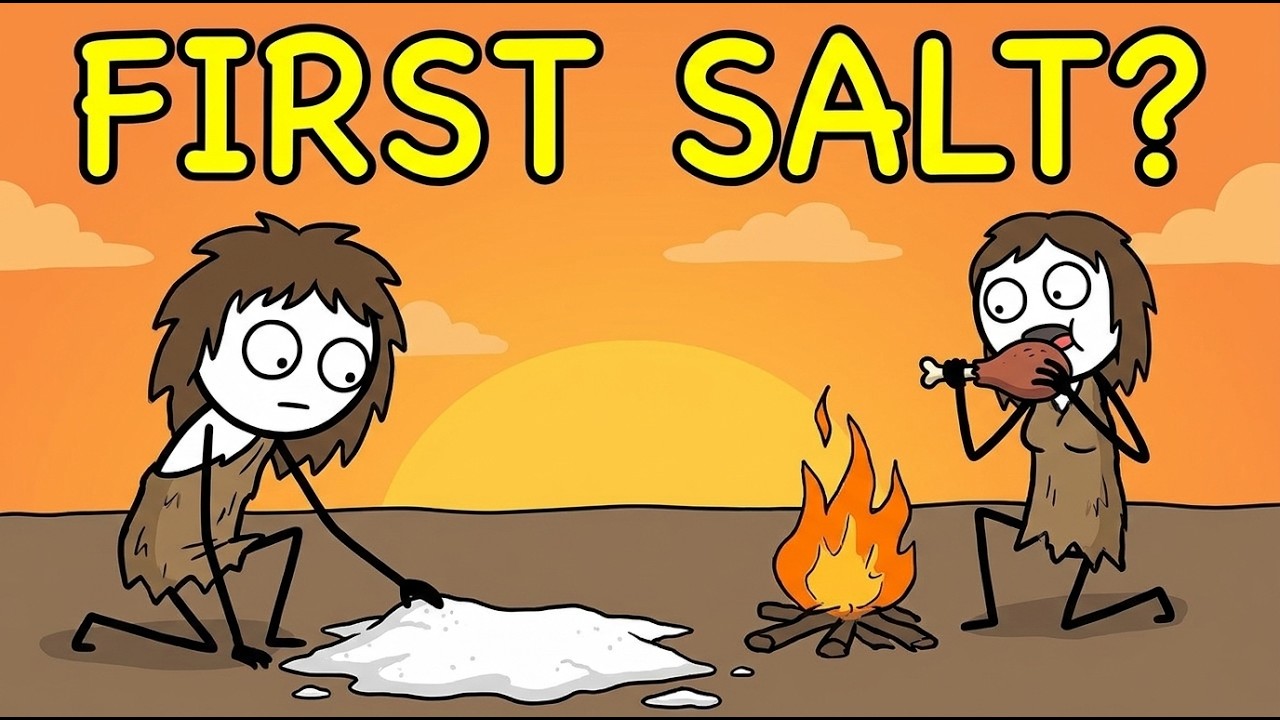
Animals consistently seek salt, with ungulates traveling significant distances to mineral licks to supplement dietary minerals. Early humans, expert animal observers, would have eventually investigated these locations and tasted the mineral drawing animals there. The discovery of salt as something worth seeking was likely made many times in many places independently, as groups followed animal behavior patterns that led to natural salt sources. The alternative, that early humans ignored salt licks animals sought enthusiastically and only discovered salt after agriculture developed, is considerably harder to believe.
Natural salt sources take several forms, including inland salt lakes and playas in arid regions, salt springs where underground water passes through salt-bearing formations, and coastal environments with sea spray and tidal pools. The Afar region of Ethiopia, one of the most important regions for early human fossil finds, contains significant surface salt deposits, meaning early hominins there would have had regular contact with exposed minerals. Traditional peoples without access to refined salt developed creative methods for supplementing sodium, documented in indigenous communities in Papua New Guinea, the Amazon basin, and parts of Central Africa. These communities burned specific plant species rich in sodium and consumed the resulting ash as a condiment, a practice functionally identical to salting food.
This demonstrates that the drive to supplement dietary sodium was strong enough to produce significant behavioral innovation even without direct salt sources. The earliest confirmed archaeological evidence of deliberate salt production dates to approximately 8,000 years ago at Lunca in Romania, where brine springs were boiled to extract solid salt at scale. The existence of production technology implies that demand existed that natural sources couldn’t fully meet, and you don’t develop production methods unless you are already dependent on salt in quantities passive collection can’t provide. The transition to agriculture was the key inflection point in the human relationship with salt.
Agricultural diets dominated by grain crops are extremely low in sodium, while physiological requirements remain unchanged. The difference between the sodium content of a grain-based diet and a varied hunter-gatherer diet can be several grams per day, creating what could be called a salt gap that required external supplementation. Agriculture also increased population density and enabled social complexity, trade networks, and storage systems, all of which required food preservation at scales hunter-gatherer bands didn’t need. Salt preserves food because salted meat and fish last longer, and salted vegetables can be stored through winter.
Salt enabled the food storage that enabled the population densities that enabled civilization. These two functions, dietary supplementation and food preservation, drove salt from a pleasant mineral encountered occasionally to one of the most strategically important substances in the ancient world. The archaeological record shows increasing density of salt production sites, growing complexity of production technology, and multiplying evidence of salt trade across significant distances. The Roman Empire’s relationship with salt is the most commonly cited historical example.
Roman soldiers received a salarium, an allowance for salt from which the English word salary derives. The Via Salaria, the Salt Road, was one of the oldest roads in Italy, existing specifically to move salt from the Tiber’s mouth to interior populations. The Roman salt trade was state-controlled, taxed, and strategically important. But Rome was not where this began.
Salt trade routes in China date to at least 2,700 BCE, and salt production in the Sahara drove trans-Saharan trade routes connecting sub-Saharan Africa to the Mediterranean, where salt was traded weight for weight against gold. Salt pans were important to the Maya, and salt springs in North America were fought over by indigenous nations before European contact. Every complex civilization independently converged on the recognition that salt was essential enough to organize production, control distribution, and tax consumption. This convergence reflects the biological reality that salt is physiologically required, agricultural diets don’t provide enough of it, and whoever controls salt controls something people will pay essentially anything for.
Salt is not a luxury good whose demand falls when price rises. It is a necessity with relatively inelastic demand, making it the ideal tax base for pre-modern governments and the ideal trade good for merchants. This is what made the British salt tax in India so effective, and it is what Gandhi chose as the symbol and target of his first major act of civil disobedience when he walked 240 miles to the sea in 1930 to make salt in defiance of British law. The French Gabelle, a salt tax considered one of the most hated fiscal policies of the ancien régime, was a direct contributor to the social grievances culminating in the French Revolution.
Taxing salt was taxing the ability to eat, and the rage it produced was proportionate to the biological necessity of what was being taxed. The political economy of salt is the political economy of necessity, and necessity-based political economies produce the most intense conflicts when access is restricted. The human taste system has dedicated sodium receptors, and saltiness is a primary taste processed through a dedicated neural pathway. The reward response to salt is mediated partly through the same dopaminergic pathway that mediates other primary rewards, and sodium-depleted animals show elevated dopamine release in response to salt.
The salt craving produced by sodium depletion is a drive state, motivated, persistent, and satisfied specifically by salt. This drive state was adaptive across evolutionary history because it motivated sodium-seeking behavior when availability was uncertain. It became potentially maladaptive in the modern environment of unlimited sodium availability, contributing to hypertension, one of the leading causes of cardiovascular disease globally. Early humans likely started eating salt when they were human enough to follow animal behavior to mineral licks, taste what they found there, and recognize it met a need.
This probably happened hundreds of thousands of years ago. For most of human prehistory, salt remained a supplement to dietary sodium rather than a primary source, because hunter-gatherer diets provided enough sodium through food alone in most circumstances. The transformation came with agriculture, approximately 10,000 years ago, with the shift to low-sodium grain-based diets that created a real deficit and with food preservation needs that made salt industrially valuable. The craving that makes people reach for salt before tasting food is a hundred thousand years older than agriculture.
The trade routes, taxes, wars, cities built around salt springs, the word salary, Gandhi’s march, and revolutionary grievances are all superstructure built on a simple biological requirement that has remained unchanged across the entire span of human existence.