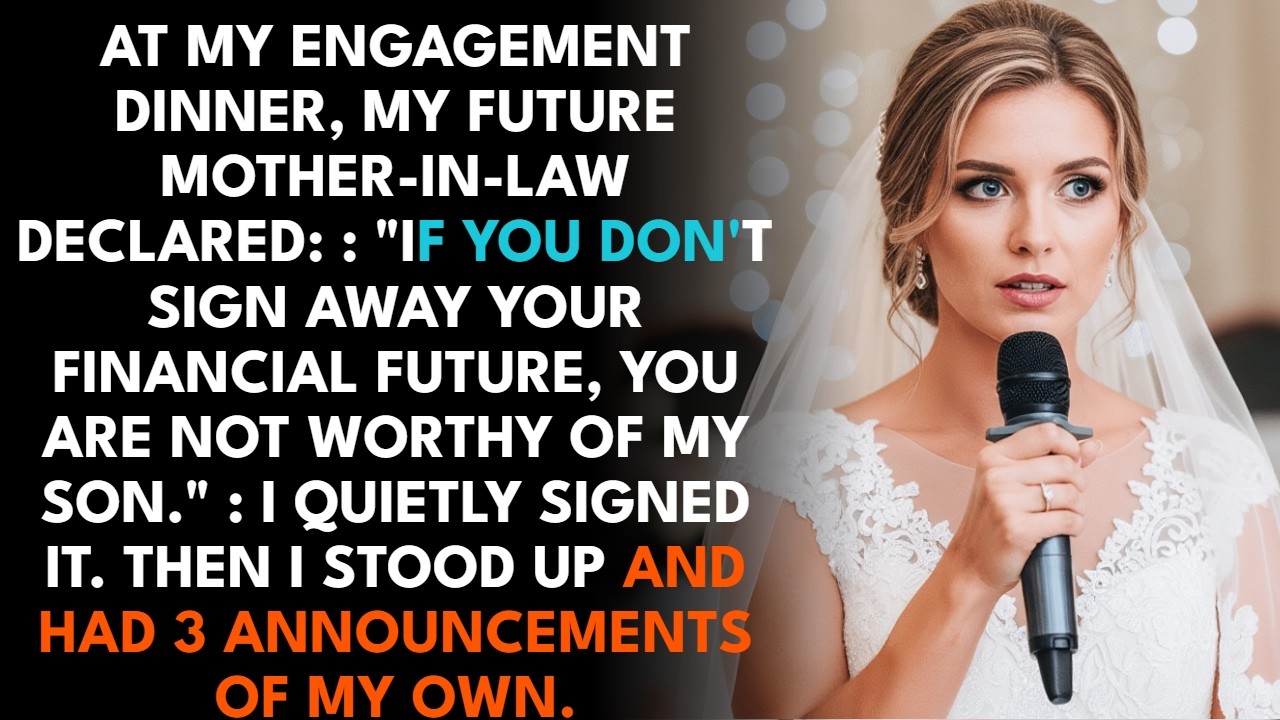
His mother stood at the head of the long table in the Pelham Club’s private dining room, tapping her champagne glass with one manicured nail, and said the words that were supposed to break me. “Before we proceed with the toasts,” she announced, her voice carrying the practiced authority of a woman who had never once been told no, “I have a small formality to attend to. ”
I looked at Reese. He was already staring at his plate.
That told me everything I needed to know. Reese and I had been together for two and a half years. We met at a mutual friend’s birthday party in the fall. He was charming, funny in the way that felt effortless rather than performed, and he had this habit of looking at me like I was the only person in a loud room.
We moved slowly, which was how I preferred it. I was thirty-one, building something I cared about, and I had no interest in compressing myself into whatever shape a relationship demanded. But Reese was patient. He showed up consistently, and after a year I introduced him to my parents, who live a four-hour drive upstate, and who, in that quiet way of theirs, simply asked me if he made me feel safe.
I said yes. I meant it at the time. I met his mother for the first time eight months in, at a Sunday brunch she hosted at her home in Westchester. The house was immaculate in the way that suggested no one actually lived there.
She greeted me at the door, took one long look at me, my blazer, my non-designer bag, my state school alumni pin, and smiled the smile of someone filing a report. She was not unkind. She was something more precise than unkind. She was calibrated.
Every question she asked me over that brunch was a measurement. Where did I go to school? What did my parents do? Where did I grow up?
What was my five-year plan? I answered honestly. I was from a mid-size city in Ohio. My mother was a retired nurse.
My father had run a hardware store for thirty years. I had a master’s in computer science. I was working in tech. She nodded slowly after each answer, the way someone nods when they’ve confirmed a suspicion.
After brunch, when Reese walked me to my car, I told him his mother didn’t like me. He laughed it off. “She just takes time to warm up,” he said. I didn’t argue, but I noticed.
Over the following year, his mother never warmed up. She included me in family events, but in the way a host includes an unfamiliar guest, present, acknowledged, not quite belonging. She mentioned frequently the women Reese had dated before me, women from families she knew, women with the right connections. She never said it directly, but she didn’t need to.
The message was consistent. When Reese proposed, quietly, in my apartment, with a ring I later found out he had gone into significant debt to purchase, I said yes. I loved him. I still believed the good in him outweighed the part that bent under his mother’s gravity.
The engagement dinner was her idea. Forty-three people. Her side of the family, their social circle, Reese’s colleagues, a few couples whose names I had heard but whose faces I was still learning. My parents drove in the night before.
They dressed carefully. My mother wore the blue dress she saves for occasions she wants to honor. My father ironed his shirt twice. The Pelham Club was a private members establishment in midtown that she had belonged to for twenty years.
The private dining room had oak paneling, low lighting, and oil paintings of landscapes that probably had names I didn’t know. Every detail of the evening had been arranged by her, down to the menu and the seating chart, which placed my parents at the far end of the table, partially hidden behind a large floral arrangement. I noticed that, too. We were an hour into dinner, salmon, a second round of wine, the light kind of conversation that fills a room without meaning anything, when she stood up.
She was wearing a deep emerald gown. Her hair was set. A single strand of pearls that her late husband had given her for their thirty-fifth anniversary. She looked like the evening had been designed around her, which, in every practical sense, it had.
She tapped her glass once, twice. The room quieted. “Before we proceed with the toasts,” she said, “I have a small formality to attend to. ”
She reached down to her chair, where I now saw a leather portfolio resting against the leg.
She lifted it onto the table, unzipped it with the careful deliberateness of someone who had rehearsed this moment. Inside was a document, thick, bound, color-tabbed. “Reese is our only son,” she began. “Our family has built something over four decades, and it matters deeply to us that it is protected.
Not out of distrust. ” She looked directly at me as she said this, her smile never shifting. “But out of love. True love requires honesty.
”
She walked around the table to where I was sitting. Forty-three people watched. My mother’s hand moved slightly toward mine under the tablecloth, and then stopped, because she didn’t want to embarrass me by showing that I needed steadying. She placed the document in front of me.
“This is a prenuptial agreement,” she said, still addressing the room as much as she was addressing me. “It’s quite standard. It protects the family’s existing assets, the properties, the business holdings, and simply clarifies what both parties retain in the event that the marriage doesn’t work out. ”
She paused.
“Reese has already reviewed and signed it. ”
I looked at the last page. His signature was there, dated three days ago. So, this was not spontaneous.
This was a plan. I was just the last one to be told about it. “I thought it would be a lovely gesture to sign it tonight,” she continued, her voice soft as a spring breeze, “in front of everyone who loves you both. A fresh start.
No secrets. ”
She produced a pen from the portfolio and set it beside the document with a small, decisive click. The room was very quiet. Forty-three faces waited.
Some looked away. Some stared directly at me. I looked at Reese. For just a moment, his eyes met mine.
And then, very deliberately, he looked back down at his plate. I pulled the document toward me and began to read. What was inside was not standard. The agreement stated that I would make no claim on any property or business holding acquired during the marriage, regardless of contribution.
That I would receive no spousal support in the event of divorce. That any intellectual property I developed while married, any company, any patent, any product that benefited from marital resources in any way, would be subject to joint claim by the family. In other words, I would come in with nothing and be entitled to leave with nothing, while anything I built could be absorbed. At the far end of the table, behind the flowers, my parents sat very still.
My mother’s face had gone to that careful blank of someone holding something back with everything they have. My father’s jaw was set. They had not been told this was coming. Neither had I, not officially.
From somewhere near Reese’s cousin’s end of the table, I heard a whispered laugh. Brief, barely concealed. I read to the last page. I took the pen.
There were three things I thought about as I signed my name. The first was eighteen months ago, when Reese had called me at eleven at night, his voice low and tight, to tell me that his family’s flagship venue had lost two major contracts in the same month and they were going to miss payroll. He hadn’t asked me directly. He had just told me, and I had transferred two hundred seventy-five thousand dollars from my personal account to a holding account the following morning with a promissory note.
Notarized, witnessed, that he had signed without hesitation because he needed the money and trusted I would never actually use it. The second was the company I had been quietly building for four years. A wellness and productivity tracking platform sold to corporate HR departments. My co-founder and I had kept our names off the early press releases because we were still negotiating, and because a woman’s successful venture attracts a particular kind of interference before the paperwork is airtight.
The acquisition had closed nine days ago. The cash consideration for my stake was eight point seven million dollars. The third was the document I was signing. Which I signed not to preserve this relationship, but because signing it was the first step in the only plan that actually mattered now.
I capped the pen and set it down. The room exhaled. His mother received the portfolio from my hands with a satisfied nod. She tucked it under her arm and began the graceful walk back to her seat.
The walk of a woman who had gotten exactly what she came for. The table stirred, forks lifted, voices resumed. The moment appeared to be over. I pushed my chair back and stood up.
Reese reached for my arm. “What are you doing? ” he said under his breath. “Sit down.
”
I looked at him for one long moment. Then I picked up the butter knife from beside my plate and tapped it against my water glass. The room quieted again. “Thank you,” I said.
My voice was clear and steady. “I appreciate everyone being here tonight. I have three things I’d like to share before the evening continues. ”
His mother stopped walking.
She turned. “The first. ” I looked at Reese, who was staring at me with an expression I hadn’t seen on his face before. Something caught between panic and calculation.
“Effective right now, our engagement is over. This wedding will not take place. ”
The silence lasted exactly two seconds. Then the room came apart.
Reese shot to his feet. “Sit down,” he said, louder now, the politeness entirely gone. “You signed the paperwork. It’s done.
”
“I signed it,” I said calmly. “Yes, I’ll come back to that. ”
His mother had turned and was moving toward me with the controlled speed of someone refusing to appear to hurry. The composure on her face had gone rigid, like lacquer applied over something cracking underneath.
“This is not appropriate,” she said, very quietly, very pointed. “You signed a legal agreement in front of witnesses. There is nothing further to discuss. ”
“I’m not discussing anything,” I said.
“I’m making announcements. I have two more. ”
Several guests had already raised their phones. I had expected that.
“Second. ” I reached into my evening bag and removed a single folded page I had placed there that morning. I unfolded it and held it so the room could see, though the text was too small to read at distance. “Nine days ago, the company I co-founded was acquired.
The terms are confidential, but my stake is valued at eight point seven million dollars. The funds are currently in escrow and transfer to my personal account next week. ”
The room went completely still. I set the page on the table in front of my empty chair.
“I mention this not to make a point about money, but because several assumptions were made here tonight about my circumstances that turned out to be inaccurate. I wanted to correct the record. ”
At the far end of the table, behind the floral arrangement, my father set down his fork very slowly. My mother pressed both hands flat to the tablecloth.
Neither of them moved. His mother’s face had changed. Not dramatically. She was too practiced for that.
But the calculation behind her eyes had shifted into something that looked, for the first time all evening, like uncertainty. “That’s…” Reese started. He stopped. “Third,” I said.
He sat back down. “Eighteen months ago, I transferred two hundred seventy-five thousand dollars into a holding account at Reese’s request to cover a payroll shortfall at the family’s venue business. I did this under a signed and notarized promissory note. The repayment date specified in that agreement is today.
”
I paused for exactly one beat. “With the contractual interest applied, the amount currently owed is three hundred forty thousand dollars. My attorney sent a formal demand letter to Reese’s home address this morning. If payment is not received within thirty days, she will file for enforcement and apply for a lien on all assets held in his name.
”
I folded my hands on the table. “That’s everything I wanted to say. The food really is wonderful. I’m sorry for the interruption.
”
I picked up my evening bag, stepped around my chair, and walked toward the far end of the table. What happened behind me I heard rather than saw. His mother’s voice, stripped now of every layer of cultivation, calling my name with a sharpness that had no warmth left in it at all. Reese’s chair scraping back, a glass tipping.
Someone near the middle of the table making a sound that was half gasp, half something that wanted to be laughter and thought better of it. Two guests near the door quietly collecting their things and leaving before whatever came next had a chance to involve them. I reached my parents. My father stood before I got to him.
He didn’t say anything. He just stepped in front of me the way he used to when I was small and something in a parking lot was moving too fast. My mother took my hand. Her palm was cold.
She’d been holding it pressed in her lap, and she gripped it hard between both of hers. “You didn’t tell us,” she said very quietly. “I know. I didn’t want to worry you before it was finished.
”
“Eight point seven million,” my father said. He said it the way he used to read numbers out loud from the quarterly reports of his hardware store, careful, deliberate, just making sure they were real. “Yes. ”
He put one hand on my shoulder for exactly two seconds.
My father is not a man who touches people in public. Those two seconds cost him something, which meant they meant everything. “All right,” he said. “Let’s go.
”
We walked out of the private dining room at the Pelham Club, past the oil paintings and the oak paneling and the maître d who held the door with the professional composure of someone who had witnessed worse. Behind us, I could hear his mother’s voice rising, and Reese saying my name over and over, the syllables losing their shape the more he repeated them. I did not look back. My father pulled the car around.
My mother and I waited on the sidewalk while the city moved past us, indifferent and continuous. It was cold. I had left my coat inside. She offered her wrap before I could say I was fine, and I took it this time without arguing.
We drove in near silence for twenty minutes. My father’s hands were steady. My mother sat beside me in the back and kept hold of my hand. Not because she thought I needed it, I think, but because she did.
“The loan,” she said eventually. “When did you… you never mentioned it. ”
“I didn’t plan to use it. I thought we had a future together.
It felt like helping someone I loved. ”
I paused. Then I started seeing how things were structured. What his mother expected from the beginning.
What Reese was willing to let happen to keep the peace with her. And I realized the money was only one part of what I was being quietly asked to give up. My father’s eyes found mine in the rearview mirror. “You had already decided before tonight,” he said, not a question.
“I decided when I saw his signature on those documents dated three days ago,” I said. “He had three days, and he didn’t call me. He didn’t warn me. He just let tonight happen.
”
I looked out the window at the dark highway. “Tonight was just the closing statement. ”
My mother made a sound I can’t quite describe, relief and grief pressed together the way a long-held knot feels when it finally lets go. My phone was buzzing in my bag.
I took it out and looked. Fifty-two missed calls from Reese in the time we had been in the car. A long string of texts, the kind that reveal a person’s character by the order in which things occur to them. First disbelief, then self-justification, then reframing himself as the victim of my planning, then, near the bottom, “I can’t pay that money back and you know it.
Please don’t do this to my family. ”
I read them all. Then I went to his contact, held it down, and deleted it. I blocked the number.
I sent my attorney a text that said, “Please proceed. ” Then I put my phone face down in my lap and watched the road home. What happened to the family in the weeks that followed reached me in pieces. From mutual acquaintances.
From one of his cousins, who had apparently found the whole spectacle more darkly amusing than tragic. And eventually from a brief item in a business blog that covered private event venues in the tri-state area. His mother attempted to contest the promissory note, arguing that the transfer had been informally structured and constituted a gift rather than a loan. My attorney replied within forty-eight hours with the notarized original document, the wire transfer confirmation, two witness statements, and a note that the thirty-day repayment window was running.
The family’s attorney did not write back. The debt was settled in full within twenty-six days. I did not know how they raised it. I did not ask.
I heard that the dinner had been captured on several guests’ phones and had made quiet rounds through the social circles where his mother had spent a lifetime carefully building her reputation. I heard that she had given an interview to someone she believed to be sympathetic and had instead revealed herself to be precisely as she was. I heard that two of the venue’s long-standing corporate clients had declined to renew. I did not feel triumphant when I heard these things.
I felt something quieter. The particular stillness of something that had been loud inside me for a long time finally going calm. Six weeks after that evening, I was in a meeting with a group from a private equity firm that had reached out about a co-investment opportunity on a project adjacent to what I was building next. It was a Tuesday morning, unremarkable.
The managing director came in last. His name was Bowen. He was calm in the way that capable people are calm. Not performed ease, but the actual thing, the absence of wasted motion.
He had read everything before he arrived. His questions were specific and well-aimed. He did not waste my time, and he seemed to register that I noticed. After the meeting, while the others were filing out, he held back for a moment.
“I was at the Pelham Club in March,” he said. He said it simply, without drama, as though stating a piece of context that was relevant to where we were now. “I didn’t put it together until I read your bio this morning. ”
I looked at him.
“Were you one of the ones recording? ”
A brief pause. “No, I was one of the ones who left early. ”
“Smart call.
”
“I thought so at the time. ”
He held out a business card. It was the plain kind, a name, a title, a number, nothing else. “I’d like to be in the room for whatever you’re building next, if you’re open to the conversation.
”
I took the card. “I’ll think about it. ”
He nodded once, collected his things, and left. I looked at the card for a moment, then slid it into the front pocket of my wallet behind my transit card, where I keep things I actually intend to use.
My mother called that evening. She did that more now, called without a reason, just to talk without making it feel like checking on me. We covered an hour easily. Her garden.
A book she’d been reading. A neighbor’s dog who had developed a truly inconvenient talent for escaping through the fence. Near the end of the call, she asked how I was doing. Not in the careful, searching way she had been asking since March, the way that really meant, Are you all right?
Are you falling apart? Just in the ordinary way. The way that meant she thought I might actually be fine. “I feel like myself again,” I said.
“I forgot for a while that that was still an option. ”
She was quiet for a moment. Then, “Your father talked about you last week. He doesn’t, you know how he is.
He doesn’t say things directly, but he told me he has never been more proud of anyone in his life. ”
I put the phone down for a moment. I picked it back up. “Tell him thank you.
”
“Come tell him yourself. Visit soon. ”
“I will. I promise.
”
After I hung up, I stood at my kitchen window for a while looking out at the street below. The city was doing what it always does, moving, continuous, alive, without asking anyone’s permission. Cabs cutting through intersections. A street light throwing yellow light onto wet pavement.
A couple walking a dog that was in a tremendous hurry to get somewhere. I thought about the woman who had walked into the Pelham Club six weeks earlier carrying a non-designer bag, a folded page in her evening wallet, and no intention of becoming the cautionary tale anyone in that room was expecting. I thought about what it costs to be underestimated by the wrong people for long enough that a quiet part of you starts to wonder if they might have a point. They never have a point.
That is the thing worth holding on to. Not the money. Not the specific satisfaction of watching an elaborate trap fold in on itself and become the instrument of its own unraveling. Those things are real, but they’re not the thing that lasts.
The thing that lasts is the knowledge that they were never right about you. That you knew it even on the nights when it was hardest to know. That when the moment came, you didn’t run, and you didn’t beg, and you didn’t disappear quietly into whatever version of yourself was easier for other people to manage. You walked to the microphone.
You said what was true. And then you went home.