The earliest chemically confirmed evidence of deliberate cannabis intoxication comes not from a palace or a royal tomb, but from blackened wooden bowls found in a mountain cemetery on the Pamir Plateau, in what is now western China. At the Jirzankal Cemetery, roughly 3,000 meters above sea level, archaeologists recovered wooden braziers with burned interiors. Inside them, they found stones that had been heated intensely, and chemical analysis detected residues of cannabinoids, specifically the degradation product CBN, indicating that cannabis with high levels of psychoactive compounds had been burned in these vessels around 500 BCE. This discovery does not represent the first time humans used the plant, but it offers the strongest evidence for when people deliberately inhaled its smoke in a structured ritual.
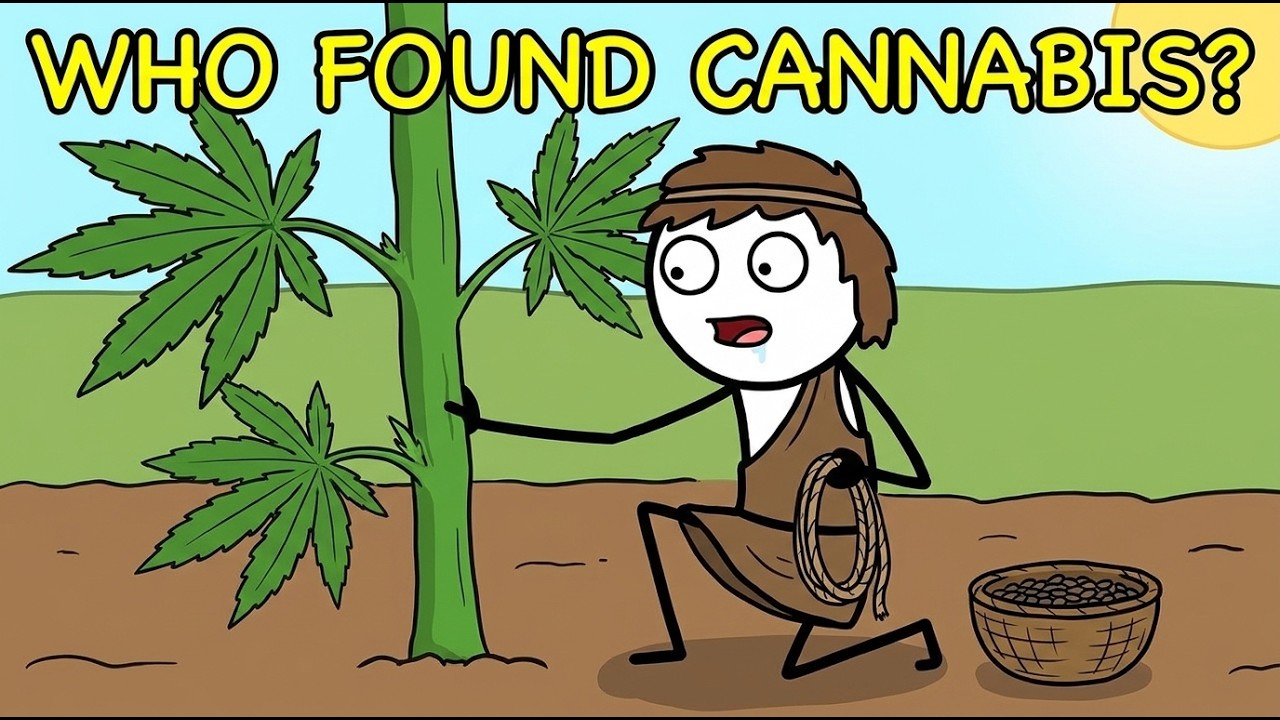
Reconstructing the true origins of human-cannabis interaction requires treating several distinct discoveries as separate events. The plant was valuable as food, fiber, medicine, and a mind-altering substance, and these uses developed at vastly different times and places. Cannabis has grown in Asia for millennia, but its exact wild origin is hard to pinpoint because humans have cultivated, moved, and abandoned it for so long. As an annual plant that thrives in disturbed soil, it likely grew naturally near human settlements.
Ancient people would have noticed its nutritious seeds, strong stem fibers, and, in some plants, a powerful resinous smell. Crucially, not all cannabis plants produce the same effects. Wild and fiber varieties contain far less THC, the main intoxicating compound, than modern drug strains. For a psychoactive effect to occur at all, the acidic precursor THCA must be converted into active THC through heat, in a process called decarboxylation.
Even then, an open campfire disperses smoke and destroys active compounds, so a dramatic effect would have required the right plant, controlled heat, and an enclosed space. This demanding combination explains why humans could live beside cannabis for centuries without discovering its more profound properties. Evidence for the plant’s earliest usefulness points to fiber and food. Cannabis stalks, after a process called retting, produce bast fibers suitable for cord, rope, nets, and cloth.
This may have been cannabis’s first great attraction, although fiber leaves poor archaeological evidence. Seeds survive better, especially when charred, but identifying a single seed does not reveal whether people cultivated the plant, gathered it wild, or valued it for food rather than intoxication. Genetics adds another layer of understanding, and one major genomic study proposed that the ancestors of modern hemp and drug-type cannabis separated from a basal domesticated population roughly 12,000 years ago in East Asia. This places early domestication near the dawn of agriculture.
However, genetic dates are models based on living genomes and population assumptions. They estimate when lineages diverged, not what a person did with a plant on a specific day. Early cultivators may have selected for seeds, fiber, or both, and selecting for tall, strong stems can actually pull a plant away from high THC production. The plant’s reproductive biology shaped its many uses.
Cannabis often has separate male and female plants, and female flowers produce resin rich in compounds. Unfertilized females continue investing in resin instead of seeds, and at some point people learned to favor certain plants, gradually separating the plant’s personalities into rope, food, medicine, and a substance used in rituals. Later Chinese traditions attribute the first use of medical cannabis to the legendary ruler Shennong, often dated to around 2700 BCE, but the herbal work associated with him was compiled much later, probably in the early centuries of the common era. Early Chinese texts do show hemp’s cultural importance as a crop and fiber source, and later pharmacological texts discuss potentially powerful effects of certain plant parts.
Yet, the terms used did not always specify a high-THC plant, and a preparation using seeds might have had no intoxicating purpose. Writing only entered the room later and began taking credit for discoveries that predated it. The first substantial physical evidence of humans collecting potent cannabis comes from the Yanghai tombs near Turpan in northwestern China. Around 2,700 years ago, a man was buried with roughly 789 grams of prepared plant material contained in a leather basket and wooden bowl.
The desert preserved the material well enough for researchers to examine its physical features, chemistry, and genetics. The cannabis was consistent with a variety valued for psychoactive properties. The larger stems and male plant parts had been removed, while the resin-producing structures remained, and chemical analysis found evidence of THC-related compounds, although thousands of years of oxidation had altered the chemistry. The man was buried with writing equipment, weapons, and musical instruments, leading researchers to suggest he may have had a ritual role.
The grave proves deliberate collection and value, but it does not prove how the cannabis was consumed, as no pipe or smoking device was found. The Jirzankal cemetery provides the missing evidence. Around 500 BCE, people there placed hot stones inside wooden containers, added cannabis, and allowed it to smolder inside an enclosed space, producing smoke that participants inhaled during funerary ceremonies. Cannabinoid markers appeared on nine of ten braziers recovered from eight tombs.
The site lay near major routes connecting communities across Central Asia, and isotope evidence shows some people buried there had grown up elsewhere, suggesting that knowledge of cannabis may have traveled through the same networks. The evidence cannot say whether these plants were cultivated for THC or gathered from unusually potent wild populations, but preparing multiple braziers in multiple tombs was clearly intentional knowledge with a procedure and a setting. The Greek historian Herodotus, writing in the 5th century BCE, described a strikingly similar practice far to the west. He claimed that the Scythians placed hemp on red-hot stones beneath felt coverings, producing a vapor that made participants shout with delight.
He interpreted this as a cleansing bath after burial, and archaeology has since found related equipment in Scythian contexts, including frames, coverings, vessels, stones, and cannabis seeds. Herodotus was an outsider reporting an unfamiliar ritual, but his account shows that cannabis fumigation had become established across parts of the Eurasian Steppe by the first millennium BCE. Cannabis later appeared in medical and ritual traditions across South Asia, where preparations called bhang developed deep cultural and religious importance. In the ancient Near East, the term kunubu has been proposed as a cannabis reference, but ancient plant names are unreliable, and a linguistic resemblance is suggestive rather than conclusive.
In Egypt, claims of cannabis in pharaonic medicine and mummies are much weaker, and previous claims of cannabinoid traces have faced serious questions about contamination and interpretation. By the Greek and Roman periods, medical writers like Dioscorides described hemp more clearly, especially its seeds, and noted medicinal applications, but physicians were writing about plants that generations of healers had already experimented with. The discovery of psychoactive cannabis likely followed several plausible paths. Accidental burning is one: resin-rich flowers entering a poorly ventilated fire could produce an unmistakable effect, but an accident does not create a tradition unless someone remembered the plant part, season, dose, and setting, and convinced others it was meaningful.
The medicinal path is another: people testing plants for pain or sleep may have noticed mental effects, but ingested cannabis behaves differently from inhaled cannabis, and the delayed onset creates its own problems. Deliberate selection is a third path, as farmers noticing desirable variation could save seeds and spread them. Cultural contact is a fourth: communities growing low-THC hemp might have met traders carrying resin-rich cannabis, discovering not a new species but what someone else had already shaped. By the time archaeology catches humans at Jirzankal, they were no longer experimenting.
The hot stones were ready, the braziers were carried into tombs, the correct plants had been chosen, and the mourners understood what came next. They inhaled beside the dead, perhaps to soften grief or to open a path between worlds. The chemical residue cannot tell us their beliefs, but it tells us that 2,500 years ago people were deliberately changing consciousness together. The discovery had moved from plant to practice, from practice to ritual, and from ritual to memory.
As for when humans first discovered cannabis, the answer depends on what kind of discovery is meant. If it means encountering the plant, people in Asia may have known wild cannabis deep in prehistory. If it means domesticating it, genomic research points to East Asia around 12,000 years ago, although this remains a model. If it means using it as food or fiber, the relationship lasts many thousands of years.
If it means collecting potent cannabis for ritual or medicinal purposes, the Yanghai tombs provide evidence from about 2,700 years ago. And if it means deliberately heating psychoactive cannabis so a group could inhale it, Jirzankal gives the clearest early proof from around 500 BCE. This is the oldest secure evidence, but it is not necessarily the first event. Archaeology preserves a tiny, unfair sample of human behavior.
Cannabis leaves decay, smoke vanishes, wooden pipes burn, and leather containers rot. The first users may have lived centuries or millennia earlier and left no surviving residue. The chemical trace in a brazier marks the earliest moment we can confidently see, not the moment the idea was born. The original discovery probably had no date, no king announced it, and no healer filed a report.
Someone simply noticed that one plant made stronger rope, another produced seeds worth keeping, and another changed the room. Then they showed someone else, and that second person may be more important than the first. An accidental effect becomes human knowledge only when it can be remembered, repeated, taught, and fitted into a culture.

