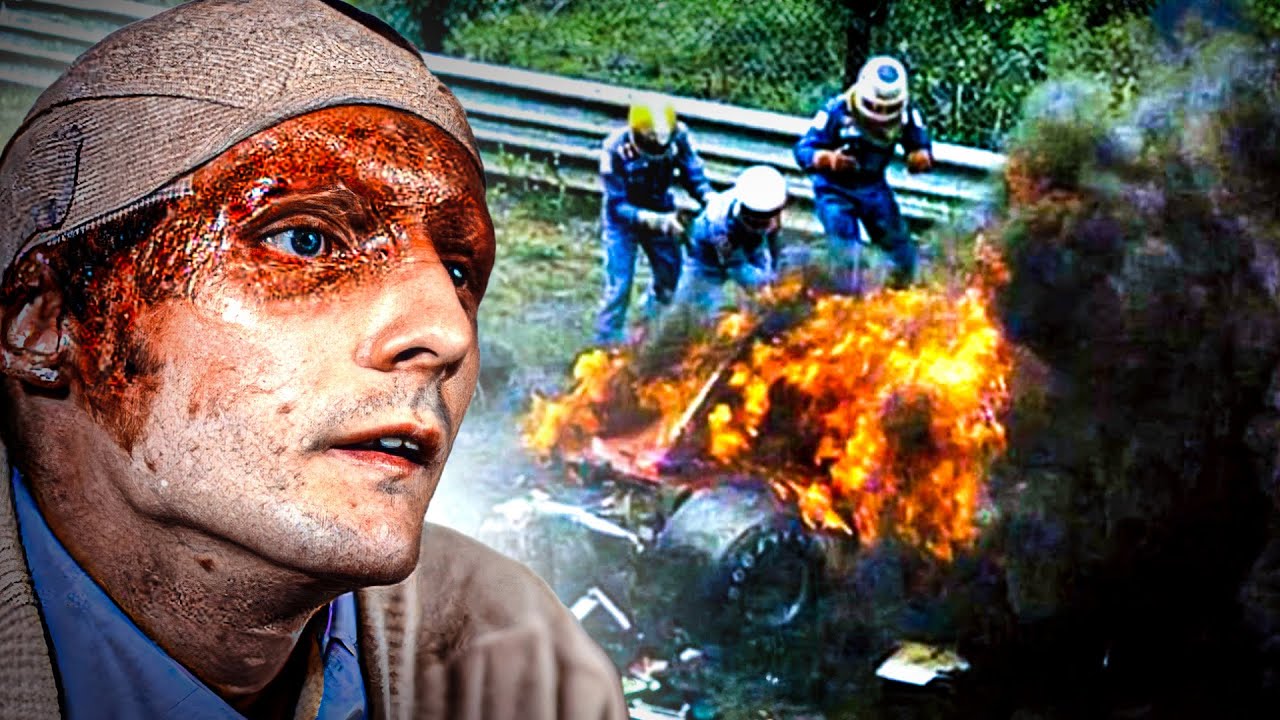
The roar of the V12 Ferrari engine was a promise of glory, a sound that had come to define the 1976 Formula 1 season for Niki Lauda. But on August 1st, at the notorious Nürburgring, that mechanical symphony turned into a death knell. In the span of 55 seconds, the reigning World Champion was trapped inside an inferno, his body consumed by flames, his life hanging by a thread that only sheer willpower and the bravery of fellow drivers would keep from snapping.
The German Grand Prix was supposed to be a coronation. Lauda had dominated the season, amassing 61 points against his rival James Hunt’s 16. The Austrian, known for his clinical precision and ruthless calculation, was on the verge of securing back-to-back titles for Ferrari.
 Yet, the Nürburgring, a 14-mile behemoth winding through the Eifel Mountains, was a track he desperately feared. He had been vocal in his opposition to racing there, citing deplorable safety standards, insufficient fire crews, and a track layout that was a relic of a bygone era. His warnings were unheeded, his peers outvoting him in a drivers’ association meeting that would haunt them forever.
As the cars lined up on the grid, a light drizzle fell. Lauda, ever the pragmatist, chose to start on wet-weather tires, a decision that proved immediately costly. The track dried faster than expected, forcing him to pit after the first lap for slick tires.
He rejoined the race with a fury, his red Ferrari tearing through the field in a desperate attempt to reclaim lost ground. It was a move of pure aggression, but the cold tires lacked grip. At the fast left-hand kink of Bergwerk, the rear stepped out, and the car veered off the racing line, slamming into an earth bank before careening back onto the track.
The impact sheared off a significant portion of the car, rupturing the fuel tank. With a full load of petrol onboard, the Ferrari instantly became a blazing torch, skidding across the asphalt in a maelstrom of fire and smoke. Lauda, still conscious, was strapped into his seat as the flames began to lick at his exposed skin.
His helmet offered some protection, but his hands, his head, and his torso were vulnerable to the searing heat that melted his visor and ignited his overalls. He was trapped, a prisoner in a burning tomb, with only seconds separating him from a fate too horrific to fathom.
Brett Lunger, a former US Marine and Vietnam War veteran, was approaching the scene at high speed. He saw the accident, braked as hard as he could, but collided head-on with the wrecked Ferrari, further redirecting the burning car toward the track’s edge. Unscathed by the impact, Lunger leaped from his own car and sprinted toward the blaze.
It was a scene of chaos, with marshals seemingly absent and the fire extinguishers on hand pitifully inadequate for a fuel-fed blaze of this magnitude. Lunger, knowing time was critical, struggled to pull Lauda free but was beaten back by the intense heat and fumes.
The situation was desperate. Lauda’s screams were masked by the roar of the fire, his body instinctively fighting against the harness that held him in place. Fellow driver Guy Edwards managed to grab a fire extinguisher and sprayed the cockpit, but the flames were too powerful.
It was then that Arturo Merzario, a former Ferrari driver and a personal friend, arrived. He had witnessed the crash from behind and, with no regard for his own safety, plunged into the fiery wreck. The heat was so intense that his own overalls began to singe, but he was driven by a singular focus: he had to get Lauda out.
Merzario found the six-point harness buckled tight. Lauda was in agony, straining against the belts, his body trying to escape the enveloping flames. His fingers were already burned to the bone, his tendons exposed, making it impossible for him to release himself.
Merzario tried desperately to flick the central buckle, but the pressure from Lauda’s struggling body made it impossible. The seconds ticked by—an eternity of blistering heat and toxic smoke. Finally, as the flames intensified, Lauda lost consciousness.
His body went limp, and only then could Merzario, along with Lunger, free the buckle and drag him from the cockpit.
The moment Lauda hit the open air, his burns were visible. His scalp was charred, his right ear was all but gone, and his eyelids had been burned away, leaving his eyes exposed. He had been inside the fire for 55 seconds, a duration that would permanently etch itself into his identity.
He was airlifted to a hospital in Mannheim, where his condition was deemed critical. The doctors fought to stabilize him, but his lungs were filled with toxic fumes and his body was wracked with infection. A priest was called to his bedside to administer the Last Rites, a grim gesture that suggested the end was near.
 The motorsport world began to prepare for his funeral.
Three days later, against all medical probability, Lauda opened his eyes. His first words, delivered with the same dry, cutting wit that defined his career, were a message to the priest: “Tell the priest I’m still alive.” His survival was a testament to his monstrous physical constitution, but the road back was far from over.
When he was finally well enough to ask a nurse for a mirror, she hesitated. He insisted. She switched on a neon light, and Lauda saw the full extent of the damage.
His head had fused into his shoulders due to the heat and swelling, his skin grafted and raw. He later said it “got better and better” merely because he had seen his injuries at their absolute worst.
Despite the horror of his injuries, Lauda’s resolve was unshakeable. Ferrari had already replaced him within days of the crash, a move that enraged the champion, but he was determined to prove them wrong. Just 33 days after the accident, barely able to close his eyes, still swathed in dressings and soaked with sweat, he showed up at the Fiorano test track.
Team manager Daniele Audetto recalled the apparition: “He was like a ghost.” Lauda tested the car and declared himself fit to race, defying every doctor and every expectation that suggested he should never drive again. He finished fourth at the Italian Grand Prix in Monza, a result that was more heroic than any victory he had ever claimed.
The championship fight went down to the final round in Japan. Lauda led Hunt by three points, but the race in Fuji was run in treacherous, monsoon-like conditions. Lauda, his eyes still compromised by the damage to his tear ducts, recognized the danger immediately.
He pulled his car into the pits after two laps, voluntarily retiring from the race, shocking the world. He reasoned that his life was worth more than a title, a decision that ran counter to the supposed “win at all costs” ethos of his rivals. Hunt went on to win the championship, but Lauda’s stock rose higher than ever.
He had faced the abyss and chosen to walk away on his terms, a display of courage that was arguably more profound than his fiery return.
The following year, with a rebuilt Ferrari team, Lauda reclaimed his crown, winning his second championship with a cool, strategic dominance. His career would continue, culminating in a third title in 1984, scored by half a point over his McLaren teammate Alain Prost. He would retire as one of the most decorated and respected figures in the sport’s history.
Yet, the 55 seconds at the Nürburgring were never far behind. The scars on his face, the missing ear, the permanent hat—all were tangible reminders of his dance with death.
Throughout his subsequent career, the crash remained a phantom passenger. He spoke about it often, not with fear, but with a chilling mathematical detachment that was his trademark. The crash influenced his safety campaigns, his management style, and his interactions with other drivers.
He knew, perhaps better than anyone, that the margin between glory and death in a Formula 1 car was measured in fractions of a second. Those 55 seconds taught him the true value of life, a lesson he applied to everything he did afterward, from founding an airline to his return to the paddock as a Mercedes team advisor.
 On May 20, 2019, Niki Lauda passed away. The cause was complications from a lung transplant he had received months earlier, a direct consequence of the toxic fumes he inhaled while trapped in that blazing cockpit. Four decades after the accident, the inferno on the Nürburgring finally caught up with him.
The 55 seconds of death had become a decade-spanning sentence, subtly eroding his body from the inside out. He survived the fire, but he never escaped its fumes.
His legacy is twofold. He is remembered as a three-time World Champion, a master strategist, a visionary in aviation, and a man of brutal honesty. But he is also immortalized by that horrific day in 1976.
It was in those 55 seconds that the mere racing driver transformed into an icon of human endurance. He did not just walk away; he returned, raced, and conquered, all while acknowledging that his greatest victory was simply surviving to see another sunrise. The priest’s visit in 1976 was dismissed, but the pale rider of death was never truly deterred, only delayed.
Lauda, the man who spat at death’s door, bought himself 43 more years of life, and he spent them proving that his spirit was made of something far more durable than bone and skin.
The footage of the crash is grainy, shot from distant camera angles, yet it carries a visceral horror that no modern high-definition broadcast can match. The red dot of the Ferrari, so consumed by the orange fireball, is a stark visual metaphor for a man being erased from the world. When the car finally stops moving, the smoke clears to reveal a skeletal frame of a machine that moments before was the pinnacle of engineering.
It was in that wreckage that Lauda’s will to live was tested and found to be indomitable. The courage of Merzario and Lunger, who risked their own lives to pull a comrade from the flames, is a testament to the brotherhood that exists at the top levels of motorsport, a world where fractions of a second can turn friends into saviors or casualties.
Lauda’s story transcends racing. It is a universal narrative of tragedy, resilience, and redemption. He faced the ultimate fear—being burned alive in a remote forest—and returned to the exact same environment, the exact same car, the exact same high-speed circuit, within weeks.
He refused to let fear dictate his fate, even as his body screamed in protest. Every time he sat in the cockpit after 1976, he was racing not just his competitors, but also the memory of the man he almost became—a charred corpse at the side of a German racetrack.
His marriage of intellect and raw courage was perhaps his greatest weapon. While James Hunt was celebrated for his bohemian charm, Lauda’s approach was cold, analytical, and scientific. He calculated the risks, understood the consequences, and proceeded anyway.
He famously complained about the Nürburgring’s dangers, yet when his peers overruled him, he accepted the democratic decision. It was a decision that nearly cost him his life, and the irony was not lost on the man who always debated safety with a slide rule in his hand. He knew better, he said so, and he was punished for it.
In the years that followed, Lauda channeled his experience into making Formula 1 safer. He lobbied for better fire-resistant materials, improved marshalling, and more robust medical facilities. His voice, amplified by the credibility of his scars, carried immense weight.
He was a living argument for change. The modern sport, with its halo devices and high-tech barriers, owes a debt to the suffering Lauda endured. His accident was a catalyst that forced the sport to confront its own recklessness, transforming it from a gloriously dangerous pastime into a professional discipline obsessed with risk mitigation.
 The narrative of the “rat” who became a champion is also a story of profound self-awareness. Lauda never deluded himself about his appearance or his popularity. He knew he was not the darling of the media like Hunt, nor did he care to be.
He traded charm for competence, ruthlessly optimizing his own performance. The crash, ironically, made him a more sympathetic figure. The public saw a man of immense fragility, a counterpoint to the invincible robot he seemed to be.
The burns and scars humanized the machine, making his subsequent successes feel like collective triumphs for everyone who had ever faced adversity.
As the years passed, Lauda’s presence in the paddock remained a moral compass. He served as a non-executive chairman at Mercedes, acting as a mentor to drivers like Lewis Hamilton and Nico Rosberg. He was the calming influence, the strategic mind, and the enforcer of discipline.
His relationship with the modern generation of drivers was built on mutual respect, forged in the crucible of his own experience. They knew that when Lauda spoke about risk, he spoke with the authority of a man who had been to the edge and dragged himself back. His advice was not theoretical; it was carved into his flesh.
His death in 2019 triggered an outpouring of grief from the global sports community. Tributes poured in from all corners of the world, praising not just his driving, but his character. He was a man who told the truth, even when it was painful, and he demanded the same from others.
The lung transplant that failed was a final, cruel irony—a reminder that the choices made in a split second in 1976 had eternal consequences. The toxic fumes he breathed while helpless were the slow poison that ended his life. He survived the fire, but the smoke followed him to the end.
The story of those 55 seconds is not just a story about racing; it is a story about the precariousness of existence. It reminds us that our lives can change irrevocably in the blink of an eye, and that our responses to such cataclysms define who we are. Lauda’s response was to fight, to refuse, and to return.
He did not allow the crash to be the end of his story; he forced it to be a chapter, a grueling ordeal that he overcame and then used as a foundation for everything else he achieved.
His legacy endures in the safety standards of the sport, the culture of transparency, and the mythos of the comeback. Every driver who straps into a modern Formula 1 car benefits from the 55 seconds that Lauda spent in hell. The fire-resistant suits, the quick-release harnesses, the extrication procedures—all were improved in the wake of his accident.
He did not just survive for himself; he survived to ensure that no one else would have to endure the same ordeal. That is the true measure of his impact.
Niki Lauda was not a man who lived under illusions. He saw the world as it was, with all its imperfections, and he navigated it accordingly. The 1976 crash stripped away any final vestiges of naivety.
He knew the score, he knew the odds, and he played the game with a grim determination that was fascinating to witness. He was a man who outran death, not once, but for four decades, until the remnants of that fiery day finally caught up with him. His story is a testament to the power of the human will, and it will be told for as long as motorsport exists.