My fingers were numb as I stared at the lab results. Ethylene glycol. I read the words again and again, because I needed to be sure. Ethylene glycol, the main ingredient in antifreeze, found in the herbal tea leaves my husband kept in a sealed tin on the top shelf of our kitchen cabinet.
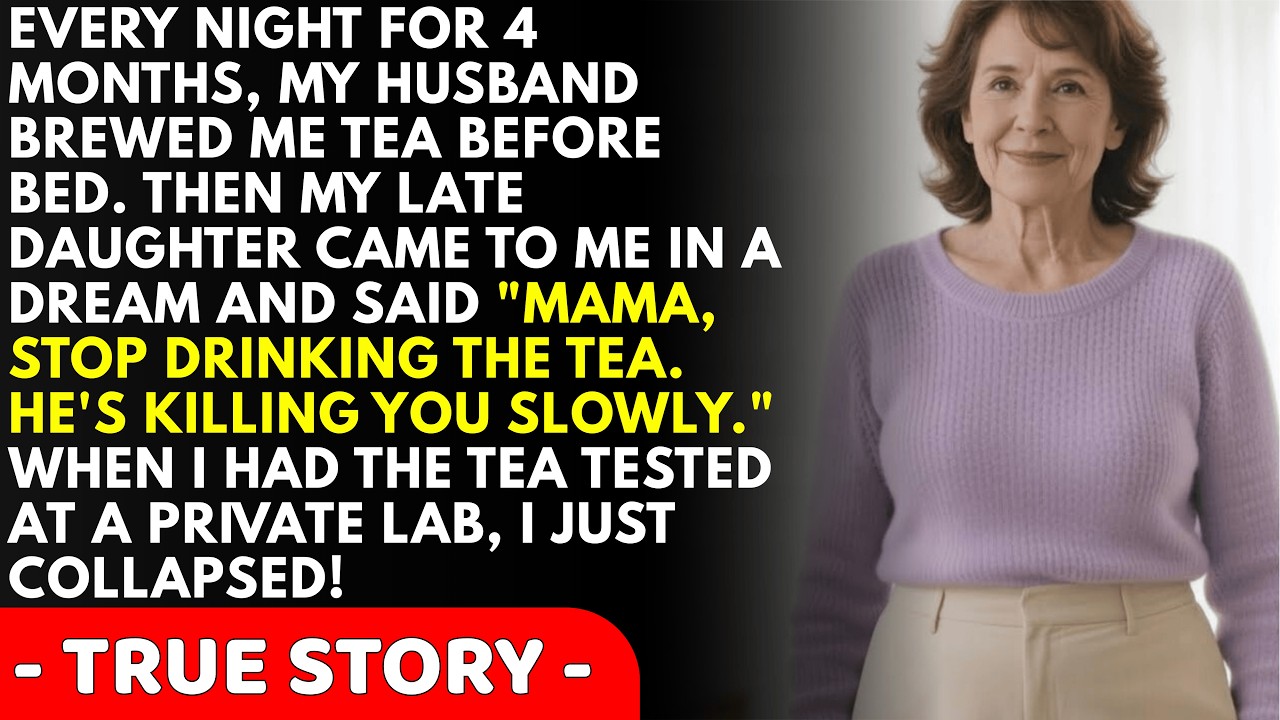
The tin only he ever touched. The tea he brewed for me every single night for the past four months, setting it on my nightstand with a kiss on my forehead. Three nights ago, my daughter came to me in a dream. Her voice was sharp and desperate.
“Mama, stop drinking the tea. He’s killing you slowly. Please, Mama, stop drinking the tea. ”
My daughter has been dead for three years.
And now I know why. My name is Dorothy Callahan. Everyone has called me Dot since I was a girl in Decatur, Georgia. I’m sixty-four years old, and I spent thirty-eight years as a registered nurse at Emory University Hospital.
I’ve held the hands of dying patients. I’ve watched families crumble under grief. But nothing prepared me for what was happening inside my own home. Robert and I married in 1985.
We were both twenty-three, full of that reckless optimism young people have when they think love is enough to carry them through anything. For a long time, it was. We built a brick house on a quiet street in Marietta, a garden I loved, two children. Our son Patrick is forty now, lives in Denver, works in construction management.
He’s steady, reliable. The kind of man who shows up when he says he will. And then there was Sarah. My youngest, my baby girl.
She became a veterinarian because she said animals were more honest than people. She had this laugh that filled whatever room she was in. She married Kevin Price when she was twenty-eight. Kevin was charming.
I’ll give him that. Good-looking, polite, came from a decent family in Savannah. He worked in pharmaceutical sales, traveled a lot, made good money. Robert liked him right away.
They’d watch football together, go fishing on weekends. Sarah and Kevin had a son, Tyler. He’s six now, the spitting image of his mother. Same dark curls, same stubborn chin, same way of tilting his head when he’s thinking hard.
Tyler is the reason I get up in the morning. He’s the reason I kept going after Sarah died. Sarah drowned three years ago. That’s what the police report said.
Accidental drowning at the lake during a family camping trip. She’d gone for a swim alone at dusk. Kevin said she’d been drinking wine with dinner and must have gotten a cramp or misjudged the current. They found her the next morning, floating face down near the dock.
I didn’t believe it. Not fully. Sarah was a strong swimmer. She’d been on the swim team in high school.
She wouldn’t have gone swimming alone in fading light after drinking. It wasn’t her. But grief does strange things to judgment. Robert told me I was in denial, looking for someone to blame.
The therapist said the same thing. Even Patrick gently suggested I was struggling with complicated grief. So I let it go. I buried my suspicion with my daughter.
Kevin collected seven hundred and fifty thousand dollars from Sarah’s life insurance policy. Robert explained it was standard. Sarah was young, healthy, the primary earner in the household. Within eight months, Kevin sold the house and moved into a modern condo in Buckhead.
He sent Tyler to private school. He bought a new car. And he started coming to our house more. Not for me, for Robert.
Investment planning, Robert called it. He said Kevin needed guidance managing Sarah’s money, that he was helping him make smart choices for Tyler’s future. I was too sick to question much of anything. It started about four months ago.
A tiredness that went beyond normal fatigue. Then nausea in the mornings, sometimes so bad I couldn’t eat breakfast. My joints ached. My vision blurred.
Headaches that wrapped around my skull like a vice. Robert was concerned. He made me doctor’s appointments, drove me himself, sat in the waiting room with a worried expression. The doctor ran blood panels, checked my thyroid, tested for autoimmune conditions.
Everything came back inconclusive. Stress and age, the doctor said. Try to get more sleep. That’s when Robert started making the tea.
A tin of loose leaf herbal tea from a specialty shop downtown. His former coworker had recommended it for sleep. Chamomile and valerian root. He brewed it fresh every night, brought it to me in bed, watched me drink it.
It had a slightly sweet, almost syrupy taste I didn’t love but didn’t hate. Robert said that was the valerian. Give it time, he said. It’ll help.
I drank it every night for four months, and I kept getting sicker. The first dream came on a Wednesday. I was standing in Sarah’s old childhood bedroom, the walls still that pale yellow we’d painted when she was twelve. Sarah was sitting cross-legged on the bed, wearing the blue sundress she’d worn at Tyler’s first birthday party.
She looked at me with those clear brown eyes and said, “Mama, pay attention. Something’s not right. ”
I woke up crying. Of course something’s not right.
My daughter was dead. I was sick. Nothing had been right in three years. The second dream came five days later.
Sarah was standing by the kitchen stove, arms crossed, face tight with frustration. She looked older, the age she would have been now if she’d lived. “Mama, listen to me. The tea.
Stop drinking the tea he gives you every night. Something is in it. It tastes like death. ”
I sat up gasping.
Robert was asleep beside me, snoring softly, his face slack and innocent in the moonlight. On my nightstand sat the half-finished cup of tea. I stared at it until something cold moved through my stomach that had nothing to do with nausea. I told myself it was just a dream.
Grief and illness mixing together. The dead don’t warn the living. But I didn’t finish the tea that night. I poured it down the bathroom sink when Robert wasn’t looking.
The third dream came two nights later. I was in a place I didn’t recognize, somewhere white and vast. Sarah grabbed both of my hands. I could feel her fingers, warm, real.
The calluses on her palms from years of working with animals. The small scar on her left thumb from vet school. “Mama, I don’t have much time. Robert is poisoning your tea.
It’s killing you the same way he killed me. He held me under the water, Mama. He was at the lake that night. Kevin wasn’t the only one there.
Please, stop drinking it, and don’t let him know you’ve stopped. You have to be smart about this. You were always the smart one. ”
I woke up and couldn’t breathe.
I lay in the dark beside my husband, and for the first time in thirty-nine years of marriage, his warmth terrified me. The nurse in me took over. That’s the only way I can explain what happened next, because the wife in me wanted to crawl under the covers and pretend she’d never dreamed at all. But the nurse, who’d spent nearly forty years trusting clinical instinct, got out of bed and started looking.
I waited until Robert left the house the next morning. He said he was going to Home Depot. I had maybe two hours. I went straight for the tea tin.
I opened it and smelled it. Chamomile, yes. Valerian, maybe. But underneath those earthy notes, something else.
Something faintly sweet, almost chemical. Wrong. My hands were shaking, but my mind was clear. I’d worked in emergency medicine for a decade.
I’d treated poisoning cases. Ethylene glycol antifreeze is one of the most common household poisons because it’s sweet-tasting, easily accessible, and initially hard to detect. Early symptoms mimic the flu. Fatigue, nausea, joint pain, blurred vision, headaches.
In small amounts over time, it causes progressive kidney damage that can look like natural organ failure. Every symptom I’d been experiencing for four months. I put a sample of the tea leaves in a ziplock bag and drove to a private laboratory in Roswell I knew from my nursing days. I paid for an expediated analysis out of my own pocket.
While I waited, I started digging. Robert managed all our finances. He always had, but I still had access to our online banking. He’d set up my login years ago and never changed it, probably because I’d never checked it myself.
What I found made my vision tunnel. Robert had withdrawn over a hundred and eighty thousand dollars from our retirement accounts in the past two years. Our savings account had four thousand three hundred dollars in it. He’d opened three credit cards I didn’t know about, all maxed out, over ninety thousand dollars in debt.
And there were regular transfers, two or three thousand at a time, to an account I didn’t recognize. In Robert’s home office, in the bottom drawer of his desk behind a false panel, I found a second phone. A prepaid phone, the kind you buy at a gas station with cash. It was dead, but I found a charger.
When it powered on, there were over two thousand text messages, all to one number, all to Kevin. I didn’t read them all. I couldn’t. But I read enough.
The earliest messages were from five months before Sarah died. They started casual, football talk, fishing plans. But they shifted. Kevin started talking about money problems, debt, bad investments.
Then Robert confessed his own secrets. Gambling losses he’d never told me about. A failed real estate scheme. Money he’d borrowed from his company before retiring that he’d never repaid.
Then, eight weeks before Sarah drowned, Kevin wrote, “What if there was a way to fix both our problems at once? ”
They planned my daughter’s death the way businessmen plan a merger. Logistical, clinical. Kevin would take Sarah camping.
Robert would drive up separately and park at a different access point on the lake. Kevin would make sure Sarah drank enough wine to slow her reflexes. Robert would be waiting at the dock. Robert, my husband, held my daughter under the water until she stopped moving.
Then he drove home, climbed into bed next to me, and held me the next morning when the police called to tell us our baby was gone. I put the phone down and vomited into the waste basket. The messages continued after Sarah’s death. Kevin collected the insurance money and shared a portion with Robert, but it wasn’t enough.
Robert’s debts had grown. The gambling continued. And somewhere in those months of shared guilt and desperation, the messages became something else entirely. They became romantic.
My husband and my dead daughter’s husband were having an affair. I found the life insurance policies in the same drawer. Two new policies on my life taken out over the past year. Total value, one point four million dollars.
Beneficiary, Robert. Secondary beneficiary, Kevin Price, listed as family trustee for minor grandchild. They were going to kill me the same way they’d killed Sarah. Slowly, quietly, in a way that would look like natural causes.
A sixty-four-year-old retired nurse with declining health, progressive kidney failure, eventual organ shutdown. Tragic, but unsurprising. The lab results confirmed it. Ethylene glycol in significant concentration, consistent with chronic low-dose exposure.
I sat in that parking lot and screamed into my steering wheel until my throat was raw. Then I called Patrick. He was on a plane from Denver within four hours. He didn’t ask questions.
He didn’t doubt me. He heard his mother’s voice and he came. Patrick arrived at nine that night. Robert was already in bed.
I’d pretended to drink my tea, emptying the cup into a thermos hidden under my pillow when Robert went to brush his teeth. I’d been doing this for three nights, since the third dream. Patrick and I sat in his rental car in the driveway and I showed him everything. The lab results.
The financial records. The phone. The insurance policies. My strong, steady son put his head in his hands and wept.
We planned through the night. Patrick wanted to go to the police immediately, but I stopped him. We had evidence, but a good lawyer could create doubt. If Robert got even a hint that we knew, he might destroy evidence or run.
We needed him to incriminate himself directly. We needed a confession. Patrick set up recording equipment. He had a friend who worked in security systems, called in a favor, had small cameras and audio devices overnighted to the house.
While Robert went to meet Kevin the next afternoon, Patrick and I wired the living room, kitchen, and dining room. Then I invited Kevin over for dinner. “Kevin, honey,” I said, keeping my voice warm and grandmotherly. “I’ve been feeling so much better lately.
Why don’t you bring Tyler over for dinner on Saturday? I’ll cook. Robert can grill those steaks you boys like. Let’s be a family.
”
Kevin hesitated but agreed. I could hear something in his voice, surprise or suspicion, but he said yes. Patrick drove back to Denver, or so Robert believed. In reality, he checked into a hotel thirty minutes away and coordinated with a detective at the Cobb County Police Department.
I’d called the detective myself, a woman named Sergeant Angela Torres. She listened. She’d seen the evidence, particularly the text messages, and agreed it warranted surveillance. But for the poisoning charge, she said, we needed to catch him in the act or get an admission.
So that’s what we would do. Saturday evening, the table set for four adults and one child. Robert grilled steaks in the backyard while Kevin played with Tyler in the living room. I watched Kevin pushing Tyler on the tire swing, and across the yard, he smiled at Robert in a way that made my skin crawl.
How had I missed it? All those fishing trips, all those football Sundays, all those business meetings. I’d been so blind. Dinner was pleasant on the surface.
I played my role perfectly. I complimented Robert’s cooking. I asked Kevin about his work. I helped Tyler cut his steak.
I smiled until my face ached. After dinner, I put Tyler in the guest room with a movie and a bowl of ice cream. Then I came back to the dining room where Robert was pouring bourbon and Kevin was clearing plates. “I need to talk to both of you about something,” I said.
Robert looked at me. Kevin froze. “I went to the doctor again last week. My kidneys are failing.
Stage three. If it keeps progressing, I’ll need dialysis within a year. ”
I watched their faces. Robert’s expression cycled through concern, then a flicker behind his eyes that might have been calculation.
Kevin looked at his glass. “Oh, Dot,” Robert said, reaching for my hand. “I’m so sorry. We’ll get through this together.
”
“Will we? ” I said softly. “Because I’ve been thinking, Robert, about the life insurance. I want to make sure Tyler is taken care of.
I’ve been thinking about updating my will. ”
The silence was thick enough to choke on. “That’s a good idea,” Robert said slowly. “We should talk to a lawyer.
”
“Kevin,” I said, turning to him. “You’re Tyler’s father. If something happens to me, Robert would get the insurance money, but I want some of it to go into a trust for Tyler. Would you be willing to be the trustee?
”
Kevin’s eyes darted to Robert. Just for a second. A look that said everything. Panic.
Question. Conspiracy. “Of course,” Kevin said. “Whatever you need, Dorothy.
”
“Good,” I said. “Because I also want to understand something. ” I pulled out my phone and set it on the table. “I want to understand why my tea has antifreeze in it.
”
The room went dead silent. Robert’s face drained of color. Kevin’s bourbon glass slipped and cracked against the table. “Dot, what are you…
”
“I had it tested,” I said. My voice was steady. Thirty-eight years of delivering devastating diagnoses had taught me how to stay calm when everything was falling apart. “A private lab confirmed ethylene glycol in the herbal tea you’ve been giving me every night for four months.
The same substance that causes the exact symptoms I’ve been experiencing. ”
Robert stood up. “This is insane. You’re confused, Dot.
The grief, your illness. You’re not thinking clearly. ”
“Sit down, Robert. ” He didn’t.
“I also found your phone. The prepaid one in the false bottom of your desk drawer. Two thousand text messages between you and Kevin, including the ones where you planned how to kill my daughter. ”
Kevin made a strangled animal noise and pushed back from the table.
“Don’t move,” I said, “either of you. Because Sergeant Angela Torres of the Cobb County Police Department is parked at the end of our driveway with two patrol cars, and my son Patrick is in the guest room next to Tyler. Everything you’ve said and done in this house tonight has been recorded. ”
Robert lunged for my phone.
I stepped back. And then Patrick was in the doorway, tall and solid and furious, blocking the exit. “Don’t touch her,” Patrick said. His voice was low and dangerous in a way I’d never heard from my gentle son.
Kevin broke first. He always was the weaker one. He dropped into his chair and started babbling. It was Robert’s idea, all of it.
He came to me about the money, said we could fix everything if Sarah had an accident. I didn’t want to. I loved Sarah. He said he’d make sure I went down alone if I didn’t cooperate.
And then after, he said we could be together. I was so messed up, so guilty, I just went along with it. “Shut up,” Robert roared. “Shut your mouth.
”
“He held her under,” Kevin whispered, tears streaming down his face. “At the lake. He was waiting at the dock like we planned, and he held her under the water, and she fought him. She fought so hard.
”
I’d known, on some level, since the dreams. But hearing how my daughter fought for her life while her own father held her beneath that dark water, something inside me fractured that will never fully heal. “And the tea? ” I said, because I had to hear it all.
“Whose idea was the tea? ”
“Robert’s,” Kevin said. “He researched it. Said small doses of antifreeze would mimic natural kidney disease.
Said it would take about six months. He got the tea to mask the taste. ”
Robert was shaking, vibrating with rage and fear. “Dorothy,” he said, and his voice had shifted, soft now, pleading.
“You don’t understand the pressure I’ve been under. The debts, the mistakes. I was trying to protect this family. ”
“You murdered our daughter,” I said.
“You murdered Sarah. And you’ve been poisoning me for four months. That’s not protection, Robert. That’s evil.
”
Sergeant Torres came through the front door with three officers. They arrested Robert first. He went quietly in the end, all the fight draining out of him the moment the handcuffs clicked. Kevin was next, still crying, still babbling confessions, still trying to explain himself as if there were words in any language that could justify what they’d done.
Patrick carried Tyler out through the back door so he wouldn’t see. My grandson slept through most of it. Patrick drove him to the hotel and read him stories until he fell asleep. I sat in my kitchen after everyone was gone.
I poured myself a glass of water from the tap. Just water, clean and cold and safe, and I drank it slowly, grateful for the simple act of swallowing something that wasn’t trying to end my life. The investigation took five months. Cobb County reopened Sarah’s case.
They found what they’d missed three years ago, inconsistencies in Kevin’s statement about the timing, cell phone data placing Robert at the lake that night, trace evidence on the dock matching his shoes. The original detective who’d ruled it accidental admitted the investigation had been incomplete. He apologized to me personally. I accepted his apology, but I didn’t forgive him.
Not yet. Maybe not ever. Robert was charged with first-degree murder for Sarah’s death and attempted first-degree murder for my poisoning. He refused to plead guilty.
He went to trial and sat in that courtroom with his jaw set and his eyes empty, looking at me, his wife of thirty-nine years, like I was a stranger who’d inconvenienced him. I testified for six hours. I told them about the tea, the dreams, the phone, the messages, the lab results, the dinner, the recording. I told them about Sarah, about her laugh, her stubbornness, the way she loved animals more than people because animals never lied.
I told them about Tyler, about what it means to know your grandson will grow up without either of his biological parents, because one is dead and the other is a murderer. The jury deliberated for four hours. Guilty on all counts. Robert was sentenced to life without parole for Sarah’s murder, plus thirty years for the attempted murder of me.
He’s sixty-six years old. He’ll die behind bars. Kevin pled guilty in exchange for testifying against Robert and received thirty-five years. I don’t care if he lives to see release.
I filed for divorce from prison. The judge granted it in twenty minutes. Patrick has full custody of Tyler now. He and his wife moved back to Georgia, bought a house ten minutes from mine.
Tyler is in first grade. He’s in therapy. He asks about his mother sometimes, and I tell him the truth, the age-appropriate version at least, that his mama loved him more than anything in the world, that she watches over him. I don’t tell him about the dreams.
Not yet. Maybe when he’s older. My kidneys are recovering. The damage was caught early enough that with treatment, my doctors say I should regain most of my function.
I take medication now. I drink a lot of water. I don’t drink tea. I live alone in a small yellow house with a garden and a porch swing.
Tyler comes over after school every day and does his homework at my kitchen table while I cook dinner. Patrick picks him up at six. On Sundays, we all eat together. It’s our ritual, our way of proving that the family Robert tried to destroy is still standing.
On quiet nights, I sit on my porch and look at the stars, and sometimes I dream of Sarah. Not the desperate, urgent dreams from before, but gentle ones. She’s smiling in them. She’s at peace.
She’ll be sitting on her old bed in that pale yellow room, and she’ll look at me and say, “You did it, Mama. You listened. ”
I did listen. But I also want to be clear.
The dreams warned me. Maybe it was truly Sarah reaching out from wherever she is. Maybe it was my own subconscious putting together clues I’d been too afraid to see. I don’t know which it was, and I don’t need to know.
What matters is what I did after I woke up. I investigated. I gathered evidence. I used every skill I’d learned in thirty-eight years of nursing to diagnose what was being done to me.
I called my son. I called the police. I sat across from two murderers and laid out the truth without flinching. Sarah warned me.
But I saved myself. Trust the voice that tells you something’s wrong. Trust it whether it comes in a dream or a gut feeling or a detail that doesn’t add up. Trust it especially when it’s about the person sleeping beside you, because the most dangerous people in our lives are often the ones closest to us.
The ones who make us tea and kiss our foreheads and tell us everything’s going to be fine. If something feels wrong, it probably is. You know your own life better than anyone. Robert wanted me to fade away quietly.
A slow decline. A grieving widow whose body simply gave out. Instead, I woke up. I paid attention.
And I’m still here. Every night before bed, I light a candle on my windowsill. Just one. For Sarah.
I stand there, and I watch the flame, and I tell her what Tyler did that day. How he scored a goal in soccer. How he lost his second front tooth. How he drew a picture of a dog and said he wanted to be a vet like his mama.
And then I blow it out and make the same wish I’ve made every night for the past year. That wherever she is, Sarah knows her mama heard her. That she knows Tyler is safe and loved. That she knows the men who took her life are paying for what they did.
Pay attention to the warnings you’re given. Trust your children, even the ones you’ve lost. And if someone you love tells you not to drink the tea, whether they say it in the kitchen or in a dream, listen. I listened.
And I’m alive to tell you about it.