Sugar was not discovered in a single moment, but rather through a long series of developments stretching across millions of years of evolution and thousands of years of human history. Long before humans existed, the ability to taste sweetness was already deeply embedded in primate biology. Ancient taste receptor genes guided early primates toward fruits, nectar, and other carbohydrate-rich foods because sweetness reliably signaled available energy in environments where calories were scarce. When anatomically modern humans emerged in Africa roughly 300,000 years ago, they inherited this attraction.
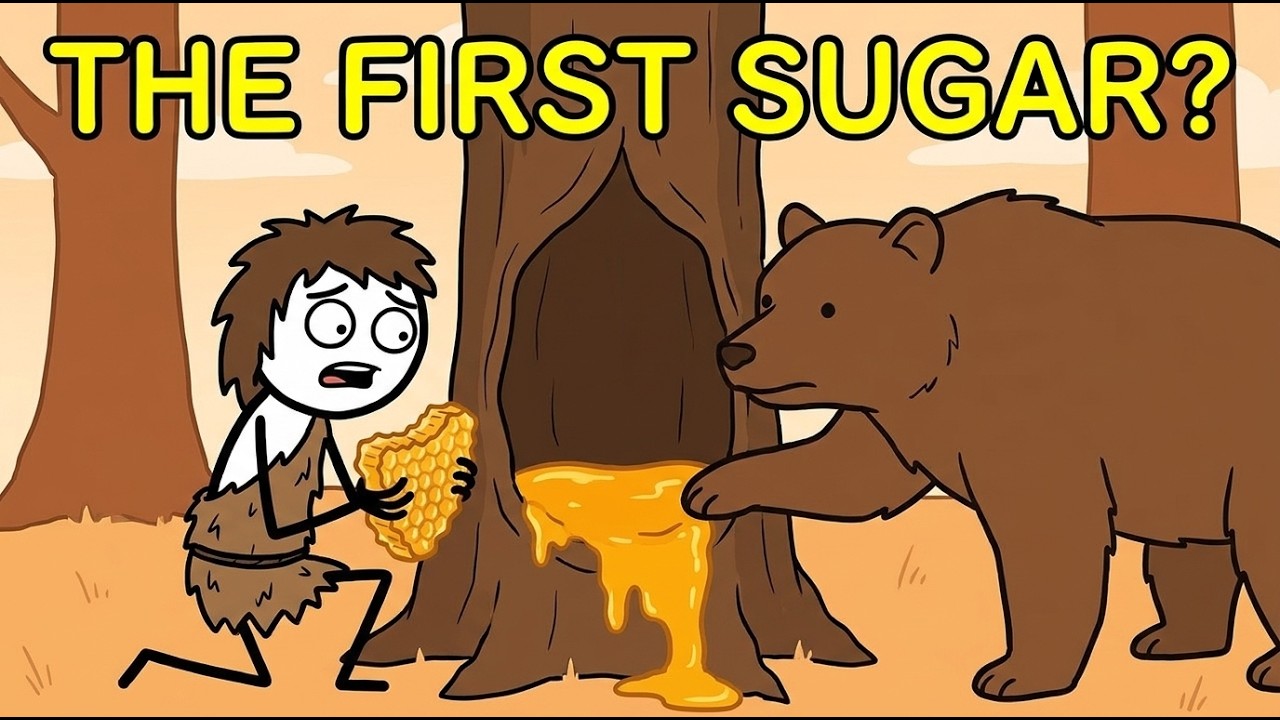
Sweetness was not something early humans had to discover—they were born knowing it mattered. Even human infants show a preference for sweet tastes, since breast milk contains lactose. Among naturally sweet foods, honey held exceptional value. Bees transform nectar through enzymes and water reduction, creating an energy-dense substance that can remain edible for long periods.
Prehistoric humans likely raided bee colonies long before agriculture, though the exact timing remains unknown because honey and tools decay without leaving traces. Chemical evidence offers some insight. Researchers have identified beeswax residues in prehistoric pottery from Neolithic sites across Europe, North Africa, and Western Asia. At Çatalhöyük in Anatolia, bee products were in use by the 7th millennium BCE, meaning people were exploiting honeybees at least 8,500 years ago—though the practice almost certainly began earlier.
The next major transformation came with sugarcane. Modern genetic evidence connects domesticated noble cane largely to wild populations from New Guinea, with the usual estimate placing domestication around 8,000 BCE. Papuan communities selected and propagated sweeter, thicker forms of the grass, which could be chewed directly for its sweet juice. From New Guinea, sugarcane spread through island Southeast Asia.
Austronesian-speaking voyagers carried it eastward into the Pacific and westward toward mainland Asia. By roughly the first millennium BCE, varieties of sugarcane were known in India, where the next crucial breakthrough occurred. Indian producers learned to crush sugarcane, extract its juice, boil it to evaporate water, and concentrate the result into dense masses of unrefined sugar—products ancestral to what is now called jaggery or gur. More importantly, they learned to control crystallization, transforming sticky syrup into dry or semi-dry granular solids that could be stored, packed, and transported.
The question of when exactly crystals were created remains uncertain. Popular timelines often claim Indians invented crystallized sugar around 350 CE during the Gupta period, while others place forms of granulated sugar centuries earlier, perhaps near 500 BCE. Ancient Sanskrit and Pali texts mention sugarcane juice and various sugar products, but translating old food terms into exact modern manufacturing categories is difficult. The evidence supports ancient India as the major early center of sugar making and crystallization, but does not provide one inventor or one date.
Language preserves this journey. The Sanskrit word sharkara referred to gravel or granular material and became associated with sugar. It traveled through Persian and Arabic forms such as shakar and sukkar before entering European languages. The English word candy traces back through Arabic and Persian to the Sanskrit kanda, meaning pieces or lumps of sugar.
Knowledge moved both east and west. Chinese sources recorded sugarcane early, but more advanced refining techniques came from India. During the Tang period in the 7th century CE, Chinese missions reportedly sought Indian expertise in sugar manufacturing. To the west, cane cultivation reached Sasanian Persia by approximately the 6th century CE, where producers improved irrigation, boiling, and refining methods.
After the Arab conquests connected vast territories, sugar technology spread across the Islamic world. Farmers adapted the crop, engineers modified mills, and physicians classified its properties. By the medieval period, Islamic agricultural networks were producing sugar on a significant scale in places including Persia, Mesopotamia, Egypt, North Africa, Sicily, Southern Spain, Cyprus, and the Levant. For centuries, sugar remained rare and expensive in Europe.
Ancient Greeks and Romans knew of sweet cane products from the East but used honey as their ordinary sweetener. Medieval Europeans encountered sugar through trade with Islamic territories and described it as a kind of sweet salt that could be sprinkled. Sugar appeared as an exotic substance or medicine rather than a daily food. That changed when European powers began cultivating sugarcane on Atlantic islands such as Madeira and the Canary Islands.
When Columbus brought sugarcane to the Caribbean on his second voyage in 1493, plantation systems began to develop. Portuguese colonists built a major sugar industry in Brazil, while Spanish, English, French, and Dutch powers expanded plantations across the Caribbean and parts of the Americas. This turned sugar from an elite spice into a mass commodity and created one of history’s most brutal economic systems. Sugarcane demanded enormous labor, and European plantation owners solved that problem through enslavement.
Millions of Africans were forcibly transported across the Atlantic, many to sugar colonies where conditions were exceptionally lethal. Workers endured exhausting field labor, dangerous machinery, extreme heat, disease, and violence. This suffering was not an unfortunate side detail. It was central to how sugar became cheap.
Plantations converted stolen land, enslaved labor, and industrial processing into vast quantities of sweetness for European markets. Profits financed merchants, ports, refineries, banks, and states. Tea, coffee, and chocolate accelerated the cycle. These naturally bitter drinks were transformed by sugar, and European consumers increasingly combined one colonial commodity with another.
A cup of sweetened tea appeared harmless but stood behind a vast global machine of plantations, ships, factories, taxation, warfare, and lives classified as production costs. By the 18th century, sugar consumption in Britain and Europe had risen dramatically. What had been rare white crystals became ordinary, and ordinary is where history disappears. During the 18th century, European chemists demonstrated that sugar beets contained the same sucrose found in cane.
In 1747, German chemist Andreas Sigismund Marggraf identified sugar in beets. Disruptions to cane imports during the Napoleonic Wars encouraged Continental Europe to expand beet sugar production in the early 19th century. Industrial technology improved extraction, with vacuum pans, centrifuges, and new filtration materials transforming production into a large-scale factory operation. Chemistry eventually explained what ancient producers had manipulated through experience.
Only at that point did humans scientifically discover sugar—not as a taste, not as cane juice, not as crystals, but as a chemical substance called sucrose. This history provides several answers to the question of when sugar was discovered. Humans first encountered sugars before our species existed through sweet plants and milk. Prehistoric humans harvested concentrated sugar in honey thousands of years ago.
Papuan farmers domesticated sugarcane around 10,000 years ago. Ancient Indian producers developed methods for concentrating and crystallizing cane sugar roughly 2,000 or more years ago, though the exact chronology remains uncertain. And chemists identified sucrose at a molecular level in the modern scientific era. Each discovery revealed something different.
Evolution discovered sugar as information. Hunter-gatherers discovered it as a rare reward. Farmers discovered it as a crop. Indian craftspeople discovered it as a manufactured crystal.
Merchants discovered it as portable wealth. Empires discovered it as an industry. Chemists discovered it as sucrose. Our modern appetite for sweetness remains intense because our biology developed in a world where concentrated sugar was limited.
For most of human history, acquiring sugar required waiting for fruit, locating honey, or paying heavily for refined products. The reward systems that helped our ancestors survive under scarcity now operate in an environment where sugar is inexpensive and available in quantities those ancestors could scarcely collect. The tragedy emerged when human ingenuity combined with conquest and treated other people as machinery. Sugar itself did not create slavery.
People built economic systems in which sweetness justified it. One teaspoon of sugar contains no visible history. That is what makes it easy to swallow. But inside those crystals are a tropical grass descended from plants selected in New Guinea, cultivation traditions carried across oceans, ancient South Asian boiling pans, Persian irrigation systems, Arab agricultural texts, Atlantic ships, African lives, Caribbean plantations, and modern factories.
Sugar was not discovered once. It was recognized, cultivated, extracted, concentrated, crystallized, traded, industrialized, and finally explained.