The sun rose over a dusty mission in San Antonio on March 6, 1836, and by 6:30 that morning, 198 men lay dead within its walls—but the story of who those men truly were has been obscured by two centuries of simplified legend. While American history books trumpet the names of Travis, Bowie, and Crockett, the cold arithmetic of sacrifice reveals a startling truth: one in eight of the defenders who gave their lives at the Alamo was born not in the United States, but in the British Isles. A staggering 23 men from England, Scotland, and Ireland fought and died under the Texas flag, their motivations as varied as their homelands, yet their sacrifice remains largely unchronicled in the mainstream narrative.
The battle itself was not a simple clash of freedom versus tyranny, but a complex convergence of immigration policy, slavery economics, and the ambitions of a Mexican president determined to crush rebellion. Santa Anna’s forces numbered at least 1,500 troops on day one, swelling to more than 3,000 by the final assault, yet the defenders refused to surrender despite knowing that a red flag flown from a nearby church meant no quarter would be given. This is the untold story of the British and Irish men who chose to make their last stand in a foreign land, far from the green fields of their birth, and whose bones were burned in a mass pyre by order of a furious tyrant.
 The stage for this forgotten chapter was set more than a decade before the first shot was fired, when Mexico, having finally thrown off the shackles of Spanish rule in 1821, began actively encouraging immigrants to settle its vast, sparsely populated northern province of Texas. The invitation was not altruistic; the Mexican government hoped American settlers would serve as a buffer against hostile Comanche raids and create economic development in a region that had languished under Spanish neglect. What they did not anticipate was that these settlers, arriving with their families, tools, and in many cases, their slaves, would develop a fierce independence that would ultimately clash with Mexico City’s centralizing authority.
By 1830, the Anglo-American population in Texas had swelled to over 7,000, far outnumbering the Mexican residents of the province, and many of these newcomers were not Americans at all, but immigrants from the British Isles who had first stopped in the United States and then pushed onward toward the promise of cheap land. The Mexican government’s initial welcome soured as fears grew about American influence, leading to laws restricting further immigration, but these measures only fueled resentment among a population that had been promised autonomy and prosperity. The settlers brought with them not just agricultural ambitions, but a cultural baggage that included an abhorrence of Mexican laws banning slavery and trade restrictions that crippled their economic survival.
It was into this volatile environment that a new breed of adventurer entered, men who had already crossed the Atlantic once in search of opportunity and were willing to uproot themselves again for a chance at prosperity in the Texas frontier. James Gwyn, a 32-year-old Englishman who had first settled in Mississippi before the call of Texas became irresistible, represented this restless spirit that would soon find itself at the epicenter of revolution. David Wilson, born in Scotland in 1807, arrived in Texas in early 1835, just as the political horizon was darkening with the threat of armed conflict.
His fellow Scot, Isaac Robinson, one year his junior, had successfully navigated the Mexican bureaucracy to obtain a land grant in September 1834, a legal claim that would prove worthless if Santa Anna’s centralization succeeded. And then there were the sons of Ireland, men like Joseph Hawkins and the colorfully named Jackson Rusk, who had left their homeland to escape poverty and hunger, only to find themselves trapped in a land where the political winds were shifting toward tyranny. These men were not professional soldiers, nor were they wealthy plantation owners fleeing a loss of privilege; they were laborers, tradesmen, and small farmers who simply wanted to carve out a life for themselves and their families in a new world.
But by 1835, that world was on the brink of war, and their dreams of settlement would collide with the iron will of a Mexican president who viewed their presence as a threat to national sovereignty.
Antonio Santa Anna, who assumed the presidency of Mexico in 1833, was a charismatic and ruthless leader who abandoned the federalist constitution of 1824 and sought to impose a centralized government that would answer directly to him. For the residents of Texas, who had enjoyed a hands-off administrative approach that allowed local governance to flourish, this change was a declaration of war on their way of life. Santa Anna’s policies were not merely political; they struck at the very heart of the Texan economy, particularly his attempts to ban slavery and his crackdown on illegal immigrants who had flooded across the border from the United States.
 To the American settlers, many of whom had arrived from slave-holding southern states, the prospect of abolition was economic ruin, and to the British and Irish immigrants who had witnessed similar oppression in their homelands, Santa Anna’s militaristic posturing was an all-too-familiar smell of despotism. The first spark came in October 1835 when Mexican forces attempted to reclaim a small cannon that had been loaned to the town of Gonzalez for defense against Indian raids. The settlers refused to hand it over, and in a brief skirmish that followed, they routed the Mexican troops, proving that they were willing to shed blood for their rights.
This victory electrified the region, and within weeks, volunteers were streaming into Texas from the United States, along with the first contingent of the New Orleans Grays, a uniformed company of around 122 men who would become a cornerstone of the Texan military forces.
Richard Ballentine, born in Scotland in 1814, had immigrated to America with his family at age six, and by his early twenties, he was among the fervent volunteers who took ship from Alabama to join the cause. Before leaving, he and his fellow volunteers signed a statement declaring, “We have left every endearment at our respective places of abode in the United States of America to maintain and defend our brethren at the peril of our lives, liberties, and fortunes,” words that would prove tragically prophetic for many of them. The New Orleans Grays were distinct from the civilian volunteers, who dressed in whatever clothes they owned, because the Grays actually wore uniforms, carried well-maintained muskets, and drilled as soldiers, appearing for all the world like a professional force.
Among their ranks was William Blazby, born in Ipswich, Suffolk, in 1795, who had made his way to New Orleans by way of New York and would be appointed second lieutenant in Captain Thomas Bree’s company. Also serving was Sergeant James Dimkins, an Englishman born in 1804 who was living in New Orleans by 1834, alongside two other Englishmen, Richard Starr and Thomas Waters, each of whom had their own reasons for joining this foreign war. Their arrival in Texas coincided with the siege of Bexar, the fortified settlement known today as San Antonio, where the Texans were attempting to dislodge a Mexican garrison that was strategically located at the crossroads of the province.
The siege of Bexar lasted nearly two months, and the Texans, despite being outnumbered two to one, managed to force the Mexican garrison’s surrender on December 11, 1835, after a grueling campaign that cost the defenders 35 casualties. Among the wounded was Irish-born New Orleans Gray James McGee, who would recover just in time to join the defenders of the Alamo, a decision that sealed his fate. The fall of Bexar was a major victory for the rebels, but it also guaranteed a response from Santa Anna, who saw the loss of this key city as an affront to Mexican honor that demanded vengeance.
 While the Texans celebrated their victory and began to believe that independence was within reach, Santa Anna was already assembling a force of thousands of soldiers to march north and crush the rebellion once and for all. The Texan commander-in-chief, Sam Houston, understood that San Antonio, being a vital transportation hub, would likely be Santa Anna’s primary target, and he ordered the fortification of the Alamo, a former mission that commanded the approaches to the city. On January 19, 1836, Colonel James Bowie arrived with a small force of 30 men, bringing the garrison size to a mere 120, a pathetic number to face the coming storm, yet they refused to retreat.
In early February, Lieutenant Colonel William Travis arrived with reinforcements, and shortly thereafter, the legendary Davy Crockett made his appearance, hoping to rebuild his political career through military glory, though he would find only death. The Alamo’s defenses were strengthened, with 18 cannons placed along the walls, a serious threat to the Mexican forces who would have to advance across open ground to attack. The artillery was manned by a company under Captain William Carey, who had funded their equipment from his own pocket and nicknamed the unit the Invincibles, a boast that betrayed a certain naïve optimism.
Within this company served Lieutenant William Jackson, from County Monaghan, Ireland, a former sailor who had settled in Kentucky before moving to Texas; his presence represented the growing Irish contingent in the rebellion. Sergeant William David Hersee, a 31-year-old Englishman who had been wounded at the siege of Bexar, was back in action despite his injuries, as were two Irishmen named Samuel Burns and Burke Trumell, both in their twenties. Santa Anna finally arrived outside the Alamo on February 23, 1836, with a force of 1,500 men, and raising a red flag from a nearby church to signal that no quarter would be given, he declared the defenders, whom he branded as pirates, would face certain death.
The siege began with ominous speed; on the very first day, Jim Bowie collapsed from illness, leaving Travis as sole commander of a force that had swelled to around 150 men. Travis immediately wrote a now-famous letter pleading for reinforcements, but despite an assembly of over 300 potential relief soldiers, only 32 men from the town of Gonzalez managed to sneak through the Mexican lines during the dark of night on March 1. These so-called Immortal 32 included Englishmen Marcus Swoon, a shoemaker, and George Brown, who had arrived in New York in 1832 before moving to Texas, as well as Irishman Andrew Duvalt, a plasterer who had already fought at Bexar and returned home before volunteering again.
In total, 40 men from Gonzalez would fight and die at the Alamo, including Englishman Daniel Bourne, born in Kent in 1810, who had arrived in America in May 1835 and joined the revolution just in time to meet his end. More than a hundred men chose not to risk their lives, remaining in the safety of their homes, yet their absence did not change the inevitable outcome, as Santa Anna received an additional 1,000 troops on March 3, bringing his total force to approximately 3,000 soldiers against a garrison of 198 defenders.
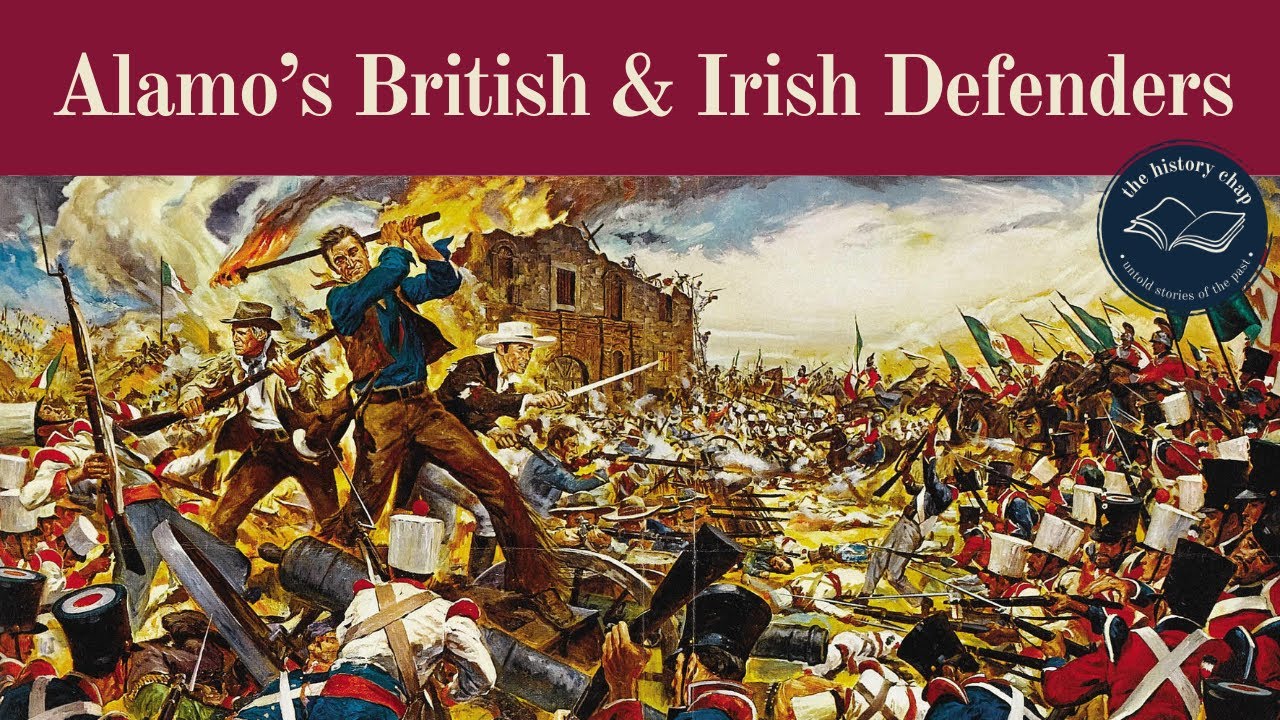
 The final assault came at dawn on March 6, 1836, a Sunday morning that would forever echo in the halls of world history, as the defenders knew they would not survive the day. The battle lasted just 90 minutes, a brutal chaotic melee of cannon fire that used nails, door hinges, and scrap metal instead of proper canister shot, followed by desperate close-quarters combat. Despite repulsing two attacks, the defenders were overwhelmed in the third assault, and the fighting devolved into a massacre of the defenders, who fought to the very last man.
Among the fallen were all 23 men born in the British Isles—10 from England, four from Scotland, and nine from Ireland—with the exception of a few civilians who survived to tell the tale. Susanna Dickinson, whose husband was among the dead, recounted the desperate final moments, including Major Robert Evans’ attempt to reach the magazine and blow up the gunpowder, a suicide mission that failed when he was shot down before reaching his target. The defenders’ bodies were not given honorable burial; instead, Santa Anna ordered them burned in a mass pyre, while his own dead, numbering around 600 killed and wounded, were buried in a local cemetery.
The Alamo was technically a Mexican victory, but it became a rallying cry for Texas, a symbol of heroic defiance that motivated thousands to join Sam Houston’s army. On April 21, 1836, Houston’s forces routed Santa Anna’s army at the Battle of San Jacinto, capturing the Mexican president himself and forcing him to sign a treaty recognizing Texas independence. The Republic of Texas, which had declared independence on March 2, 1836, just days before the Alamo fell, lasted until its annexation by the United States in 1845.
The men who died at the Alamo, including those from the British Isles, fought for a cause they believed to be just, whether their motivation was survival, ambition, or adventure. Their yells of defiance on that fated morning were not just cries of American defiance but echoed the voices of immigrants who had crossed oceans and continents to find a better life. When you hear today the shout “Remember the Alamo,” remember not just the immortal American legends, but the ordinary men of Britain and Ireland who composed one in eight of the fallen.
They came from Ipswich, Perthshire, Dublin, and London, and they died in a mission far from home—yet their legacy is untold, buried beneath the dirt of a Texas battlefield that changed the course of a continent.

