History remembers certain queens as monsters whose names still provoke fear centuries later. But the records that shaped those reputations were often written by men with political reasons to destroy them. Separating genuine cruelty from manufactured slander requires examining how the stories were created and who controlled the narrative. Queen Athaliah of Judah, who ruled in the 9th century BC, holds a unique record: she is the only woman ever to reign over Judah in her own right.
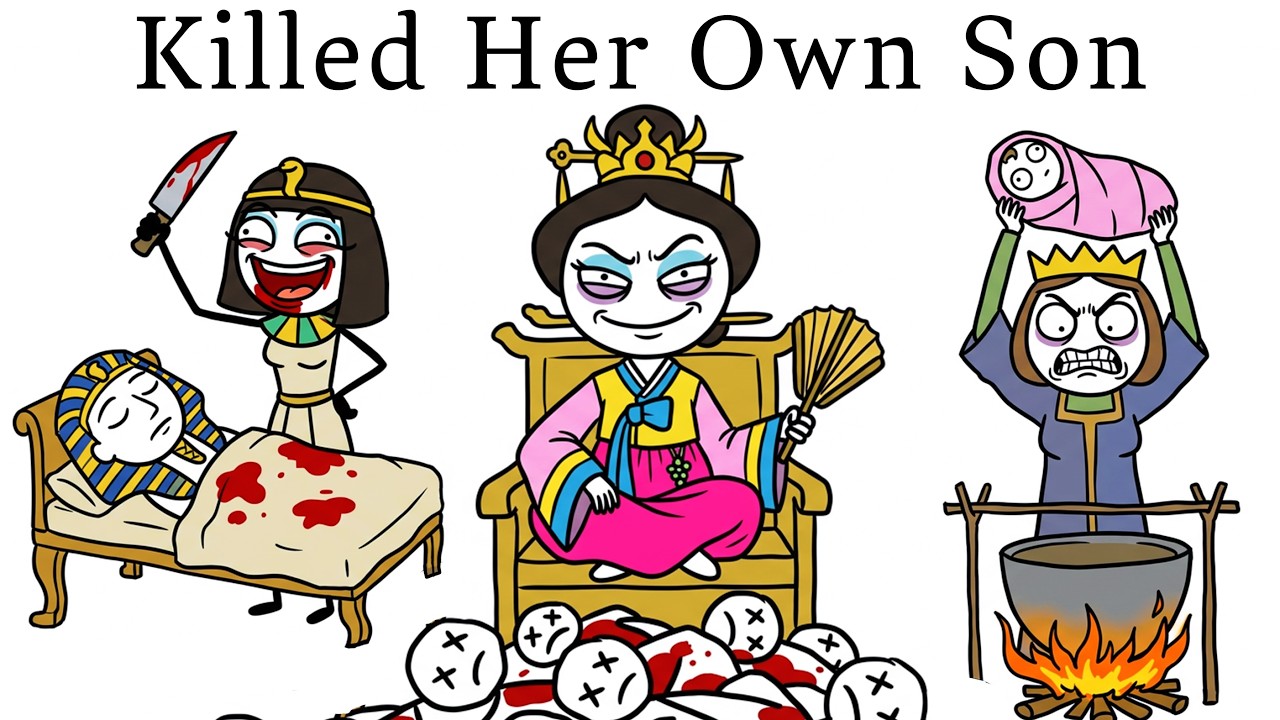
According to the biblical account in Second Kings, she seized power by slaughtering her own grandchildren after her son King Ahaziah was killed. One child, a baby named Joash, was smuggled to safety by his aunt and hidden inside the temple for six years while Athaliah ruled unknowingly. When the high priest Jehoiada crowned the seven-year-old boy, Athaliah was dragged from the temple and executed at the horse gate. The source material for Athaliah’s crimes is exclusively the Bible, with no independent confirmation.
The writers who recorded her story despised her for worshipping a foreign god, a motive that could easily have turned history into propaganda. Scholars also dispute her parentage, arguing that writers may have deliberately linked her to the infamous Queen Jezebel to make her appear worse. Jumping to the 4th century BC, Alexander the Great’s mother Olympias seized control of Macedon around 317 BC and launched a violent purge. She captured her rival royal couple, Philip III and his wife Eurydice, then had Philip stabbed to death by Thracian assassins.
She sent Eurydice a sword, a noose, and a cup of hemlock, letting her choose her death. Eurydice hanged herself with her own belt. Olympias then executed around 100 leading Macedonians loyal to her enemy Cassander. Before her political savagery, Olympias had a reputation for religious extremism.
The biographer Plutarch describes her devotion to the ecstatic cults of Dionysus, claiming she kept large tame snakes that coiled around sacred objects and allegedly around her while she slept. Her husband King Philip was reportedly so disturbed by finding a serpent in her bed that it ended their marriage. Olympias met her end the next year when Cassander cornered her. Soldiers dispatched to kill her refused when she appeared in full royal robes, so Cassander handed the job to the families of her victims, who reportedly stoned her to death.
The sources here are late and written by her enemies, so while the purge appears real, the bloodthirsty witch characterization should be weighed carefully. In first-century Rome, Agrippina the Younger was sister to Emperor Caligula, wife of Emperor Claudius, and mother of Emperor Nero. She became the first living empress to appear on Roman coins and renamed her birthplace, which we now call Cologne. She married her uncle Claudius, then reportedly poisoned him with mushrooms in 54 AD to place her teenage son Nero on the throne.
When Claudius did not die quickly enough, his physician allegedly finished him with a poisoned feather. Nero eventually turned on his mother. His first attempt involved a specially designed boat meant to collapse and sink at sea, but Agrippina swam ashore. He then sent a gang of men to kill her in her villa.
The historian Tacitus records that she tore open her robe, pointed at her belly, and told them to strike the womb that had carried Nero. When astrologers had warned years earlier that her son would rule and then kill her, she reportedly replied, “Let him kill me as long as he becomes emperor. ”
Agrippina had survived her brother Caligula’s banishment of her to a small island, where he seized her property. She clawed back to power only after his assassination, yet still chose to manufacture an emperor of her own.
The sixth-century Frankish queen Fredegund began as a household servant, essentially a slave, and rose to become queen of Neustria. For roughly 40 years, she waged a personal blood feud against rival queen Brunhilda that dragged entire kingdoms into war. The deeds attributed to her include strangling a rival royal wife, killing a king with poison blades, and knifing a bishop at an altar during Easter service. She reportedly even tried to murder her own daughter by slamming a treasure chest lid on the girl’s neck.
Beyond assassination, Fredegund was a battlefield commander who once won a night attack by disguising soldiers with tree branches and tying bells to horses so enemy scouts assumed they heard cattle. What made Fredegund especially dangerous was her strategy. Every rival she removed cleared a path for her son, the future Clothar II. After her husband was assassinated, she secured her young son’s claim and ruled as regent.
Here is the detail that sets her apart from this list: after a lifetime of arranging deaths, she died peacefully in her own bed at old age in 597. Her rival Brunhilda, by contrast, was eventually tied to wild horses and torn apart. The chronicler Gregory of Tours, whose account dominates the record, was firmly on Brunhilda’s side, so the good queen versus evil queen storyline should be read skeptically. In seventh-century China, Wu Zetian became the only woman in more than 2,000 years of Chinese history to rule as emperor in her own name, establishing her own dynasty.
She began as a low-ranking teenage concubine and rose to the most powerful position in the world’s largest empire. The most infamous accusation against her states that she smothered her own infant daughter to frame the reigning empress, who was then disgraced and removed. Wu built an informer network using a copper box where citizens could drop anonymous accusations, then used it to purge the aristocracy. But nearly all the monstrous material comes from Confucian historians writing centuries after her death, some as much as 350 years later.
The baby murder story is notably absent from the writings of her actual living enemies, and it mirrors crimes attributed to an earlier empress, suggesting a template was reused. The historical Wu Zetian stabilized an empire, expanded the examination system so talent could outrank noble birth, and lowered taxes on farmers. She invented new Chinese characters, including one combining the symbols for sun and moon, a special character for her own name. When she died, her tomb featured a massive memorial stone deliberately left blank, as if daring the future to write her story for her.
The late medieval era produced Isabella of France, known as the Shewolf, a French princess married to King Edward II of England around 1308. She invaded her own husband’s kingdom and took it from him, a feat almost no queen had ever achieved. Years earlier, she had reported her brothers’ wives for conducting secret affairs with two knights, a scandal that detonated the French royal family, imprisoning the princesses and executing the knights. Edward II lavished his attention on male favorites while humiliating his wife, seizing her lands and children.
Isabella teamed up with exiled baron Roger Mortimer, who became her lover and general, and landed in England with an army in 1326. English nobles defected to her almost immediately, Edward was forced to abdicate in 1327, the first English king ever removed from his throne, and he died within months. Isabella and Mortimer enriched themselves shamelessly until her teenage son Edward III launched a midnight coup, hanged Mortimer, and put his mother into comfortable retirement. The legend that Edward II was murdered with a red-hot poker was almost certainly invented propaganda, and it only appeared after Mortimer was executed.
The Shewolf nickname came from a poet around 400 years later, derived from a phrase Shakespeare had used for a different queen entirely. Isabella was buried with her husband’s heart resting on her chest, which she had kept for roughly 30 years. Catherine de’ Medici, an Italian banker’s daughter married into the French royal family, became the most powerful person in France after her husband died in a jousting accident. Her reputation rests on the St.
Bartholomew’s Day Massacre of August 1572, which began during her own daughter’s wedding and escalated into a slaughter of Protestant Huguenots across France, with death toll estimates ranging from thousands in Paris to tens of thousands nationwide. Catherine was branded the great Italian poisoner, a witch queen using spies to seduce secrets from powerful men. Modern historians lean toward a more complicated version: the evidence suggests she wanted a targeted hit on a small number of Huguenot leaders, most chiefly Admiral Coligny, and likely ordered it. But the strike was botched, and the violence spiraled into an uncontrolled mass killing never intended.
She was not innocent, but the image of a criminal mastermind engineering nationwide genocide comes largely from Protestant pamphlets seeking a foreign woman to blame. The infamous flying squadron of seductive spies does not appear in any record until more than 100 years after her death. Queen Ranavalona I of Madagascar seized power in 1828 and ruled for 33 years as a ferocious isolationist determined to expel European influence. Her signature justice system, the tangena ordeal, forced accused people to swallow poison mixed with three pieces of chicken skin.
Those who vomited up all three pieces were declared innocent; those who failed often died, with the poison killing between a fifth and half of all participants. By some estimates, this killed around 3,000 people per year. She banned Christianity in 1835, executing believers by the hundreds, and worked staggering numbers of her own subjects to death through forced labor and military campaigns. The most dramatic statistics, such as claims that her kingdom’s population halved in six years, come from missionary and colonial sources who had every reason to paint her as a madwoman.
Modern scholars treat these figures with caution. There is now a serious movement to reframe Ranavalona as an early anti-colonial leader resisting European empires, a characterization that does not erase the reality that she was poisoning her own people by the thousands to do it. The modern era’s most famous case is Empress Dowager Cixi, who effectively ran China for nearly half a century, from 1861 to 1908. She began as a minor teenage concubine and seized power through a palace coup.
For a solid century, Western imagination painted her as a scheming, murderous dragon lady, and a shocking amount of that image traces to a single con man: a British forger named Edmund Backhouse, who faked a Chinese official’s diary, fooled historians for around 50 years, and privately bragged in his memoirs about a sexual relationship with Cixi that never happened. Cixi did back the disastrous Boxer Rebellion in 1900, declaring war on the combined Western powers. She was also accused of siphoning funds meant for China’s navy to renovate her summer palace, where she had a marble pavilion built in the shape of a stone boat that cannot float. But the charge that refuses to go away involves her nephew, the Guangxu Emperor, who had been kept under house arrest for years after trying to modernize against her wishes.
He died suddenly in November 1908, one day before Cixi herself died. For a century, the suspicious timing was just rumor. Then in 2008, researchers exhumed and tested his remains, finding arsenic at levels roughly 2,000 times higher than normal, a single enormous deliberate dose. He was murdered.
Whether Cixi personally gave the order remains unproven, but the timing points directly at her. Her case proves the central difficulty of this entire history: most of her evil reputation was invented by an Englishman with a typewriter, while her one provable crime stayed hidden for a hundred years. Figuring out which queens were true monsters and which merely made the unforgivable mistake of winning while female remains the hardest task in history.


