A weathered clay tablet, smaller than a human hand, sits in a museum in Baghdad. Covered in tiny wedge-shaped marks, it remained unreadable for over a thousand years. When 19th-century European scholars finally decoded it, they discovered it was not a king’s decree or a hymn to the gods. It was a grocery list—barley, oil, sheep—recorded by an anonymous accountant who died more than 4,000 years ago.
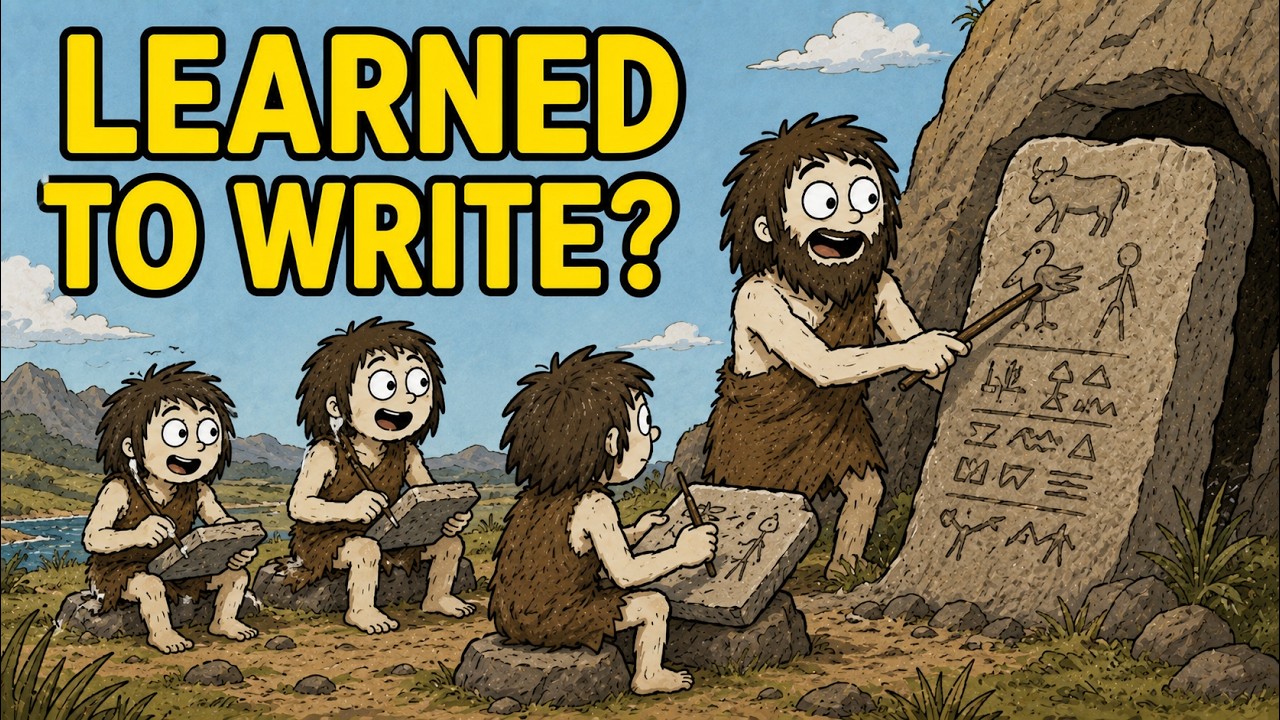
That accountant was not trying to make history. They were solving a problem: human memory was not reliable enough to track how much grain crossed the temple gate that morning. So they made a mark. Every word ever written traces back to that moment.
The invention of writing is one of the strangest stories in human history, because for roughly 95 percent of the time humans have walked the earth, no one could read a single word. There were no symbols, no scripts, no alphabets—only speech that vanished the moment it left the mouth. This was not because ancient humans were less intelligent. A hunter living in southern France 40,000 years ago had a brain biologically identical to the one reading these words today.
The hardware was the same. What was missing was the software—the cultural technology of writing. Before writing, all human knowledge lived inside human heads. Communities depended on spoken language, stories told at night, songs passed between generations, and the oral wisdom of elders.
Elders functioned as living archives, knowing which plants cured fever, the boundaries of territorial lands, and the genealogies of families. But a library that could get sick, lose its memory, and die. When an elder died without passing on their knowledge, that information vanished without a trace. And when stories passed through 20 generations of retelling, they changed with each telling—details dropped out, new elements entered, the sequence shifted.
Oral cultures were not ignorant cultures. Their songs and stories were sophisticated mnemonic technologies. But they had hard limits. They could not carry precise numbers, complex legal agreements between parties who did not trust each other’s memory, or the specific measurements needed to build an aqueduct.
When settlements grew large enough for these limits to matter, something had to change. Agriculture changed everything. Around 10,000 years ago, scattered communities across the world independently began planting crops and keeping animals. They stopped moving, built permanent structures, and stored food.
Staying in one place made ownership—this land is mine, this grain is mine—not just possible but necessary. Ownership created problems memory could not solve. If a family stored 500 units of grain at the temple, who would confirm that number later? If a merchant sent oil with a trading partner traveling three weeks away, how would the recipient know the shipment had not been reduced?
If a king taxed one sheep out of ten, how would collectors track who had paid? The administrative complexity of early agriculture demanded record-keeping that memory could not provide. The solution emerged not from philosophers or poets, but from accountants. The oldest physical precursors to writing were not cave paintings.
They were tokens. Beginning around 10,000 years ago in what is now Iran, Iraq, and Syria, early administrators developed small clay objects—cones, spheres, disks, cylinders—each representing a specific commodity and quantity. To conduct a transaction, you gathered the appropriate tokens, placed them inside a hollow clay ball, pressed it shut, and handed it to your trading partner. The ball was a sealed record of the agreement.
Historian Denise Schmandt-Besserat spent decades documenting this token system, tracing its use across thousands of archaeological sites. The small clay shapes, long misidentified as toys or ceremonial objects, were in fact the world’s first data storage system. The system worked for thousands of years, but a problem emerged. A merchant receiving a sealed clay ball could not know what was inside without breaking it open, which destroyed the record.
So administrators began pressing the tokens into the wet clay surface of the ball before sealing it, leaving outlines visible on the outside. Now the record could be read without destroying it. Around 5,500 years ago, someone noticed the obvious: if the impressions on the outside told you everything the tokens inside contained, you did not need the tokens anymore. You could press the shapes directly onto a flat clay surface.
The hollow ball became a flat tablet. The three-dimensional token became a two-dimensional mark. Writing had begun. The impression on the clay was not the grain or the sheep.
It was a representation of them. For the first time in history, meaning existed outside of the object it described. That is the foundational leap of all written language. By around 5,200 years ago, in the southern Mesopotamian city of Uruk—one of the world’s first true cities, with a population that may have reached 50,000—this system had evolved into something far more sophisticated.
Scribes pressed a cut reed into wet clay to produce wedge-shaped marks. Because the reed tip made natural wedge shapes and struggled to draw smooth curves, the script adapted to its tool. Signs that began as crude pictures of oxen and grain became abstract arrangements of wedges, faster to write and no longer recognizable as pictures. This script is called cuneiform, from the Latin for wedge-shaped.
It was not invented at a single moment by a single person. It evolved over centuries, shaped by the practical demands of anonymous scribes working in temple storerooms. The early tablets record nothing poetic—they record sheep counts, grain allocations, labor assignments, and temple inventories. First came the accounting.
The literary ambitions came later. As cuneiform matured, scribes discovered something that reshaped the system entirely. A sign depicting a physical object could also represent the word for that object. Once signs came to represent sounds rather than just things, any word could be written, including abstract concepts with no visual form.
This phonetic turn transformed writing from a limited accounting tool into a complete system for encoding language. By 3,000 years ago, Sumerian and Akkadian scribes were composing legal codes, medical texts, astronomical observations, and epic poetry. The Epic of Gilgamesh, the oldest known work of literature, was pressed into clay tablets in multiple versions across multiple centuries. The library at Nineveh, assembled by Assyrian king Ashurbanipal in the 7th century BCE, held tens of thousands of tablets.
When Nineveh burned in 612 BCE, the fire that destroyed the palace also baked and preserved the clay tablets, keeping the library intact for 2,500 years. While Mesopotamia developed cuneiform, Egypt developed hieroglyphs, appearing in the archaeological record around 5,100 years ago. The Egyptians called their script Medu Neter—divine words—believing writing was a gift from Thoth, the ibis-headed god of wisdom. Hieroglyphs were a hybrid system: some signs represented entire objects or concepts, others represented consonant sounds, and still others functioned as classifiers indicating a word’s category.
This mix made hieroglyphs enormously flexible but slow to write. Drawing a detailed hieroglyph took time a scribe recording daily transactions did not have. So Egyptian scribes developed hieratic, a shorthand version written quickly with a reed pen on papyrus. For sacred monuments, full hieroglyphs were carved in stone; for tax records, hieratic was used on papyrus.
By the time Egypt’s great monuments were being built, reading and writing belonged to a tiny fraction of the population. In Mesopotamia, scribes trained in institutions called the Edubba—the house of tablets. Training began in childhood and lasted over a decade, with students spending years copying lists of signs, words, animals, professions, and legal terms. The goal was reproduction, not comprehension.
The Sumerian poem School Days, written around 4,000 years ago, records a student being beaten repeatedly by masters for lateness, talking, bad handwriting, and standing without permission. Learning to write was a disciplined, painful, and expensive undertaking. The investment was justified by the returns. A trained scribe could work in a palace, temple, law court, or merchant’s office.
In a world where almost nobody could read, the person who could was indispensable. Literacy was not just a cognitive skill—it was a form of power. In classical Athens, historian William V. Harris estimated adult male literacy at only 5 to 10 percent.
In the Roman Empire, literacy averaged 10 to 15 percent, with rates far lower in the countryside and among slaves, women, and agricultural workers. The overwhelming majority of humans who lived through the first 4,000 years of writing’s existence never learned to read a word. For those who could read, the experience was nothing like today’s silent scanning. Ancient texts were written in scriptura continua—continuous unspaced characters with no breaks between words, no punctuation, and no lowercase letters.
A reader could not identify word boundaries visually. The only way to find the words was to say the sounds aloud and let the acoustic pattern reveal where one word ended and another began. Ancient readers read with their voices. Reading aloud was reading.
Silent reading was so rare that St. Augustine, around 380 CE, found it worth describing when he saw Bishop Ambrose of Milan reading with his eyes moving while his voice and tongue remained still. Augustine was recording an unusual behavior, not a common one. The structural change that made silent reading standard began in Irish and Scottish monasteries in the 7th and 8th centuries CE.
Monks copying Latin texts—a language they learned as scholars rather than native speakers—began leaving small spaces between words. Word separation helped them parse unfamiliar Latin. Once words were separated, the eye could identify word shapes as visual units without sounding them out first. Meaning could arrive directly from the page to the mind.
By the 13th century, word separation was standard, and silent reading had become ordinary. Writing surfaces also evolved. Stone was permanent but impractical. Clay was cheap but heavy and fragile.
Papyrus, manufactured from the Nile Delta plant, was lightweight and flexible, allowing knowledge to move. But papyrus deteriorated in wet climates, which is why almost all surviving papyrus documents come from Egypt’s dry desert sites. Parchment—animal skin stretched, scraped, and dried—was more durable and could be used on both sides. It was foldable, enabling the codex, the bound book format still used today.
Paper came from China. In 105 CE, court official Cai Lun presented the Han emperor with a new material made from pulped bark, hemp fiber, rags, and old fishing nets. The result was light, uniform, cheap, and smooth. Paper spread westward along trade routes, reaching the Islamic world after Chinese papermakers were captured at the Battle of Talas in 751 CE.
Combined with movable type printing in 15th-century Europe, it made mass production of texts possible for the first time. The alphabet is what made writing simple enough to scale. Cuneiform required memorizing 600 to 1,000 distinct signs. Egyptian hieroglyphs had a core set of about 700, with a full repertoire in the thousands.
These systems demanded years of study and produced scribes, not readers. The alphabet worked differently: 20 to 30 letters, each representing a single sound, unlocked the entire vocabulary of a spoken language. The first steps toward the alphabet were taken not by professional scribes but by Semitic laborers working in turquoise mines at Serabit el-Khadim in the Sinai Peninsula around 1900 BCE. Exposed to Egyptian hieroglyphs on temple walls but untrained in the scribal system, they borrowed the visual forms of hieroglyphs and reimagined their meaning.
A hieroglyph depicting a house became the first sound of the Semitic word for house. An ox head became the first sound of the Semitic word for ox. The principle—one sign, one sound—was entirely new. This Proto-Sinaitic script was identified by English Egyptologist Alan Gardiner in 1916, who recognized a sequence of signs spelling Ba’alat, the goddess, matching the temple at the site.
The alphabet evolved into the Phoenician alphabet of 22 consonants, which traveled with merchant trade routes. When Greek communities adopted it, they repurposed several Phoenician consonant letters that represented sounds absent from Greek as vowels. The result was the first true alphabet, recording every sound of spoken language. From the Greek alphabet came the Latin alphabet, from which these words directly descend.
The alphabet raised the ceiling of potential literacy. Under cuneiform, literacy was limited by human memory’s capacity to absorb hundreds of signs. Under an alphabet, broad literacy became theoretically achievable—though whether any society achieved it depended on economics, politics, and infrastructure. The neuroscience of reading reveals something ancient scribes could not have known.
Reading is not a natural behavior. The human brain did not evolve to read; writing has existed for only around 5,000 years, far too little time for genetic adaptation. Every literate person is repurposing brain regions that evolved for entirely different functions. Cognitive scientist Stanislas Dehaene calls this “neuronal recycling.
” The brain takes existing visual processing areas—circuits that evolved to recognize faces, animals, and objects—and retrains them to recognize letters and words. The specific region most heavily recruited is the visual word form area, at the junction of the temporal and occipital lobes in the left hemisphere. Before literacy, this area responds primarily to faces and objects; after sustained training, it becomes finely tuned to written words. This repurposing is not automatic.
It takes years and is not painless. A child learning to read is physically reorganizing their brain. One specific challenge involves mirror symmetry: the visual system evolved to recognize objects as equivalent regardless of orientation, which is useful for predators approaching from either side but catastrophic for reading letters like B and D, identical except for orientation. A reading brain must suppress this automatic mirror generalization, which is why many children experience mirror writing confusion.
Researcher Mark Changizi has observed that letter shapes across unrelated writing systems—Latin, Chinese, cuneiform—share structural features resembling those found in natural visual environments: edges, corners, intersections, and branching shapes. Writing systems, he argues, evolved to be compatible with the visual processing circuits the brain already had. The systems that survived were those that fit most comfortably into existing pathways because they could be learned most efficiently. Skilled reading uses two parallel brain pathways simultaneously.
The phonological pathway converts visual patterns of letters into sounds and retrieves meaning through the sound of the word. The lexical direct pathway maps the visual pattern of the whole word directly to meaning, bypassing phonology. Familiar words are processed through the fast direct pathway; unfamiliar words fall back on the slower phonological route. Even silent readers show tiny suppressed movements in the vocal cord muscles—the brain has not fully separated reading from speaking, only suppressed the output to an inaudible level.
Writing created the document—a statement independent of the memory of any individual. A document says what it says regardless of who remembers it or what they wish it said. This permanence made new kinds of reasoning possible. A scribe with centuries of astronomical observations could detect patterns no individual observer could notice.
A lawyer reading a full legal code could construct arguments based on precise wording. A physician with detailed case records could compare outcomes across treatments. None of this was possible when knowledge existed only in memory, because memory cannot store information with perfect fidelity. Writing extended the time over which knowledge could remain coherent and accessible.
It allowed the knowledge of dead people to remain available to the living, and each generation could begin where the previous one left off. The Inca Empire provides a striking alternative model: at its 15th-century height, it administered millions of people across millions of square kilometers without an alphabetic script, using the quipu—a system of knotted strings encoding information through knot type, position, cord color, twist direction, and branching structure. When the Spanish destroyed quipus as idolatrous objects in the 1530s, they erased a sophisticated alternative tradition of record-keeping whose full complexity we are still working to understand. The history of how humans learned to read and write is the history of how a single practical problem—recording transactions—produced a technology that restructured human consciousness.
The anonymous accountant who pressed a cone shape into clay 5,000 years ago was not trying to create literature. They were trying to remember how many jars of oil had come through the door. The scribe who realized the impression could replace the token was simplifying a workflow. The Semitic miner who borrowed an Egyptian sign to write a sound was trying to record their own name.
Writing was invented incrementally by people solving immediate problems, none of whom saw where their local solution would lead. The technology accumulated complexity over millennia as each generation added to what came before. Every literate person on Earth has physically rebuilt part of their brain through years of instruction to accommodate a cultural technology that has existed for only a tiny fraction of human history. The experience of looking at marks and hearing the voice of someone dead for centuries is a learned miracle—constructed one mind at a time through patient transmission.
The first mark in clay was not poetry. But everything that has ever been written, including these words, descends directly from it.