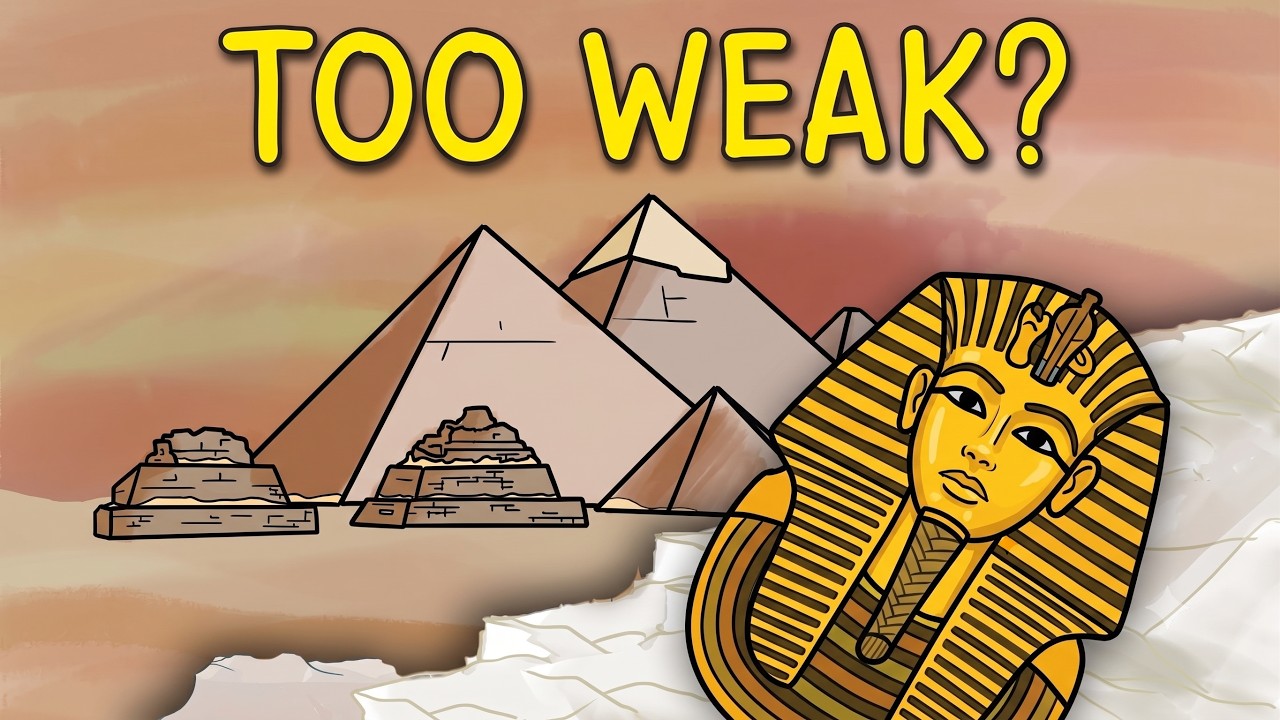
The colossal stone monuments that still puncture the desert skyline of modern Egypt are monuments to a paradox. They are testaments to a civilization of staggering longevity, one that outlasted every contemporary empire by millennia. Yet, they also stand as the ultimate gravestones for a society that died a thousand deaths before its final breath.
The story of Egypt’s fall is not a single event, but a multi-millennial tragedy of ecological fragility, administrative rot, and technological stagnation. The narrative that Rome delivered the killing blow in 30 BC is a convenient simplification; by the time Octavian’s legions marched into Alexandria, they were not conquering a living nation but performing an autopsy on a corpse that had been decomposing for centuries. The true cause of death was a systemic failure so profound that it began with a volcanic eruption on the other side of the planet, a catastrophe the Egyptians never saw coming and never understood.
 To comprehend the collapse, one must first understand the machine. Ancient Egypt was not a typical agrarian society; it was a precarious biological engine running on a single, non-negotiable fuel source: the annual inundation of the Nile River. This was not a matter of mere irrigation; it was the very heartbeat of the state.
Every year, monsoon rains falling on the distant Ethiopian highlands would send a surge of water down the river’s length, causing it to overflow its banks and flood the narrow strip of arable land that constituted the entirety of Egypt’s habitable territory. When the floodwaters receded, they left behind a thick, black, nutrient-rich silt, a natural fertilizer so potent that it eliminated the need for crop rotation and allowed for surplus harvests that could feed a massive population of laborers, priests, and administrators. The system was brutally simple and utterly fragile.
No flood meant no silt. No silt meant no food. No food meant mass starvation and the immediate unraveling of the social contract that held the entire civilization together.
This biological dependency elevated the role of the pharaoh from mere king to a living god, the linchpin of the cosmic order known as Ma’at. His primary, non-negotiable duty was not to wage war or build monuments, but to maintain this order, which in practical terms meant guaranteeing the sun rose and the Nile flooded on schedule. The pharaoh was the intermediary between the mortal realm and the divine forces that controlled the river.
As long as the floods came, the pharaoh was validated; his divinity was confirmed by the bounty of the harvest. But the moment the Nile failed to rise, the pharaoh was 𝓮𝔁𝓹𝓸𝓼𝓮𝓭 as a fraud. He was failing in his sacred duty, losing his divine mandate, and the people’s faith in the entire system began to erode.
The connection was that direct and that devastating.
Around 2200 BC, this delicate machinery encountered a catastrophe of global proportions. Climatologists refer to it as the 4. 2-kiloyear event, a severe, decades-long mega-drought that wreaked havoc across the planet.
It was not an isolated phenomenon; it contributed to the collapse of the Akkadian Empire in Mesopotamia and the Indus Valley Civilization. But for Egypt, the impact was uniquely annihilating because their entire survival was tied to a single, singular river. Modern paleoclimatology, including deep ice-core research from institutions like Yale, points to a series of explosive volcanic eruptions as the primary trigger.
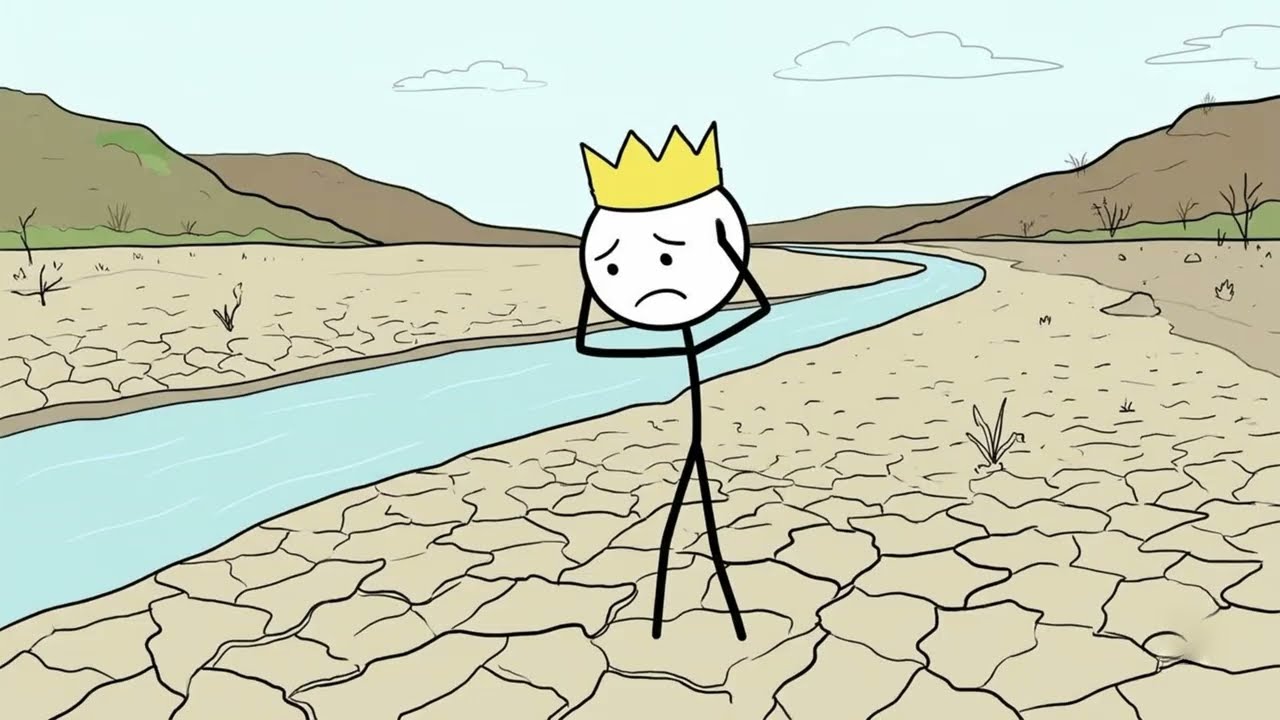
These eruptions pumped massive amounts of sulfur aerosols into the stratosphere, reflecting sunlight and cooling the planet. This cooling disrupted global atmospheric circulation patterns, specifically weakening the African monsoon. The rains in the Ethiopian highlands failed, and the Nile simply stopped flooding.
The consequences were apocalyptic. A volcano erupted somewhere on the planet, the sky changed imperceptibly, and thousands of miles away, millions of Egyptians starved to death. They had no knowledge of the distant geological forces at play.
They only knew that the river was dead, the fields were barren, and their living god had failed them. The illusion of divine control was shattered against the brutal, indifferent reality of climate change. The pharaoh’s power, which was predicated on his ability to control nature, evaporated overnight.
The people lost faith, and when a population loses faith in a living god, the entire political and religious structure unravels with terrifying speed. This environmental shock was the first, and perhaps most profound, death of Egypt.
Compounding this environmental disaster was a catastrophic failure of leadership at the highest level. This brings us to Pharaoh Pepi II, a figure who holds a grim record in human history: he likely reigned for 94 years, ascending to the throne as a child of six and simply refusing to die. On paper, a reign of nearly a century sounds like the ultimate period of stability.
In reality, it was a slow-motion administrative disaster. When one person stays in power for that long, they outlive everyone. They outlive their most capable administrators, their chosen successors, and the entire network of loyalty and competence that holds a government together.
The state apparatus, starved of fresh blood and new ideas, rotted away, replaced by an aging, out-of-touch god-king who had not seen the real world in decades.
As Pepi II aged into his nineties, central authority evaporated. The provincial governors, known as nomarchs, realized that no one in the capital was paying attention. They began to act as independent kings, ceasing to send taxes to the central government and instead building lavish tombs for themselves in their own provinces, a direct violation of the tradition of being buried near the pharaoh.
This was the archaeological equivalent of declaring independence. Pepi II was eventually forced to split the office of the vizier, his chief minister, into two—one for the north and one for the south—a silent, desperate admission that the central government had lost control. When he finally died, he left behind a fractured state with no clear successor, a kingdom already hollowed out by starvation and rebellion.
The combination of catastrophic drought and administrative collapse triggered the First Intermediate Period, a dark age of chaos and civil war. The visceral horror of this era is captured in the tomb inscription of a local governor named Ankhtifi, who wrote, “All of Upper Egypt was dying of hunger… Every man eating his own children.”
Historians debate whether this was literal truth or extreme rhetorical hyperbole, but even as hyperbole, it reveals a society in complete breakdown. When the baseline for “things are bad” is cannibalism, the civilization has devolved into a frantic, starving nightmare. The wealthiest, most powerful society on earth had collapsed into a desperate struggle for survival.
 Yet, this was not the end. Egypt died, but it also resurrected, and this cycle of death and rebirth would define its entire history.
The Old Kingdom collapsed into chaos, then slowly reformed into the Middle Kingdom. The Middle Kingdom eventually collapsed, then reformed into the New Kingdom. But with each resurrection, the state came back a little weaker.
The cultural output became more sophisticated, and the temples grew exponentially larger, but the structural integrity of the state was increasingly fragile. It was like a patient surviving a massive heart attack; they are still alive and might even start jogging again, but the heart muscle is scarred and will never function exactly the same way. The New Kingdom, from roughly 1550 to 1077 BC, is the version of Egypt most people know—the era of King Tutankhamun and Ramesses the Great.
This was Egypt acting as an aggressive global superpower, projecting military force deep into the Middle East. They were untouchable. Or so they thought, because even at the absolute peak of their power, the microscopic cracks were already showing, and they started not with foreign armies, but with the working class.
Let’s examine the year 1158 BC, during the reign of Ramesses III. In a village called Deir el-Medina, there lived an elite workforce of stonemasons, painters, and sculptors whose entire job was to build and decorate the royal tombs in the Valley of the Kings. They were paid in grain rations, oil, and clothing.
For weeks, the grain had not arrived. The government administration was heavily strained by costly wars and deep-seated corruption among local officials. The workers were literally starving while carving the eternal resting places of the living gods.
So, they did something completely unprecedented, something that should have been psychologically impossible in an autocracy. They stopped working. They laid down their chisels, walked out of the necropolis, marched toward the mortuary temples of former pharaohs, and sat down in the dirt, shouting, “We are hungry.”
This was the first recorded organized labor strike in human history. They deliberately chose the mortuary temples because they were sacred sanctuaries, offering physical protection from immediate violent retaliation by the state police. A local scribe named Amennakht wrote the whole thing down on papyrus, which is why we have a high-definition record of it today.
The authorities were completely paralyzed; you do not strike against a living god. Eventually, the officials caved and opened the temple granaries to pay the workers, but the strike happened again and again throughout the rest of Ramesses III’s reign. This is the exact moment the pharaoh lost absolute control.
When the people constructing your eternal afterlife realize they can simply say no and force you to pay them, the illusion of divine power is shattered. They were no longer working for a god; they were working for a boss who was late on payroll.
While the workers were striking, the rest of the world was literally burning to the ground. Around 1177 BC, the Late Bronze Age collapse hit the Mediterranean. It was a regional apocalyptic event.
The Mycenaean civilization in Greece was wiped out, and the Hittite Empire in Turkey collapsed entirely. The interconnected, globalized trade network of the Bronze Age completely disintegrated in less than 50 years. A major driver of this destruction was a group known to history as the Sea Peoples—a mysterious, heavily armed confederation of seafaring tribes who swept across the Mediterranean, destroying everything in their path.
The brutal truth about the Sea Peoples is that they likely weren’t just evil marauders acting out of malice; they were climate refugees, fleeing severe drought and systemic collapse in their homelands. They got on boats and kept moving, destroying cities out of sheer survival.
They eventually hit Egypt. Ramesses III fought them in desperate land and naval battles. The Egyptian archers reigned death on the invading ships, and Egypt won.
It was the only major superpower to survive the Bronze Age collapse. But surviving is not the same as winning. The monumental effort completely drained the Egyptian treasury.
Furthermore, because the entire Mediterranean trade network had collapsed, Egypt could no longer import the tin and copper it desperately needed to make bronze weapons. The regional economy was completely isolated. The state was financially hollowed out.
Egypt stood alone in a dark age, victorious but fundamentally broken. With the central government financially ruined, a new power structure emerged—and it wasn’t a new dynasty of warrior kings. It was the priests.
By the Third Intermediate Period around 1077 BC, Egypt effectively split in two. A pharaoh nominally ruled from the north, but the terrifying power in the south was held by the High Priests of the god Amun at Thebes. The temple of Amun at Karnak had become a massive, unstoppable economic engine.
 Over centuries, pious pharaohs had donated vast tracts of agricultural land and immense quantities of plundered gold to the temple. By this point, the temple was functionally a state within a state. It controlled its own agricultural production, had its own administrative bureaucracy, and even commanded its own military forces.
The High Priests of Amun were kings in all but name. When the religious institutions of a society become wealthier and more heavily armed than the secular government, the civilization is essentially consuming itself. The pharaoh was supposed to be the absolute center of gravity; now he was just another political player competing with a heavily weaponized clergy.
As the economy cratered and the government lost control of the provinces, people got desperate. In Egypt, desperation took a deeply ironic and highly blasphemous form: tomb robbing. During the 20th Dynasty, around 1100 BC, an epidemic of tomb robbing swept through the Valley of the Kings.
We know exactly how it happened because we have the actual court transcripts, known as the Tomb Robbery Papyri. The most disturbing detail is not that tombs were robbed; it’s who was doing the robbing. The thieves were the stonemasons, the craftsmen, and the security guards—the exact people hired by the state to build and protect the tombs.
They knew exactly where the hidden entrances were and used their specialized architectural knowledge to surgically strip the pharaohs of their gold. In Papyrus Leopold II, we have the forced confession of a man named Amenpanufer, who calmly described how his crew tunneled into the tomb of Pharaoh Sobekemsaf II, hacked through the outer coffins, stripped the mummy of its protective gold amulets, and set the physical body on fire.
To understand how catastrophic this is, you must understand Egyptian theology. The entire purpose of the tomb and the mummy was to preserve the soul for eternity. By hacking a mummy to pieces to steal a few ounces of gold, these thieves were not just committing a property crime; they were murdering a god.
They were literally destroying the eternal souls of their own ancestors to pay for their groceries. The local government officials were deeply complicit; the mayor of Western Thebes knew it was happening and was almost certainly taking a cut of the stolen gold to look the other way. When a society begins cannibalizing its own most sacred, fundamental beliefs just to survive the week, the end is very, very close.
While Egypt was busy eating itself from the inside, the rest of the world had moved on. The Bronze Age was over; the Iron Age had begun. Iron is significantly harder, sharper, and more durable than bronze.
It is also much cheaper to produce if you have access to the raw ore. And that was Egypt’s fatal geographic flaw. Egypt was built on sand, limestone, and river silt.
It had plenty of gold but almost no iron ore. The surrounding empires—the brutal Assyrians, the Babylonians, and the rising Persians—were rapidly equipping massive armies with iron weaponry. Egypt was still fielding armies equipped with expensive, inferior bronze.
In the ancient world, technological stagnation is a death sentence. When you are fighting with bronze swords against an enemy swinging iron swords, you don’t need to lose a hundred battles to lose a war; you just need to lose one battle at the wrong time. Egypt was trapped in a technological dead end.
Because of this internal rot and severe technological disadvantage, the last thousand years of ancient Egypt was essentially a humiliating conveyor belt of foreign invasions. First came the Libyans. Around 943 BC, Libyan mercenaries who had settled in the fertile delta slowly gained political control and established their own dynasties.
Egypt wasn’t conquered by a massive army; it was slowly absorbed from the inside by the people it had explicitly hired for security. Then came the Nubians. Around 747 BC, the Kingdom of Kush from the south swept up the Nile and conquered Egypt.
The tragic irony of the Nubian conquest is that the Nubian kings actually respected Egyptian culture more than the Egyptians did at that point. They built magnificent pyramids and desperately tried to restore the old traditions, but they were foreign rulers, and Egypt no longer had the cultural immune system to reject them. Then came the Assyrians in 671 BC, sacking Memphis and Thebes and stripping the ancient temples bare.
Then came the Persians in 525 BC, completely absorbing Egypt into the massive Achaemenid Empire. The Persian kings took the title of Pharaoh, but they were ruling from thousands of miles away in Iran. The Pharaoh was an absentee landlord collecting taxes.
Finally, the Greeks arrived. In 332 BC, Alexander the Great conquered Egypt without a fight. When Alexander died, his general Ptolemy took over and established the Ptolemaic Dynasty.
For the next 300 years, Egypt was ruled by a family of Macedonian Greeks. They lived in Alexandria, facing the Mediterranean rather than the Nile. They spoke Greek and operated under Greek culture.
They treated the native Egyptian population largely as an exploitable tax base. For nearly three centuries, the rulers of Egypt couldn’t even be bothered to learn the Egyptian language. That brings us to Cleopatra VII.
 She is famous for being the last pharaoh of Egypt, but what people constantly forget is that she wasn’t Egyptian; she was Greek. Cleopatra was actually the very first Ptolemaic ruler to bother learning the native Egyptian language. She was fiercely intelligent, ruthlessly pragmatic, and spoke nearly a dozen languages.
She knew exactly what was happening: Rome was the new apex predator in the Mediterranean, and Egypt was the wealthiest prey.
The popular image of Cleopatra as a seductive femme fatale who manipulated powerful men with her body is entirely Roman propaganda. Octavian, the future Emperor Augustus, desperately needed to destroy her reputation to justify a civil war against his rival Mark Antony. He framed Cleopatra as a dangerous foreign witch to make his political power grab look like a patriotic defense of Roman values.
Cleopatra didn’t lose because she was weak or distracted by romance. Her relationships with Julius Caesar and Mark Antony were desperate geopolitical alliances designed to keep the devastating Roman war machine off Egyptian soil. She lost because she was the captain of a ship that had been sinking for a thousand years.
She was brilliant, but you cannot out-diplomat gravity. In 30 BC, Cleopatra committed suicide rather than be paraded through the streets of Rome in chains. Octavian formally annexed Egypt, and it became the personal property of the Roman Emperor.
A 3,000-year run of independent pharaohs ended not with an apocalyptic battle, but with bureaucratic Roman paperwork.
But here is the final twist of the knife: Egypt didn’t disappear the day Rome took over. Mummification continued, the massive temples stayed open, and the peasants continued farming the Nile exactly as their ancestors had done for millennia. The true death of ancient Egypt was a painfully slow fade into irrelevance.
As Christianity took hold in the Roman Empire, the old temples were forcefully closed or converted into churches. The priesthood, the only people on earth who still knew how to read and write hieroglyphics, slowly died out. The very last known hieroglyphic inscription was carved on the walls of the temple of Philae in the year 394 AD, over 400 years after Cleopatra died.
The language itself didn’t vanish entirely; it slowly evolved into Coptic, which is still used as a liturgical language in the Coptic Orthodox Church today. The final echoes of the pharaohs are still spoken in Sunday prayers. It wasn’t until 641 AD, when Arab armies conquered Egypt and brought Islam and the Arabic language, that the ancient cultural continuity was finally severed.
It took nearly 700 years after the fall of Egypt for the corpse to finally turn to dust.
Ancient Egypt did not fall for one single reason. It fell for all the reasons simultaneously, over such a long period of time that nobody living through it ever realized they were witnessing the end of the world. The climate changed, which caused famine.
The pharaoh lost his divine aura. Power decentralized. Bureaucrats became corrupt.
The workers went on strike. The priests hoarded the wealth. The people robbed the sacred tombs just to survive.
The military fell behind technologically. Foreign empires chipped away at the borders. And finally, a superior global superpower simply absorbed them.
Every single step in this process took centuries. The people living in 1100 BC didn’t know they were in the decline; they just thought, “Man, grain is really expensive this year, but surely next year will be better.” And that is perhaps the most terrifying lesson of all.
You do not know when you are living in a collapse. The apocalypse does not come with a cinematic soundtrack and a massive explosion. It looks like slow bureaucratic failure, persistent supply chain issues, vital infrastructure rotting while the richest people build elaborate monuments to themselves.
It looks like just another bad year. Ancient Egypt lasted 3,000 years, the longest-running, most successful civilization human beings have ever built, and it still wasn’t enough to save them.