In the winter of 373 BCE, the Greek city of Helike—home to a temple of Poseidon second in fame only to the oracle at Delphi—vanished in a single night. The ground opened, the city sank, and the sea swallowed it. All of its people and the ten warships anchored in its harbor went down with it. Days earlier, residents had noticed something strange: rats poured out of the granaries, snakes left their burrows in the middle of winter, and every crawling thing moved toward the hills.
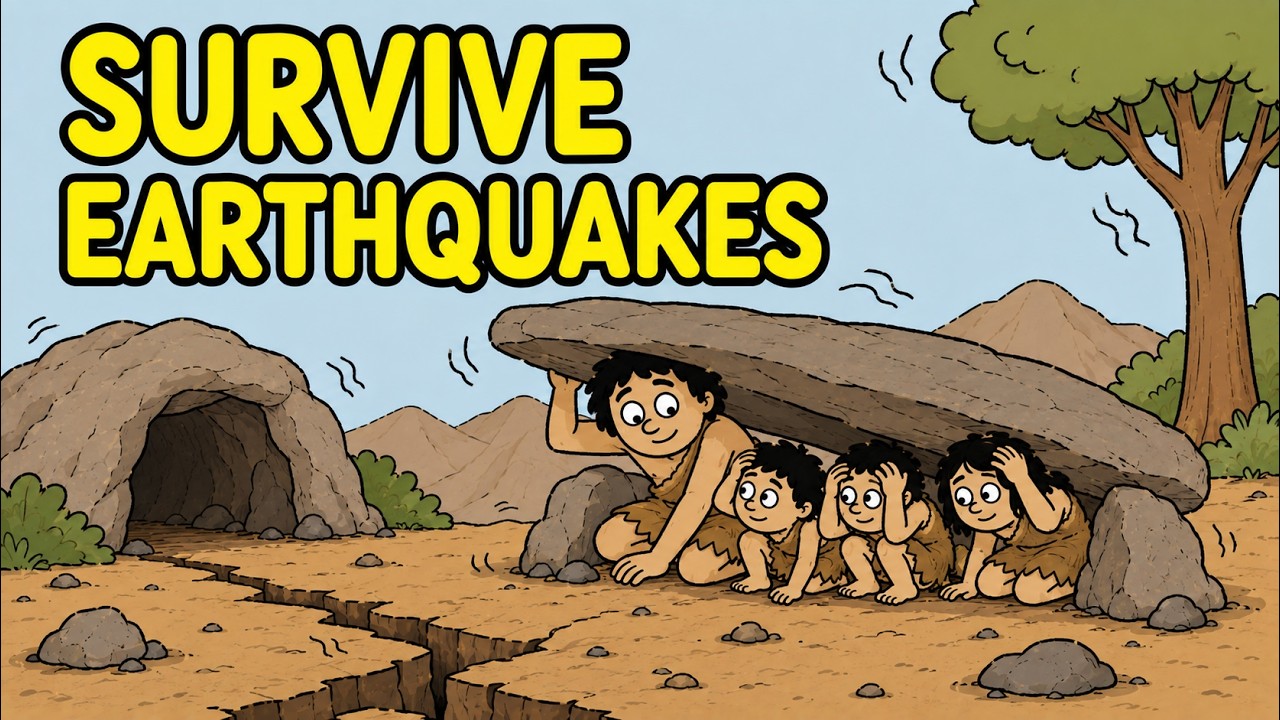
The people had no name for what was coming. More than 500 years later, a Greek traveler could still see the tops of walls standing under the water, worn smooth by the salt. What destroyed Helike was an earthquake, the sudden release of energy that had been building for millennia as two massive rock slabs ground against each other beneath the coast. Unlike floods, droughts, or storms, which announce themselves in advance, an earthquake gives nothing.
Even today, with satellites, seismometers, and supercomputers, scientists cannot say the exact day one will strike. The real question is not why ancient people feared earthquakes—it is how they managed to keep living on the most dangerous ground on the planet for thousands of years. The answer is not luck. It is a story of mythology functioning as memory, engineering built from trial and error, and communities slowly turning an unpredictable mystery into a hazard that could at least be partly managed.
Myths that blamed earthquakes on an angry Poseidon, a giant catfish named Namazu in Japan, or a serpent and thunderbird in North American traditions are often dismissed as superstition. But they served two practical purposes. They gave survivors a sense of agency—offer a sacrifice, perform a ritual, follow certain rules—at a moment when they had none. And they encoded the memory of a disaster into a portable story that would be repeated for generations, warning descendants that this ground was dangerous long after written records faded.
Long before cities, hunter-gatherers lived through earthquakes in a way that made them nearly harmless. Their shelters—hide stretched over wooden poles, brush huts, or caves—had almost no mass compared to heavy buildings. When the ground moved, the poles flexed and the hide fluttered. Even a full collapse rarely crushed the people inside.
The most primitive form of shelter was, in a narrow sense, among the safest ever built. That safety disappeared with the Neolithic Revolution. Permanent settlements needed permanent walls of sun-dried mud brick and stacked stone. These materials can hold enormous weight pressing straight down, but they are far weaker against a sideways shove—exactly what an earthquake delivers.
Once a wall lost its grip on the roof above it, gravity finished the job. Civilization had traded flexibility for permanence, and permanence is what an earthquake exploits. If this were simple bad luck, ancient people might have avoided the most dangerous ground. Instead, the opposite happened.
Map the world’s great ancient civilizations against major fault lines, and the maps line up with startling precision. Greece, Anatolia, Italy, China, Japan, and the Inca Empire all built on active seismic zones—not because they ignored the danger, but because fault zones create springs, defensible ridgelines, natural harbors, and volcanic soil so fertile it attracted settlement. Ancient people were making a calculated trade between certain benefits and an uncertain, unpredictable cost. The Greeks left the earliest clear record of learning from earthquakes.
Temple builders working in massive cut stone noticed that structures on loose, waterlogged coastal soil were shaken apart again and again, while buildings on solid bedrock survived the same earthquake intact. This was one of the earliest recorded observations of what modern engineers call soil amplification—loose or wet ground shakes far more violently than solid rock. The Greeks had no vocabulary for it, but pattern recognition built from repeated disaster began shaping where they built. The Romans took the next step and engineered solutions on purpose.
Their breakthrough was a form of concrete called opus caementicium, made from volcanic ash, lime, and water. Recent laboratory analysis revealed a deliberate technique called hot mixing, which left small white deposits called lime clasts throughout the concrete. Long dismissed as sloppy mixing, these clasts turn out to be closer to a built-in repair kit: when a crack forms, water seeps in, dissolves the clasts, and the resulting reaction fills the crack from the inside. Roman concrete could partially heal itself, something modern concrete generally cannot do.
Roman engineers combined that material with deliberate structural choices. Massive buildings like the Pantheon rested on wide, continuous foundation slabs that spread the load evenly. They inserted horizontal bands of terracotta tiles through entire walls; under severe shaking, the mortar around these bands could slip, bleeding off energy instead of letting it build into a single catastrophic crack. Some Roman concrete structures built more than 2,000 years ago are still standing today.
On the other side of the world, Japanese builders arrived at the opposite solution, and it worked just as well. Living above some of the most seismically violent territory on Earth, they abandoned heavy stone in favor of timber—woods known for high strength relative to weight and genuine elasticity. Stone resists force by being immovable; wood survives by bending and springing back. The clearest proof is the traditional five-story wooden pagoda, first built in the 6th century.
Across roughly 14 centuries of Japanese earthquakes, only two are known to have collapsed from seismic shaking. The secret lies in three features working together. Each of the five stories is a separate box resting loosely on the story beneath it, so each floor sways slightly out of rhythm with the others, preventing one large resonant motion from tearing the tower apart. A single massive timber column called the shinbashira runs through the core—but it does not hold up the roof.
In many designs it hangs freely, acting like a stabilizing pendulum; as the outer structure sways against it, friction absorbs energy. And the wide, heavy eaves work like a tightrope walker’s balance pole, resisting sudden rotation. China developed an equally ingenious system called dougong, appearing more than 25 centuries ago. Interlocking wooden brackets and blocks, joined with no nails, no glue, no metal fasteners, sit beneath the eaves and distribute roof weight into the columns.
Under lateral force, these joints shift and slide against each other by tiny amounts, and every small movement converts earthquake energy into harmless heat through friction. Chinese builders often avoided anchoring columns deep into the ground, resting them on stone pedestals instead, so a column could slide slightly across its base during a quake—an early version of what modern engineers call base isolation. China also produced the first known instrument built to detect an earthquake happening elsewhere. In 132 CE, Han Dynasty scholar Zhang Heng presented a large bronze vessel with eight dragon heads, each holding a bronze ball.
Inside, a sensitive pendulum mechanism triggered a lever when a distant seismic wave reached the capital, causing a dragon to release its ball into the mouth of a bronze toad below with a loud clang, indicating the direction of the quake. In 138 CE, the device dropped a ball signaling an earthquake to the west, though nobody in the capital felt anything. Skeptics dismissed it as a malfunction. Days later, a messenger arrived from hundreds of miles to the west reporting that a serious earthquake had struck at almost exactly that time.
No original survives, and modern replicas have never matched the sensitivity described in ancient records. Across all these approaches lies one principle ancient builders discovered through pure trial and observation: a rigid structure resists force until the instant it exceeds what the material can handle, then fails suddenly and completely. A flexible structure bends, absorbs the force through that bending, and springs back. Flexibility does not mean weakness—in an earthquake, it often means the difference between a building that cracks and a building that survives.
Ancient builders learned by watching buildings fail and changing what they built next. Across Greece, Anatolia, and the Levant, after major earthquakes, upper floors were rebuilt with lighter timber frames filled with wickerwork and plaster; builders ran horizontal timber beams through masonry walls to tie them together; roofs got lighter and building heights came down. None of it came from physics worked out on paper. It happened because a wall collapsed, someone survived to rebuild, and the next version was built a little differently—functionally close to an engineering code built entirely from lived experience.
Communities also watched for signs. Diodorus Siculus recorded that rats, snakes, weasels, and centipedes abandoned Helike five days before the quake. Roman writers like Pliny the Elder documented wells changing level or turning cloudy, strange smells, and low rumbling before major earthquakes. Modern seismology treats these reports with serious interest: before a major fault ruptures, surrounding rock can fracture in tiny amounts, releasing gases into groundwater and slightly changing water chemistry, and some animals appear sensitive to the earliest, fastest P waves that arrive just before the destructive S waves humans feel.
But these signs are inconsistent, appearing before some earthquakes and not others. They have never been turned into a dependable warning system. Surviving the shaking was never the whole story. The hours and days after brought destroyed water systems, buried food supplies, and injured people.
Recovery depended overwhelmingly on cooperation. In Roman, Han Chinese, and Inca societies alike, families and local guilds organized search efforts by hand. Communal grain stores were opened and redistributed. In the Inca Empire, the mandatory public labor system called the mita was redirected after earthquakes to clear landslides, rebuild terraces, and restore water channels.
Communities with strong social bonds recovered; those that fractured under pressure sometimes never rebuilt at all. Some earthquakes changed political history. The destruction of Helike eliminated one of the most significant cities in the Achaean League overnight. In 115 CE, Emperor Trajan was staying in Antioch during a military campaign when a violent earthquake struck; he reportedly had to escape through a window, suffering minor injuries.
In 17 CE, a nighttime earthquake destroyed 12 major cities across the Roman province of Asia. Emperor Tiberius granted the affected cities a five-year tax exemption and authorized 10 million sesterces for reconstruction—one of the earliest documented examples of a government treating disaster relief as a formal responsibility of the state. Religious life absorbed much of the psychological weight. After major quakes, temples were rebuilt larger, new rituals introduced, and pilgrimages increased.
Some of the most important religious sites were built directly on active fault systems. The Oracle at Delphi sat above fractures now understood to have released hydrocarbon gases into the chamber beneath the temple, gases plausibly connected to the trance states of the priestess. The geological instability that made a location dangerous also made it sacred. The myths functioned as something closer to an oral hazard map than superstition.
In societies without accessible written records, safety information had to travel some other way—so it was encoded into stories, place names, and taboos. A legend warning that a certain hillside was cursed, or that a marshy coastline belonged to angry spirits, often preserved real knowledge that this ground had a history of collapse, sliding, or turning to liquid mud during quakes—a phenomenon known today as soil liquefaction. Strip away the supernatural framing, and what remains is empirical observation translated into a form that could survive generations of retelling. A consistent set of unwritten rules emerges across civilizations that otherwise shared almost nothing: build lower rather than taller; favor flexible materials; avoid unstable ground; isolate the foundation; keep structures symmetrical; build in redundancy.
None of these ideas required calculus. They required paying attention to what kept falling down and what didn’t. What is remarkable is how many of these ancient solutions remain inside modern buildings. The unanchored stone pedestals are the direct ancestor of base isolation; the modern high-rise at 680 Folsom Street in San Francisco rests on a sliding friction pendulum bearing—essentially the same idea as a column resting freely on a stone base 2,000 years ago.
The free-hanging shinbashira inspired a similar central damping system built into the Tokyo Skytree. Engineers are experimenting with three-dimensionally printed interlocking concrete blocks that borrow their geometry from ancient dry-stone masonry, and cement companies are studying Roman hot-mixed concrete hoping to recreate self-healing properties in modern low-carbon concrete. Some of the most advanced earthquake engineering being built today is a rediscovery of principles ancient builders worked out without mathematics, purely through generations of watching what survived. There is one more layer to this comparison.
Modern buildings are engineered to a precision ancient builders could never have achieved, and modern seismic codes save enormous numbers of lives. But modern cities have become dependent on centralized, interconnected systems—regional power grids, fiber-optic communication networks, pressurized water pipes, and food supply chains stretching across entire countries. A large earthquake today can leave every code-compliant building standing and still leave an entire region without power, water, communication, or fresh food for days, simply by severing a few critical connection points. Ancient societies generally did not face that problem because their systems were local by default: stone, clay, and timber sourced nearby, water from a well within walking distance, recovery dependent on the physical labor of neighbors and family.
It is a genuine trade-off—today’s structures are dramatically better at surviving the shaking itself, while yesterday’s communities were, in some specific ways, more resilient once the shaking stopped. The single idea connecting all of these civilizations is this: none of them ever defeated earthquakes. Nobody has. Two thousand years of engineering progress have produced no method for stopping a fault line from slipping.
What every society actually achieved was something more modest and, in the long run, more powerful. They learned, disaster by disaster, generation by generation, how to bend instead of break, how to notice a warning sign however unreliable, and how to rebuild together instead of scattering. The civilizations that treated their buildings and knowledge as fixed and finished suffered the same catastrophic failures over and over. The ones that treated every disaster as a lesson to be carried forward were the ones still standing centuries later.
The tectonic plates that destroyed Helike are the same plates still grinding beneath the planet today. They moved under the Egyptians while the pyramids were built, under the Romans while Trajan climbed out of a window in Antioch, under the Han Dynasty court the night Zhang Heng’s bronze dragon released its ball. They are moving right now beneath cities that did not exist when any of these stories took place. Earthquakes have never distinguished between an empire at its peak and a village of a few dozen people.
And yet, across every one of these cultures, after unimaginable loss, humans kept coming back to the same ground, kept rebuilding, and each time built something a little smarter than what stood there before. Not because they defeated the earth, but because they refused to stop learning from it. That refusal to stop paying attention, more than any single invention or building technique, is the unbroken thread connecting every engineer alive today still studying how to build something that can survive the next time the ground decides to move.