The deep ocean is not a silent, empty void. It is a world under crushing pressure—what researchers describe as an “iron weight” that shapes every form of life that survives there. As you descend, the pressure increases by one atmosphere for every ten meters. At 200 meters, red light has vanished entirely, leaving only a haunting blue dimness at the edge of the twilight zone.
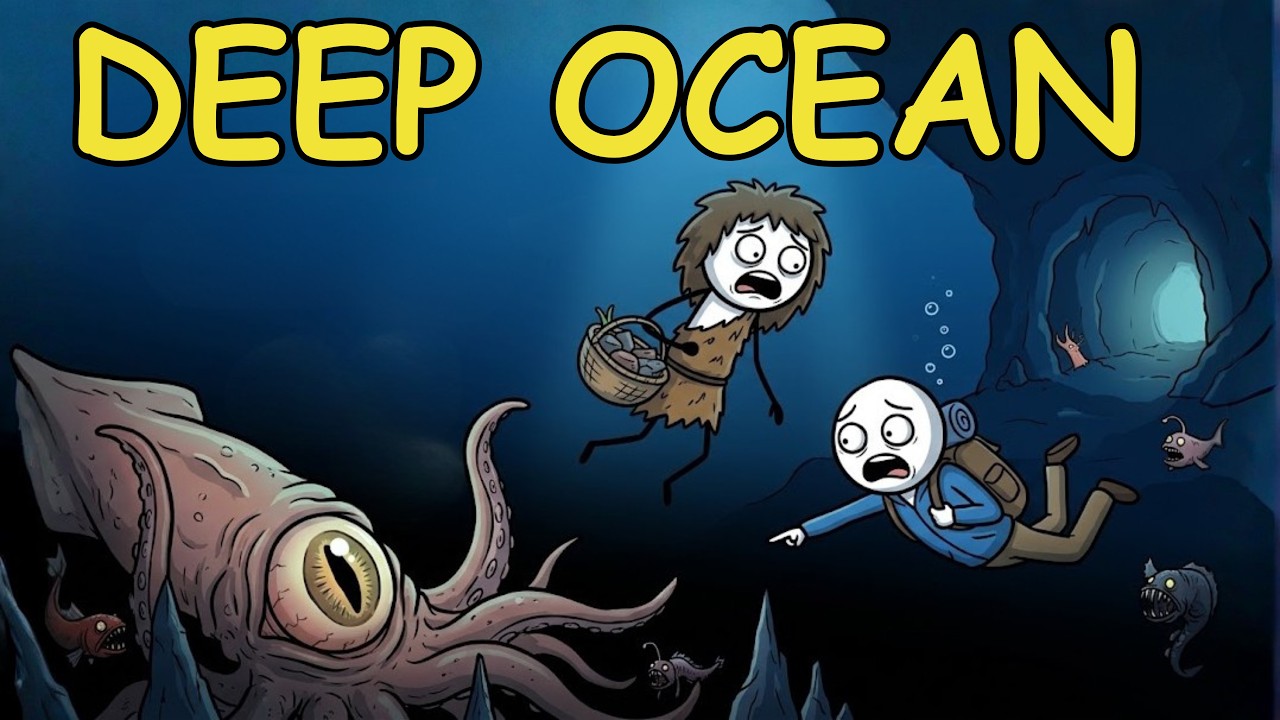
In 1934, William Beebe and Otis Barton became the first humans to observe this world directly, descending in their primitive bathysphere. They described bioluminescent sparks flickering like dying embers and a landscape that felt alien to our own planet. Decades later, technology finally caught up with their observations. The barreleye fish, Macropinna microstoma, was first captured by researchers at the Monterey Bay Aquarium Research Institute.
For years, scientists only saw specimens destroyed by collection nets, their delicate transparent heads mangled beyond recognition. It wasn’t until 2004, when the remotely operated vehicle Tiburon filmed one alive, that the truth emerged: the barreleye has a fluid-filled transparent dome on its head, with glowing green eyes that rotate upward to scan for prey silhouetted above. It looks through its own skull to survive. Below 1,000 meters lies the midnight zone, where sunlight never reaches and pressure exceeds 100 times that at the surface.
Here, light itself becomes a weapon. Most deep-sea creatures can only see blue light, since blue travels farthest through water. But the dragonfish, Malacosteus niger, produces a beam of red light from organs beneath its eyes—light that is invisible to nearly every other creature in its ecosystem. Dr.
Edith Widder, a leading bioluminescence expert, has called this one of the most unfair advantages in the natural world. The pressure also shapes reproduction. Anglerfish males, tiny compared to their female counterparts, face near-impossible odds of finding a mate in the vast blackness. When one finally does, he bites the female and releases an enzyme that dissolves both his face and her skin, fusing their bloodstreams.
He loses his eyes, brain, and organs, becoming a permanent parasite—nothing more than a source of sperm. Theodore Pietsch, a systematist at the University of Washington, has documented females carrying up to eight of these shriveled male husks. At 4,000 meters, the abyssal plain covers more than half the planet. This is the largest habitat on Earth—a vast, muddy desert under 400 atmospheres of pressure.
Here, biology encounters the carbonate compensation depth, below which calcium carbonate dissolves in the cold, pressurized water. Creatures with shells or bones literally have their armor eaten by the seawater itself. Giant isopods, resembling football-sized wood lice, can survive four or five years without food, waiting for a whale fall—a dead whale sinking from above that becomes a feast lasting decades. The deepest trenches push life to its absolute limit.
At the bottom of the Challenger Deep in the Mariana Trench, nearly 11 kilometers down, pressure reaches eight tons per square inch. For years, scientists assumed this realm was silent. But in 2015, researchers from NOAA and Oregon State University lowered a titanium-encased hydrophone into the trench and discovered it was filled with sound: the moans of baleen whales from miles above, the grinding of tectonic plates, and the muffled roar of surface storms. In 2017, a team led by Dr.
Alan Jamieson from the University of Newcastle discovered the hadal snailfish, Pseudoliparis swirei, living at depths beyond 8,000 meters. The pale, translucent fish has no scales and its bones are made of flexible cartilage—hard bone would shatter under the pressure. It produces a molecule called TMAO that props up its proteins so they don’t collapse, allowing it to swim gracefully through conditions that would crush a steel submarine. That same expedition produced a darker discovery.
When researchers sampled amphipods from the very bottom of the Mariana Trench, they found the creatures contaminated with PCBs and flame retardants—chemicals banned in the 1970s. They also found microplastics in the guts of creatures that have never seen sunlight. Human pollution has reached the most remote place on the planet, deeper than any human has ever traveled. The deep ocean remains largely unmapped.
We have higher-resolution maps of Mars and the Moon than of this realm that covers most of our planet. Yet we have already left our fingerprints on its floor. The ocean census of 2024 continues to reveal new species, including glowing red sea tomatoes and flesh-eating coral, reminders that most of the deep remains unknown territory. Life in the deep did not evolve to be frightening.
It evolved to survive an environment where every rule of the surface world is suspended. The creatures down there have made peace with the squeeze. They do not find their world creepy; they call it home. The unease we feel when contemplating the deep is simply our instinct recognizing that we are intruders in a place that has no use for the sun.
The pressure of the ocean is the pressure of time itself, pressing down on secrets that may never be fully uncovered. We have reached the bottom with our waste, but we are still far from reaching it with our understanding. The deep ocean doesn’t need our light to be beautiful, nor our understanding to be complete.
It only needs the weight of the water to keep its own counsel, as it has since the beginning of time and will long after we are gone.