I found the envelope by accident, tucked between two worn cookbooks on the shelf behind the register. Yellow with age, my name written across the front in handwriting I would know anywhere. Inside was a check for two hundred eighty thousand dollars, made out to me, signed by Maria. My hands were shaking as I slid it back into the envelope and tucked it into my apron pocket.
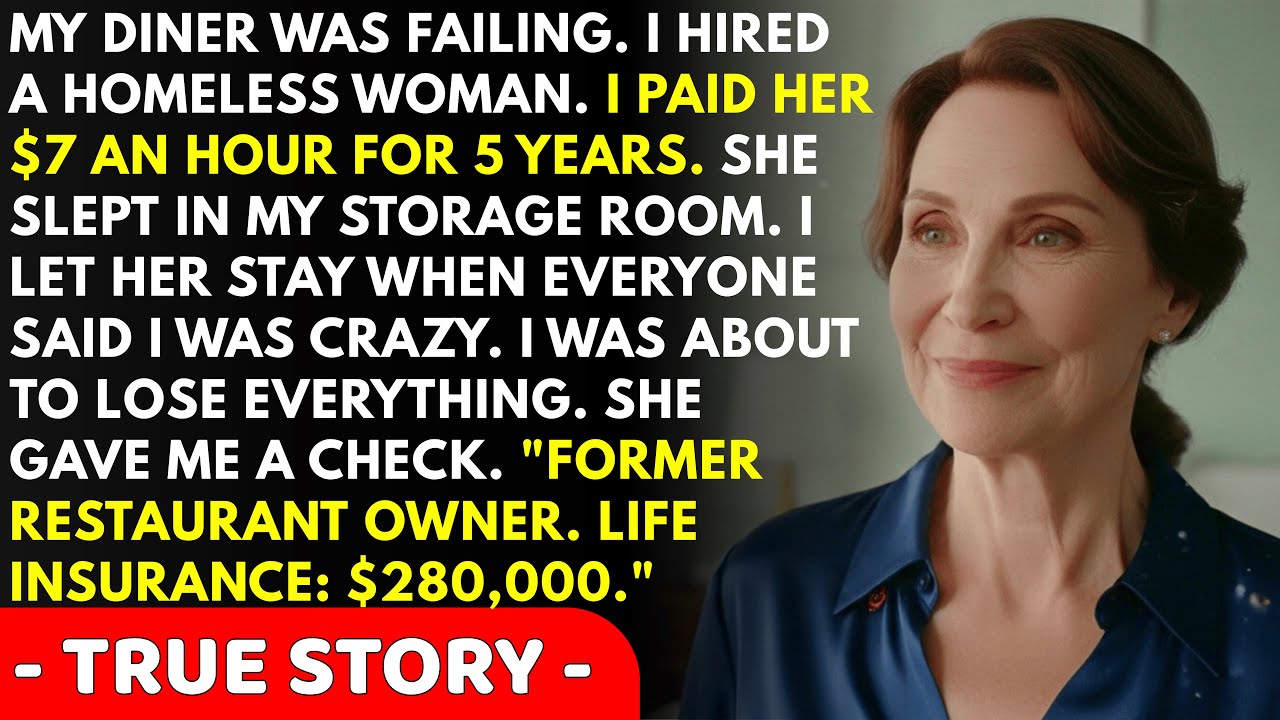
The lunch rush was starting and I had tables to serve, but my mind had traveled somewhere else entirely. Five years back, to a rainy Tuesday morning when everything in my life was falling apart. I was sixty-two years old and about to lose everything. The diner had been in my family for forty years.
My parents opened it in 1984, and when they passed, I took over. It was supposed to be my retirement plan, my legacy to pass down to my daughter Rachel. But Rachel had moved to Seattle for her tech career, married a software engineer, and made it clear she had no interest in a greasy spoon diner in Cleveland, Ohio. I couldn’t blame her.
She wanted more than I had. That’s what mothers want for their daughters, isn’t it? But then the neighborhood changed. The factory closed.
People moved away. The regulars got older, stopped coming. Coffee shops with Wi-Fi and avocado toast replaced places like mine. My daily customer count dropped from fifty to twenty, then to ten.
Some days, nobody came at all. The bank had sent the final notice. I had thirty days to pay the back mortgage or they’d foreclose. Sixty thousand dollars I didn’t have.
I’d already sold my car. I was taking the bus to work. I’d stopped buying groceries, just ate the leftover soup and day-old bread from the diner. My apartment rent was three months overdue.
Rachel offered to help, but she just had her second baby. She had her own mortgage, her own life. I couldn’t take money from my daughter. What kind of mother would I be?
That’s when I met Maria. She came in on a Tuesday morning, soaking wet from the rain. No umbrella, no coat, just a thin sweater and jeans that had seen better days. She was probably in her fifties, though the streets age you fast and it was hard to tell.
Her gray hair was pulled back in a messy ponytail. She carried a backpack that looked like it held everything she owned. “Coffee,” she said, sitting at the counter. “Please, just coffee.
”
I poured her a cup. She wrapped both hands around it like it was the most precious thing in the world. “Anything to eat? ” I asked.
She looked at the menu, then at me, then back at the menu. “How much is toast? ”
“Buck fifty. ”
She opened a small change purse and counted out quarters and dimes.
A dollar thirty-five. She looked up at me with tired brown eyes. “I’m fifteen cents short. ”
I should tell you what the smart thing was, the safe thing.
I was about to lose my business. I couldn’t afford to give away food. But something about her—I don’t know. She reminded me of my mother, maybe.
Or maybe of myself. “Toast is on the house,” I said, dropping two slices in the toaster. She looked at me like I’d just handed her a winning lottery ticket. “Thank you.
”
We got to talking. Her name was Maria. She’d been staying at the shelter on Ninth Street, but they’d kicked her out for missing curfew. She’d been looking for work, but nobody wanted to hire someone with no address, no phone, no references.
“Can you cook? ” I asked. She laughed. “Can I cook, lady?
I can cook anything. ”
I don’t know what made me say it. Maybe desperation. Maybe loneliness.
Maybe something else entirely. “I need help here. Breakfast and lunch shift. Can’t pay much—seven dollars an hour cash—but you can eat here.
And there’s a storage room in the back with a cot. It’s not fancy, but it’s dry and it locks. ”
She stared at me. “You’re offering me a job just like that?
”
“Just like that. But you have to show up every day at six in the morning. ”
“I’ll be here at five-thirty,” she said. And she was.
The next morning, she stood outside when I arrived to unlock the door at 5:15. She’d showered somehow, somewhere. Her hair was damp and clean. She wore the same clothes, but they’d been washed.
“Put you to work right away? ” I asked. “Please. ”
I showed her the kitchen—the ancient stove with the burner that didn’t light, the freezer that ran too cold, the dishwasher that only worked if you kicked it first.
She nodded at everything like she was taking mental notes. “Start with prep,” I said. “Chop the onions, dice the peppers, get the potatoes ready for hash browns. ”
She moved through the kitchen like she’d been there her whole life.
Her knife work was fast and precise, restaurant quality. She didn’t waste a single motion. By 6:30 we were ready for the morning rush, except there was no rush. Three customers between six and nine, but Maria cooked each order like it was for the president.
Perfect eggs. Hash browns crispy on the outside, soft in the middle, toast buttered to every corner. “You’ve done this before,” I said. “Long time ago,” she said.
She didn’t elaborate and I didn’t push. My daughter called that night. “Mom, you did what? ”
“I hired someone.
”
“You can’t afford to pay yourself, and you hired someone? A homeless woman? Mom, are you insane? ”
Maybe I was.
Rachel certainly thought so. She drove down from Seattle the following weekend just to talk sense into me. “You don’t know anything about this woman,” Rachel said, pacing in front of the counter while Maria worked in the back. “She could rob you.
She could hurt you. She’s living in your storage room, Mom. All the cash from the register is right there. ”
“She’s not going to rob me.
”
“How do you know that? ”
“I just know. ”
“That’s not good enough. What about background checks?
What about references? ”
“Rachel. ” I put my hand on her arm. “I know what I’m doing.
”
I didn’t really, but something told me this was right. Rachel left, shaking her head, making me promise to call the police if anything seemed off. I promised, even though I knew I wouldn’t need to. The first month, nothing changed with the business.
We still barely had customers. I still couldn’t pay the mortgage. But the diner was cleaner than it had been in years. Maria scrubbed the grout between the tiles.
She organized the dry storage. She fixed the wobbly table by the window using just a book of matches and some wood glue. “Where’d you learn that? ” I asked.
“Library has computers,” she said. The second month, she started making suggestions. “The coffee is stale. When did you buy these beans?
”
“About six months ago. ”
“You need fresh coffee, and you’re making it too weak. People can taste the difference. ”
She was right.
I bought fresh beans from the supplier and made it stronger. Two regulars mentioned it tasted better. Then she started on the menu. “Your pancakes are just okay.
But I know a recipe—my grandmother’s. You add a little cinnamon, a touch of vanilla, use buttermilk instead of regular milk. Makes them fluffy. Special.
”
“We don’t have buttermilk. ”
“I’ll make it. You have milk and lemon juice, right? ”
Her pancakes were incredible.
Light, fluffy, with this subtle sweetness that wasn’t too much. I put them on the menu as Maria’s Grandmother’s Pancakes and priced them fifty cents higher. People started coming back for them. Then she fixed the bathroom sink without me asking.
Then she repainted the front door. Then she reorganized the entire kitchen so everything was more efficient. “Where did you learn all this? ” I asked one night as we were closing.
She was quiet for a long time, wiping down the counter. “I used to run a restaurant,” she finally said. “Different life. ”
“What happened?
”
“Life happened. ” She didn’t look at me. “I made mistakes. Lost everything.
It doesn’t matter now. ”
But it did matter. I could see it in the way she moved through the kitchen, the way she looked at the menu, the way she checked the quality of every ingredient. This wasn’t just a job for her.
This was something deeper. By the fourth month, business was picking up. Not a lot, but enough to notice. We had regulars again.
The pancakes brought people in, but they stayed for the coffee, the friendly service, the clean bathroom, the food that tasted like someone actually cared. I still couldn’t pay the mortgage, though. The deadline was approaching fast. I’d managed to scrape together forty thousand from the improved business, but I was still twenty thousand short.
The bank wouldn’t budge. I didn’t tell Maria. What could she do? She was barely making enough to save for a security deposit on an apartment.
I wasn’t going to burden her with my problems. But Maria noticed everything. “You’re stressed,” she said one morning. “I’m fine.
”
“You’re not fine. You keep checking your phone. You’re not sleeping. I can see it.
”
I tried to smile. “Just business stuff. Nothing to worry about. ”
“The mortgage,” she said.
It wasn’t a question. I nodded. “I have two weeks. I’m twenty thousand short.
”
She didn’t say anything. Just went back to chopping onions. I thought that was the end of it. Three days later, everything fell apart all at once.
The oven stopped working, died in the middle of the breakfast rush. The repair guy said it would cost four thousand to fix or eight thousand to replace. I had neither. Then the health inspector came—first time in two years—and found a leak I didn’t know about, mold behind the wall.
Said I had to fix it immediately or he’d shut me down. Another three thousand. Then my landlord called. He was selling the building.
I had thirty days to vacate unless I wanted to buy it. Ninety-five thousand dollars. I sat in the diner after close, alone in the dark, and cried. Really cried for the first time since my husband died.
Forty years, and it was all going to end. I’d lose the diner, lose my apartment, have nothing. I’d have to move to Seattle, live with Rachel, be the burden I never wanted to be. That’s when Maria came out from the back.
I thought she’d gone home, but she’d been there the whole time. She sat next to me at the counter and didn’t say anything. Just sat there while I cried. Finally, when I could breathe again, she said, “How much do you need total?
”
I laughed. It was a broken sound. “More than I’ll ever have. Twenty for the mortgage, seven for the repairs, ninety-five for the building if I want to buy it.
A hundred and twenty-two thousand. ”
She was quiet for a long moment. Then she stood up, went to the back, and came out with an envelope. “What’s this?
” I asked. “Open it. ”
Inside was a check made out to me. Two hundred eighty thousand dollars.
The signature at the bottom said Maria Elena Rodriguez. I stared at it, then at her, then back at the check. “This is a joke. This can’t be real.
”
“It’s real. ”
“Maria, where would you get this kind of money? ” I stopped myself. “Your—”
“Homeless?
” she finished. “I was. I’m not anymore. Thanks to you.
”
“I don’t understand. ”
She sat back down and took a deep breath. “Twenty years ago, I owned three restaurants in Miami. High-end places.
My husband and I built them from nothing. We were successful, very successful—worth about fifteen million between the restaurants and our investments. ”
I couldn’t breathe. “Then he died.
Heart attack. He was fifty-three. And I fell apart. Completely.
Started drinking. Stopped managing the restaurants. Made bad decisions. Lost everything in three years.
The restaurants, the house, the money—all of it. ” She looked at her hands. “I ended up on the streets. Five years I was out there.
Shelters and soup kitchens and sleeping under bridges. I tried to get help, but when you’re that far down, it’s almost impossible to climb back up. Nobody will hire you. Nobody will rent to you.
You’re invisible. ”
“But the check—”
“My husband had a life insurance policy I didn’t know about. Five hundred thousand dollars. The company couldn’t find me for years because I had no address.
They finally tracked me down six months ago through Social Security. Put it in a trust account in my name. I’ve been trying to figure out what to do with it. ” She looked at me.
“Then you gave me toast. Fifteen cents of toast, and a job, and a place to sleep, and your trust. You didn’t know me. You had every reason to say no.
You were about to lose everything yourself, and you still helped me. ”
Tears were running down my face again. “You gave me my life back,” she said. “You treated me like a human being when the rest of the world looked right through me.
This? ” She tapped the check. “This is nothing compared to what you gave me. ”
“Maria, I can’t take this.
”
“Yes, you can. Buy the building. Fix the oven. Pay off the mortgage.
Keep this place running. It’s what your parents would want. It’s what I want. ”
“But what about you?
You could get your own place. Start over. ”
“I am starting over. Here.
If you’ll still have me. ”
I hugged her. We both cried. I deposited the check the next day, terrified it wouldn’t clear.
It did. I bought the building, fixed the oven, paid off the mortgage. With the money left over, I gave Maria a real salary with benefits. She moved out of the storage room and into a nice apartment two blocks away.
But she still showed up every morning at 5:30. We renovated the diner over the next year. Nothing fancy, but we made it warm and welcoming. Maria developed new menu items.
We started doing dinner service three nights a week. Business grew. Rachel came to visit six months later. She watched Maria work, watched the customers, watched the whole operation we’d built.
“I was wrong,” she said. “About Maria. About everything. ”
“I know.
”
“How did you know, though? How did you know you could trust her? ”
I thought about it. “I didn’t know.
I just hoped. And sometimes hope is enough. ”
The diner is thriving now. We have regular customers who come in every day, families who’ve made it their Sunday morning tradition, kids who order Maria’s pancakes and wear whipped cream mustaches.
Maria became my business partner last year. She owns forty percent. She insisted I keep majority ownership, but I wouldn’t have it any other way. This is as much hers as it is mine.
She still comes in at 5:30 every morning. Sometimes I ask her why she doesn’t sleep in, take a day off, enjoy her life. “This is my life,” she always says. “This is exactly where I want to be.
”
I found that envelope with the check last week while organizing the office. I never cashed it. I’d forgotten it was there, to be honest. When I asked Maria about it, she laughed.
“I wrote you another one and put it in the mail. Figured you lost the first one. ”
“I deposited a check from you for two hundred eighty thousand. That was the second one?
”
“There were two checks. I kept writing them until one went through. I think I wrote four before you finally deposited one. ”
I just shook my head.
That’s Maria. Stubborn and generous and completely impossible. Rachel is pregnant again, her third child. She called last week and asked if I’d come stay with her for a month after the baby is born.
“I can’t leave the diner,” I said. “Mom, Maria can handle it. ”
“I know she can. But who’s going to make sure she actually takes her lunch break?
”
I could hear Maria muttering something about stubborn old women in the background. We’re opening a second location next year. Maria’s idea. She says there are too many people in this city who need a place that serves good food at fair prices, made by people who care.
A place where you’re not invisible. Where fifteen cents won’t stand between you and a meal. I’m seventy years old now. Most people my age are retired, taking cruises, playing with grandchildren.
Instead, I’m working six days a week in a diner with my best friend, serving pancakes and coffee and hope to anyone who walks through the door. I wouldn’t change a thing. Maria still keeps the storage room in the back, even though she hasn’t slept there in years. She turned it into an office, but sometimes I catch her standing in there just looking around.
“Remembering? ” I ask. “Grateful,” she says. “Every single day.
”
Me too. People ask me sometimes if I was scared hiring Maria that first day. A stranger with no address, no references, nothing but a change purse and tired eyes. I tell them the truth.
I was terrified. Terrified of losing my business, terrified of making the wrong choice, terrified of ending up alone. But I was more terrified of looking at someone who needed help and walking away, of becoming the kind of person who could see someone struggling and do nothing. That terrified me more than anything.
My daughter understands now. She brought her kids to the diner last month, and her oldest, Emma, asked me how I met Maria. I told her the story—the rain, the coffee, the fifteen cents. “So you helped her because she needed help?
” Emma asked. “I helped her because it was the right thing to do. ”
“But she was homeless. Weren’t you scared?
”
Maria was listening from behind the counter. I saw her pause, waiting for my answer. “I was,” I said. “But she was scared, too.
And sometimes when we’re both scared, the bravest thing we can do is help each other anyway. ”
Emma thought about that. Then she asked, “What if she hadn’t been able to help you back? What if she didn’t have that money?
”
Good question. I looked at Maria. She looked at me. “Then I would have lost the diner,” I said.
“But I would have kept her. She would have stayed my friend, because that’s what mattered. Not the money—the person. ”
Maria smiled.
That same tired smile from five years ago, but warmer now, lighter. “Best fifteen cents I ever spent,” she said. “Best toast I ever made,” I replied. Rachel took a photo of us that day, standing in front of the diner, our arms around each other, both of us grinning like fools.
She posted it on social media with the caption, “My mom and her best friend—proof that kindness is never wasted. ” It got shared a few thousand times. People commented with their own stories of helping strangers, being helped by strangers, finding hope in unexpected places. One comment stuck with me.
It said, “This is what America should be—people helping people, not because they have to, but because they can. ”
I printed that comment and hung it behind the register. Maria sees it every day. “You think that’s true?
” she asked once. “That this is what America should be? ”
“I think it’s what humanity should be. Has nothing to do with countries or borders.
Just people seeing people. ”
She nodded. “Yeah. I like that.
”
We’re training three new employees now. One of them, David, just got out of rehab. Another, Lisa, is a single mom who lost her job during the pandemic. The third, James, has a record and can’t find work anywhere else.
Maria hired all three. She saw something in each of them that other people missed. The same thing I saw in her. “You’re building an army of misfits,” I teased.
“The best people usually are misfits,” she said. “They’ve seen the bottom. They know what matters. ”
She’s right.
David makes the best coffee we’ve ever served. Lisa connects with every customer like they’re old friends. James keeps the entire place running like a machine. Last week, I caught James sleeping in his car in the parking lot.
He said his landlord kicked him out. He was trying to save up for a new place and didn’t want to miss work. I gave him the key to the storage room. “Just until you get back on your feet,” I said.
He looked at the key like it was made of gold. “Are you sure? ”
“Maria made it nice in there. Has a small fridge now.
A microwave. Better than a car. ”
“Thank you,” he said. “I’ll pay you back.
I promise. ”
“Just pay it forward someday,” I said. “That’s all I ask. ”
Maria found out later and laughed until she cried.
“We’ve come full circle,” she said. “You’re doing for him what you did for me. ”
“You taught me well. ”
“You taught yourself.
I just reminded you why it mattered. ”
The diner isn’t fancy. It’ll never be trendy or Instagram famous or written up in magazines. But it’s full every morning.
And the people who come here know they matter. They know someone cares if they show up. They know their coffee will be hot and their eggs will be perfect and their waitress will remember their name. That’s worth more than any Michelin star.
Maria is talking about writing a cookbook. Her grandmother’s recipes, the ones she’s been making here for five years. She wants to call it Second Chances: Recipes for Starting Over. “You should write the introduction,” she said.
“Why me? ”
“Because you gave me mine. My second chance. ”
I thought about that.
“You gave me mine, too. You know, I was about to give up. You reminded me why I started this place, why my parents loved it, why it matters. ”
“So we gave each other second chances,” she said.
“Best kind. ”
I agreed. I’m writing this all down now because Maria says people need to hear stories like ours. Real stories.
Not fairy tales where everything works out perfectly, but real stories where people struggle and fail and get back up and try again. Where fifteen cents of toast changes two lives. Where a stranger becomes family. Where the scariest decision you ever make turns out to be the best one.
I don’t know how many years I have left. Could be five, could be twenty. But however many they are, I’ll spend them here in this diner with Maria, serving pancakes and coffee and hope. And if someone comes in someday wet from the rain, counting out change for a cup of coffee, coming up fifteen cents short, I’ll pour them the coffee anyway.
And maybe, just maybe, I’ll offer them a job. Because you never know who’s sitting at your counter. You never know what they’ve survived. You never know what they might become if someone just gives them a chance.
Maria taught me that.