The experience of lying in bed at night with eyes closed, body still, and breathing slowed while the mind remains fully alert is nearly universal. Yet this act of pretending to sleep often ends with real sleep arriving anyway, a phenomenon that reveals something fundamental about how the human brain transitions into unconsciousness. Sleep is not a simple on-off switch. Neuroscientists describe the transition using the flip-flop model, in which two competing groups of brain cells, one promoting wakefulness and one promoting sleep, battle for control.
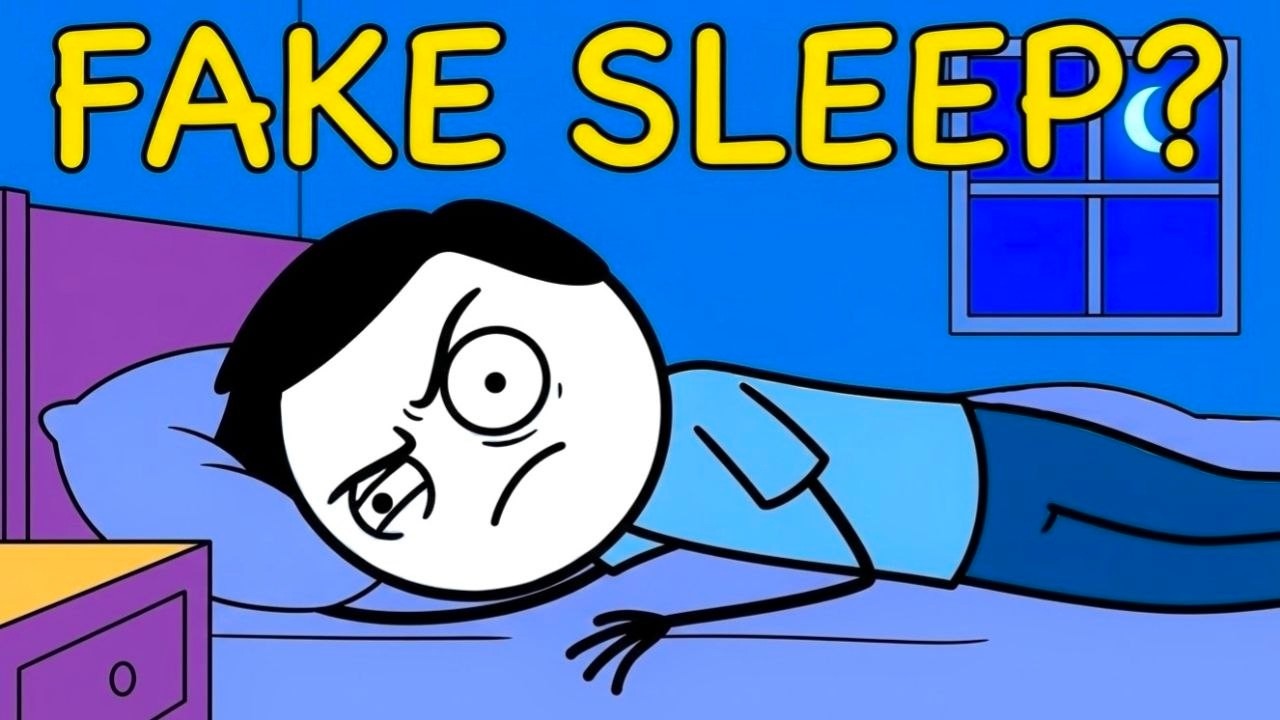
The switch between them is not instantaneous. There is an unstable in-between zone where neither system has fully won, and this is precisely the state people occupy while lying still and faking sleep. The brain uses physical behavioral signals as part of its decision-making process about whether it is actually time to sleep. This is tied to sleep pressure, which builds up through the day as adenosine accumulates in the brain.
But sleep pressure alone does not guarantee sleep. The brain also relies on external cues such as darkness, stillness, quiet, a horizontal position, and slowed breathing to confirm that conditions are appropriate for shutting down. From an evolutionary perspective, this system makes practical sense. Ancient ancestors could not afford to fall unconscious the moment sleep pressure reached a threshold, especially if they were in unsafe locations or near predators.
Evolution combined internal pressure with contextual safety checks, essentially requiring the brain to confirm through stillness and calm that the environment was safe enough to risk hours of vulnerability. The reticular activating system, a network of neurons in the brainstem, also plays a key role in regulating alertness. It receives constant input from the senses, including movement, sound, and light, and uses that input to determine how alert to remain. Deliberately reducing sensory input by lying still in a dark, quiet room starves this system of the stimulation it uses to justify staying awake.
Slow, controlled breathing triggers a measurable physiological response. Rapid, shallow breathing is associated with the sympathetic nervous system’s fight-or-flight response, while slow, deep breathing activates the vagus nerve, which stimulates the parasympathetic nervous system. This branch calms heart rate, lowers blood pressure, and signals that it is safe to power down. Consciously slowing breathing while pretending to sleep mechanically triggers this relaxation response even if the mind is still racing.
Sleep researchers and insomnia specialists emphasize the distinction between forcing sleep and creating conditions that allow sleep to happen. Insomnia often worsens when people become anxious about not falling asleep, since that anxiety activates the sympathetic nervous system and blocks sleep. This creates a feedback loop in which worrying about insomnia causes more insomnia. The pretend-to-sleep approach works partly because it sidesteps this anxious effort, presenting the body with sleep signals and letting the nervous system catch up at its own pace.
A phenomenon called sleep onset misperception complicates the experience further. Brain monitoring studies have found that people frequently enter very light stages of sleep while still feeling completely awake. A considerable portion of time spent lying there feeling hopelessly awake may actually be spent flickering in and out of the earliest stages of real sleep without conscious awareness of it. The transitional zone between wakefulness and sleep also produces hypnagogia, the strange, dreamlike mental experiences that occur during this period.
These may include vivid images, fragmented thoughts, or the full-body muscle twitch known as a hypnic jerk. Researchers believe this twitch may be linked to motor control systems briefly misfiring as they power down, possibly related to an ancient reflex from when ancestors slept in trees and a loss of muscle tone could have meant a dangerous fall. The circadian rhythm adds another layer. Specialized cells in the retina detect ambient light and send information to the suprachiasmatic nucleus, the body’s master clock.
As darkness increases, this system triggers melatonin release. Bright light, particularly blue-heavy light from screens, suppresses melatonin and disrupts the process. This explains why pretending to sleep works far better in a dark room than one lit by a glowing phone screen, darkness is an active input the circadian system uses to confirm nighttime has arrived. Modern humans are somewhat unusual among primates in their sleep patterns.
Most other primates sleep in shorter, more fragmented bursts while remaining somewhat alert to danger. Humans evolved toward longer, more consolidated blocks of deep continuous sleep, a shift researchers largely attribute to ancestors moving down from trees and sleeping on the ground, frequently near fire for protection. This transition came with a trade-off: deeper, more vulnerable sleep required more robust safety check mechanisms before the brain would fully commit. Cultural bedtime rituals reinforce the same mechanism.
Anthropologists and sleep researchers studying bedtime customs across cultures have found consistent patterns: quiet, low-stimulation activities, dimmed lighting, and predictable routines performed in the same order night after night. Ancient communities developed intuitive rituals that eased the nervous system down gradually rather than expecting an abrupt jump from alertness to unconsciousness. Some historians studying pre-industrial sleep patterns have found evidence in court records, diaries, and medical texts suggesting that segmented sleep, a first sleep and a second sleep separated by an hour or two of quiet wakefulness, was a common pattern before artificial lighting became widespread. During that middle waking period, people reportedly used the time for quiet reflection, prayer, conversation, or even visiting neighbors before settling back down for a second block of sleep before dawn.
The paradoxical intention effect describes a surprising finding in sleep psychology: deliberately trying not to fall asleep can actually help people fall asleep faster than anxiously willing themselves toward unconsciousness. Clinical studies on insomnia have tested this principle, instructing participants to lie in bed with eyes open and try to stay awake, and many fell asleep faster than a comparison group instructed to try hard to sleep normally. Removing the pressure of trying removes the anxiety that blocks the parasympathetic response needed for natural sleep. Another technique called cognitive shuffling reflects principles sleep scientists have long understood about how racing, goal-directed thoughts interfere with sleep onset.
Structured logical thinking, worrying about tomorrow’s schedule, replaying conversations, or mentally drafting messages keeps executive function regions engaged in focused processing incompatible with sleep. Shifting mental activity toward random, disconnected imagery appears to help disengage those alert regions without triggering the frustrated effort that backfires. Sleep also fits into a broader pattern of bodily processes that resist direct conscious control. People cannot force digestion to speed up, cannot heal wounds faster through willpower, and cannot directly command heart rate down through decision alone.
Many essential regulatory processes are insulated from conscious override and respond instead to indirect physical and environmental signals. Sleep is no different: it is something that happens once the right conditions are met, and pretending to sleep is the most direct method available for supplying those conditions. Stress hormones, particularly cortisol, play a significant role in how difficult this transition feels on different nights. Cortisol typically peaks in the morning and declines through the day to support sleep at night.
But acute stress from unresolved arguments, looming deadlines, or general anxiety can spike cortisol at the wrong time, directly counteracting the parasympathetic shift stillness and slow breathing are trying to achieve. That is why the same routine that works on a calm night can feel useless on a stressed night. The struggle is not a personal failure to relax but a hormonal tug-of-war that even perfect sleep hygiene cannot always immediately overcome. The reason humans must pretend to sleep in order to fall asleep comes down to evolutionary design.
Sleep was never meant to be consciously triggered on command. It was built as a cautious, multi-layered biological process requiring physical stillness, reduced sensory input, slowed breathing, darkness, and a calm nervous system before ancient safety mechanisms would permit the vulnerable state that restorative sleep requires. Pretending to sleep is not a strange workaround or a sign of malfunction.
It is a deliberate method of supplying the nervous system with exactly the physical evidence it evolved to look for before agreeing to power down completely.


