Scientists have pushed back the documented origins of poisoned weaponry by roughly 50,000 years, rewriting the timeline of human technological development in the process. A study published in early 2026 in the journal Science Advances revealed that quartz arrowheads recovered from the Umlatuzana rock shelter in South Africa carry traces of toxic alkaloids from the plant known locally as poison onion. The arrows are 60,000 years old. That chemical signature was identical to poison found on arrows collected from indigenous hunters in the 18th century.
The same plant and the same preparation method had been passed down through more than 2,000 generations without a single written record. The discovery suggests that the use of complex chemical tools is far older than previously believed. Before this find, the oldest direct evidence of poisoned weapons dated back only about 7,000 years. Long before writing, early humans had to survive a world in which food itself was a biological gamble.
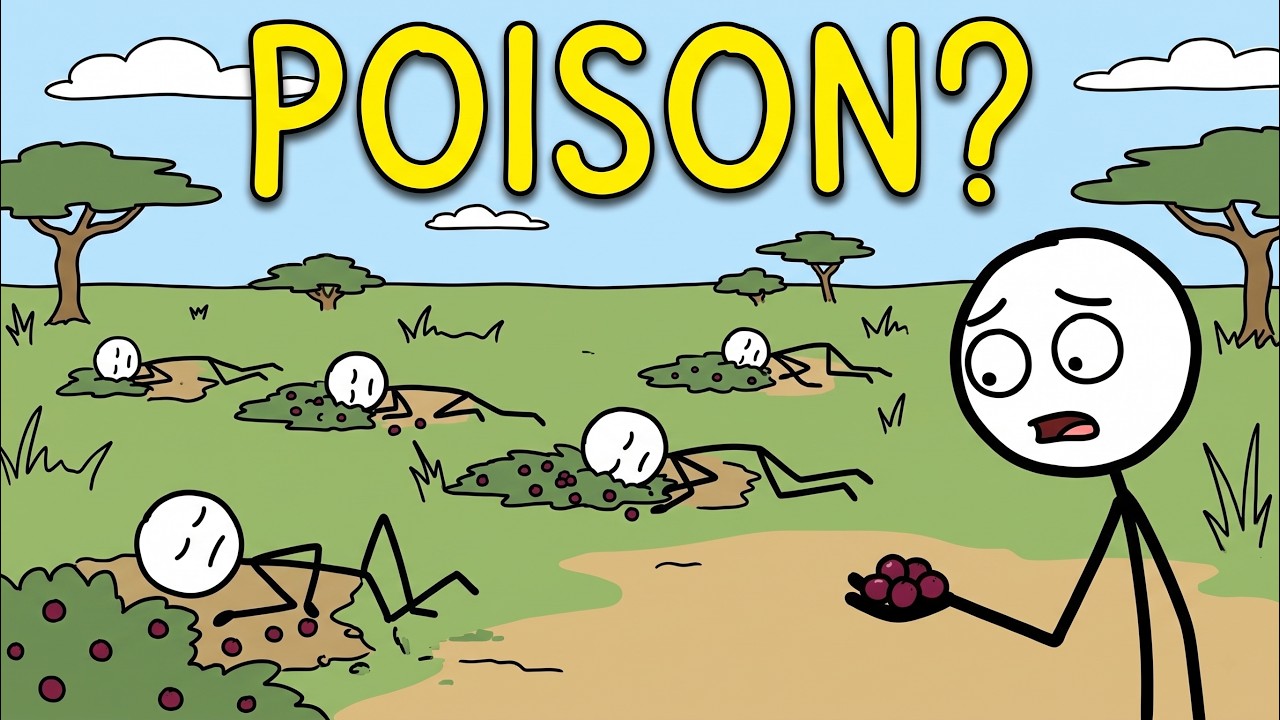
There were no labels and no grocery stores. Every meal carried the potential for injury or death. Evolution equipped early humans with biological alarm systems, such as specialized taste receptors dedicated to detecting bitterness, as well as a strong aversion response that triggers nausea after a single bad meal. Early people also watched animals.
Chimpanzees swallow rough leaves to dislodge parasites, orangutans chew medicinal vines into pastes for wounds, and lemurs rub toxic millipede secretions into their fur to repel insects. In Venezuela, capuchin monkeys actively crush toxic millipedes and rub the carcinogenic fluids onto themselves as mosquito repellent, accepting a long-term health risk for immediate survival. Observation of animal behavior eventually expanded into human experimentation. Anthropologists believe early humans developed a structured testing protocol for unknown plants: rubbing material on the skin, holding it to the lips, placing small pieces in the mouth, and finally swallowing tiny fragments after long waits.
It was a clinical trial in which the cost of failure was death. Some of the world’s staple foods today required complex chemical engineering to become edible. Raw cassava contains natural cyanide and required peeling, soaking, drying, and fermenting before it was safe. Acorns needed to be crushed and leached in running water to remove kidney-destroying tannins.
Aboriginal Australians neutralized the lethal neurotoxin in cycad seeds through slicing, soaking in running creeks, and sometimes burying them for months to ferment. Fire was the first major chemical revolution, breaking down toxic molecules and turning dangerous plants into digestible food. All this information was transmitted orally from generation to generation around campfires, meaning a tribe that lost its elders lost its encyclopedia of knowledge. The Umlatuzana discovery points to a significant cognitive leap.
Poison from the Bufo disticha plant takes hours to kill, requiring hunters to shoot an animal, watch it flee, and track it across the savanna for half a day while trusting that the poison was doing its work. This demonstrates an understanding of cause and effect across long stretches of time. Ancient cultures on every continent developed specialized toxins from their local environments. In the Kalahari Desert, the San Bushmen crushed the larvae of the Diamphidia beetle into a poison that remained lethal for a year once dried, applying it to the shaft of the arrow rather than the tip to avoid accidental self-injury.
In Europe and Asia, hunters weaponized aconite, a fast-acting cardiotoxin also known as wolfsbane. It was used to poison bait for wolves, coat javelins for tiger hunts in India, and tip spears used by Indigenous hunters in Alaska to hunt whales. Greek hunters were careful not to touch it with bare hands because it absorbs through the skin. Amazonian hunters developed an even more sophisticated approach.
They created curare, a complex mixture of plant toxins, for use with blowgun darts. The poison paralyzes the muscles of prey, causing the animal to suffocate and fall from the canopy. Critically, curare is only dangerous in the bloodstream. The Amazonian hunters knew that meat from animals killed with curare was safe to eat because the digestive system breaks the poison down, understanding the difference between intravenous and gastrointestinal absorption millennia before Western medicine formalized the concept.
In the 1930s, that same toxin became the basis for modern muscle relaxants used in general anesthesia. In Colombia, the Embera people used the golden poison dart frog, the most poisonous vertebrate on Earth. A single frog carries enough batrachotoxin to kill ten adults. Hunters held the frog over a fire, causing it to sweat out the toxin, and then rubbed their darts against its skin.
The poison shorts out the nervous system and stops the heart. These frogs lose their toxicity in captivity, as they absorb the poison from toxic beetles in the wild, a fact the Embera also understood. Other cultures learned to poison entire rivers. From the Amazon to Southeast Asia, people crushed roots containing rotenone into slow-moving water, causing fish to suffocate and float to the surface.
The fish remained safe to eat for humans due to the way rotenone is poorly absorbed in the human stomach. The line between poison and medicine has always been thin. The ancient Greeks used the single word pharmakon to mean both. In the 16th century, Paracelsus articulated the principle that only the dose makes the poison.
Modern medicine reflects this. Low doses of aspirin relieve pain; high doses cause internal bleeding. Digitalis from the foxglove plant treats heart failure in small amounts and stops the heart completely in large ones. Evidence from Neanderthal remains found in Spain suggests our closest relatives had their own pharmacy knowledge.
Teeth analysis from a Neanderthal in El Sidron Cave showed traces of poplar bark, which contains salicylic acid, the active ingredient in aspirin, alongside traces of Penicillium mold. Other remains in the same cave showed traces of yarrow and chamomile, plants with almost no calories that taste bitter but act as anti-inflammatories and antiseptics. These findings suggest archaic humans were diagnosing their own infections and gathering specific plants to treat them. The relationship between humans and poison has been a biological arms race.
Studies indicate the last common ancestor of humans, chimpanzees, and gorillas evolved a partial resistance to the alpha neurotoxins in cobra venom after being hunted by snakes for so long. Some scientists argue sharp color vision and depth perception developed partly because primates who could spot a camouflaged snake survived to pass on their genes. Some cobras evolved the ability to spit venom as a ranged defense specifically against early humans who used rocks and clubs. Evidence of poison being used against humans rather than prey is harder to find in the archaeological record, since poison leaves almost no trace while crushed bones do.
Written records fill in the gap. The Ebers Papyrus from ancient Egypt around 1550 BC reads like both a medical text and a manual for murder. During the Roman Empire, Emperor Nero employed a professional poisoner who tested her concoctions on slaves before killing political rivals. The philosopher Socrates was executed by the state of Athens in 399 BC with poison hemlock.
Poison was the weapon of the invisible. It required no sword, no armor, and no physical strength. A child, a servant, or a marginalized wife could kill a heavily armed warlord by slipping crushed seeds into his drink, bypassing the entire hierarchy of violence. Modern kitchens reflect this history.
The capsaicin in chili powder, the allicin in garlic, and the curcumin in turmeric are all chemical weapons plants evolved to kill insects and fungi. Humans call them flavors; plants use them for defense. The knowledge gathered over hundreds of thousands of years, accumulated through observation, experimentation, and generations of deaths, is still in use in every kitchen and pharmacy today.