Every time you sit down to eat, you are probably consuming the result of one of the most extreme experiments in biological engineering ever conducted. The cabbage, kale, and broccoli on your plate, along with the mustard on your hotdog and the oil in your pan, all trace their lineage back to a single group of unassuming wild weeds. These plants, which look like they belong to entirely different families, are actually members of the same genus, *Brassica*. Through thousands of years of human selection, farmers transformed a few bitter, unpalatable weeds into more than twenty distinct vegetables, two major cooking oils, and the world’s most popular condiment.
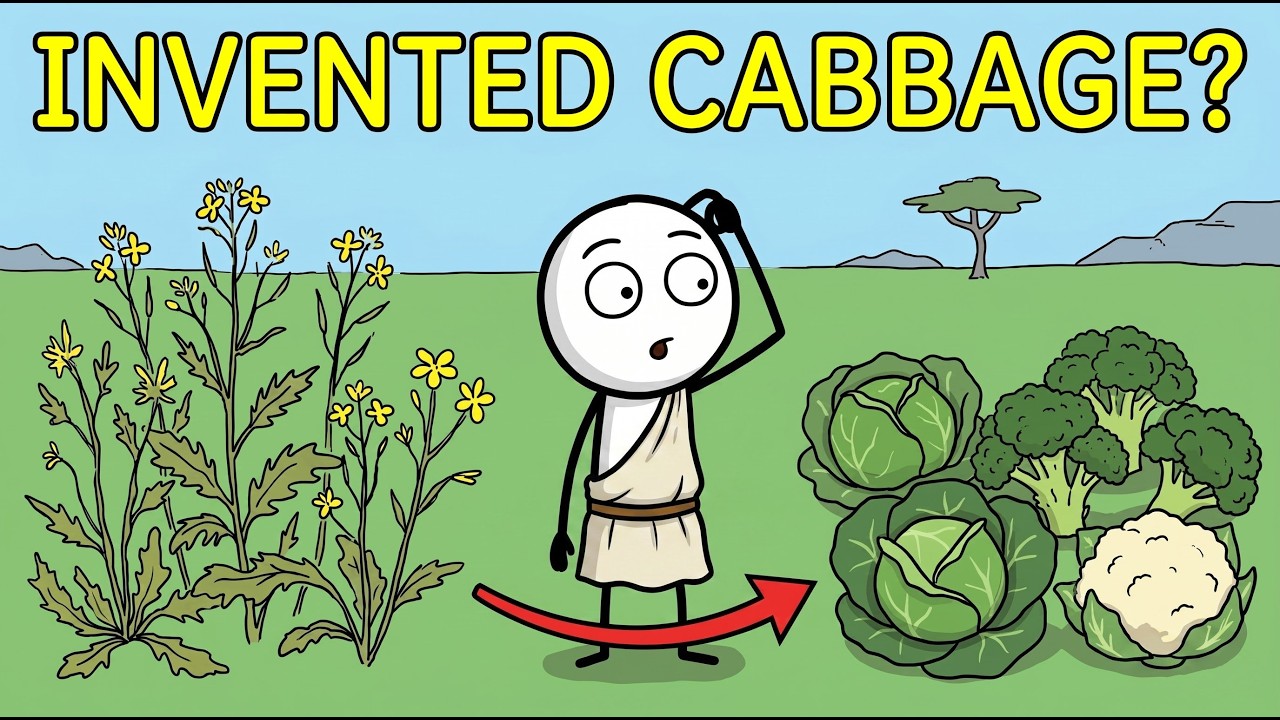
The story begins with wild *Brassica oleracea*, a hardy plant that grows on Mediterranean cliffs. If you bit into one of its raw leaves, you would be met with an immediate, sulfurous bitterness—a chemical defense system designed to deter predators. Unlike other domesticated plants where humans focused on improving a single trait, like the fruit or the root, the *Brassica* story is unique. Humans selected for every part of the plant separately and in different directions.
This single species of wild cabbage was coaxed into vastly different forms: cauliflower, which is a mass of arrested flower buds; Brussels sprouts, which are enlarged axillary buds; and kohlrabi, a swollen stem. The historical record of this transformation is surprisingly well-documented. The ancient Greeks left the earliest written descriptions. Later, the Roman scholar Pliny the Elder described several varieties, and Cato the Elder even wrote about the plant’s medicinal properties, recommending cabbage with vinegar as a cure for overindulgence.
As the Roman Empire expanded, this Mediterranean weed was carried into colder, wetter climates, where the pressure of selection in new environments helped push the plant to adapt. While the story of *B. oleracea* is remarkable, it is only half of the picture. On the other side of the world, farmers in China were performing the same feat with a different wild parent species, *Brassica rapa*.
This independent domestication event produced a completely different set of vegetables: bok choy, turnips, and Napa cabbage. Written accounts from the Qimin Yaoshu, an agricultural encyclopedia from 544 AD, describe these crops in detail. Napa cabbage itself is thought to be a relatively recent development, possibly a hybrid that emerged in the Beijing region during the Ming Dynasty, combining the leafiness of bok choy with the heading tendency of turnips. Remarkably, these different species did not just stay separate.
They hybridized naturally. *Brassica juncea*, a species that eventually produced the majority of the world’s mustard, arose from a natural cross between *B. rapa* and *B. nigra*.
Scientists now know that a whole-genome triplication event—a duplication of the entire genetic code—gave the *Brassica* family a massive surplus of genetic material. This surplus allowed the plants to explore extreme forms without breaking, providing the raw material for human selection to act upon. The diversity of these plants is so dramatic that Charles Darwin used it as a central piece of evidence for his theory of evolution. In the first chapter of *On the Origin of Species*, he pointed to cabbage, cauliflower, broccoli, kale, and Brussels sprouts as proof that selection could produce variations greater than those seen between many entire species in the wild.
Darwin argued that if human hands could reshape a plant so dramatically in a few thousand years, then natural selection operating over millions of years could indeed transform life on Earth. The reach of this single genus extends beyond the dinner plate. The bitter-tasting glucosinolates that deter insects have been shown to have cancer-fighting properties in the human body. The humble cabbage, when fermented into sauerkraut, preserved its vitamin C content, saving sailors from scurvy on long voyages.
In the 18th century, Captain James Cook kept his crew healthy by serving them sauerkraut, even as his officers dined on other fare to preserve the illusion of scarcity. The legacy is so profound that even today, people are creating new *Brassica* vegetables. With over 170 million tons of these crops produced each year, you are consuming the result of a selective breeding story that is one of the most dramatic examples of artificial selection in human history.