For a full three minutes, you have done nothing but watch its legs move one after the other in a rhythm that seems almost hypnotic. In our modern world, this is a moment of profound failure, a lapse in productivity that feels like a glitch in the system. But what if this exact moment, this quiet, empty stretch of time, is actually the most important thing that ever happened to our species? If we go back 50,000 years to a world without screens, books, or clocks, what did a person actually do with the 12 hours of daylight that weren’t spent running for their life?
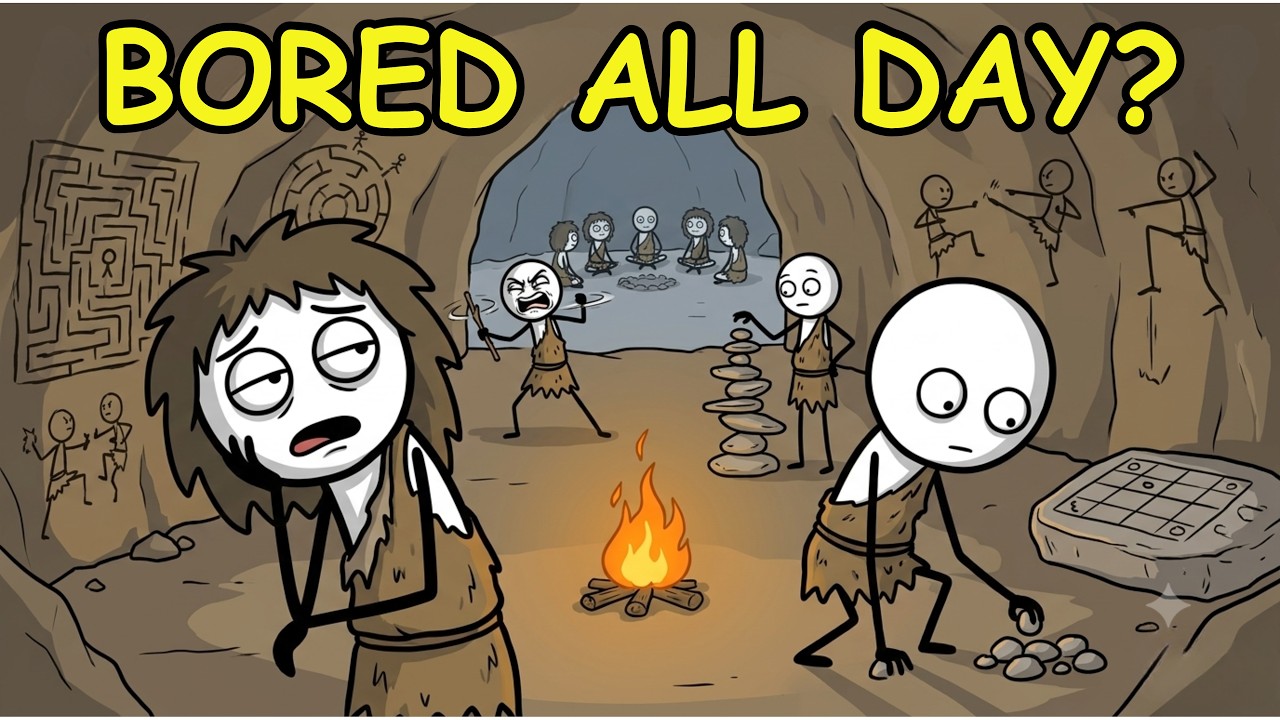
Was boredom a luxury they couldn’t afford, or was it the very thing that forced them to become human? The most common assumption we make about the deep past is that it was a nonstop struggle for survival. But if that was the case, how did we ever find the time to invent anything at all? Why would a brain that is supposedly focused entirely on the next meal develop the capacity to feel bored?
If you ask a modern neuroscientist, they will tell you that boredom is not a failure of the mind but a signal, a biological alarm bell. For decades, anthropologists operated under the man the hunter model, assuming prehistoric life was a brutal 100-hour work week of constant labor. Then, in 1966, a landmark symposium titled Man the Hunter changed everything. The rest of the time was spent in a state of absolute undisputed leisure.
Anthropologist Marshall Sahlins famously dubbed these people the original affluent society. But if you have 18 hours of free time every single day and no internet, how do you keep from losing your mind? Does the silence of the ancient world mean they were more content, or were they just better at filling the void with each other? One theory suggests that language evolved as a form of vocal grooming.
You can only groom one person at a time. As human groups got larger, we needed a way to groom multiple people at once. If 65% of all human conversation is still just social gossip, does that mean our greatest intellectual tool was forged by the simple need to kill time? Research suggests that gossip wasn’t just a side effect of language; it was the purpose.
What happens when the sun goes down and the social grooming ends, but the brain is still humming with unused energy? This is where the boredom of the day transformed into the wonder of the night. At night, 91% of the conversation turned to stories. This wasn’t just entertainment; it was a cognitive workout.
A good story creates a shared mental world. The storyteller became the most valuable member of the tribe because they could transport everyone’s mind out of the quiet cave and into a world of endless possibility. But if stories filled their minds, what did they do with their hands? Is it possible that the greatest masterpieces of human history were actually just the result of someone having nothing better to do?
Consider a freshwater muscle shell with a deliberate geometric pattern scratched into it. It’s not a tool. It’s not a weapon. It wasn’t made by a modern human.
The researcher who first noticed the carvings pointed out that the lines are incredibly precise, made with a shark’s tooth. It was a person sitting by a river 500,000 years ago focused entirely on the feel of the tooth against the shell, simply because they wanted to see a pattern where there wasn’t one before. But if they were carving shells for fun, what else were they making? They were experimenting with chemistry and color long before they had a reason to.
Some of these tools are so thin and delicate they would have broken the moment they hit a bone. But what if the task wasn’t physical at all? What if the most useless things they did were actually the sparks that lit the fire of modern science? There is also a baboon’s leg bone with three columns of notches carved into it.
For a long time, people thought it was just a tally stick for counting kills. But one column contains prime numbers between 10 and 20. They were the first mathematicians, not because they needed to solve a problem, but because their brains were hungry for a structure to chew on. We don’t have prehistoric apps, but we do have evidence of the very first games.
In the archaeological record, we find smooth, rounded stones and bone dice that predate written history. This is play in its purest form, the voluntary engagement in a difficult, unnecessary task. Evolutionary biologists argue that play is a way to practice for life. There is a concept in behavioral ecology called optimal foraging theory, which suggests animals should move in the most efficient way possible to get food.
When the local valley becomes familiar and boring, the human brain starts to devalue it. The grass literally looks greener over the next hill because the brain rewards the discovery of new information with a burst of neurochemicals. The bored teenager who wandered 5 miles further than anyone else was the one who found the new flint deposit or the hidden spring. But what was the cost of all that wandering?
If we were always moving and always seeking, did we ever find a way to just be still? There is one activity that ancient humans did that we have almost entirely lost: the art of doing absolutely nothing together. It’s not meditation and it’s not sleep. They weren’t bored in the way we think of it because they weren’t fighting the silence.
In our world, a 30-second elevator ride without a phone feels like a prison sentence. But they knew the exact way the light changed between 3:00 and 5:00. They knew the specific sound of the wind before a storm. We need more and more noise to feel a baseline level of engagement.
But a single bird call or a strangely shaped leaf was enough to capture their attention for 20 minutes. We have the same brain, the same thirst for novelty, and the same 18 hours of affluent leisure time, but we’ve traded the bone flute for the algorithm. Is the feeling of boredom actually the most human thing about us? The one who is bored is the one who will eventually notice the patterns in the stars, the one who will carve the first flute from a vulture’s wing, and the one who will tell the stories that keep his tribe together.
He is bored, and because he is bored, he is about to change the world. If we ever truly cure boredom with a perfect 24/7 stream of entertainment, do we lose the very thing that made us creative in the first place? We might find that the silence was the only thing keeping us sane. If you had to spend a full day in 50,000 BC with no tools and no tasks, what is the first thing you would create to keep the silence at bay?
Would you start scratching lines into the dirt, or would you find someone to tell your secrets to? We often think we’re so different from those people sitting around the fire, but if you take away your phone for just 1 hour, you’ll feel that same prehistoric itch. The image of that single red ochre hand print on a cave wall in Spain or Indonesia is often cited as the first “I was here. ” Maybe it was just the result of a long hot afternoon where there was nothing else to do.
Imagine a world where the only thing you could hear for days was your own breath and the wind in the grass. We call that leisure time now, but to a brain wired for connection and growth, that silence was a predator more dangerous than any saber-toothed cat. We are the restless animals who couldn’t sit still in the garden, so we paved it over and built a theater. But the silence hasn’t actually gone anywhere.
It is the biological alarm bell that has been ringing since the first man watched a beetle on a rock, and it doesn’t care about your entertainment. It only cares that you are still here in the quiet with nothing to do. They were screaming into the silence so they wouldn’t have to hear it. And the most terrifying part of human history is that the silence never answered back.
We are still just children in the dark telling stories to ourselves so we don’t have to notice the quiet. What would you say if the silence finally spoke back? If you enjoy diving into the deep strange history of our species and want to explore more of these forgotten corners of the human experience, consider joining us for the next journey. But for now, you should probably find something to do.
History is just a long, complicated way of avoiding the fact that we are sitting on a rock in the middle of nowhere.