Every great civilization in history has either collapsed or is still running its experiment. The civilizations that appear to be ongoing today—the United States, the European Union, China—are not the same entities that existed a few centuries ago. The Bronze Age civilizations of the Eastern Mediterranean, including Egypt, Mycenae, the Hittites, Ugarit, and the kingdoms of the Levant, collapsed within decades of each other around 1200 BCE in one of history’s most dramatic and least fully explained events. The Western Roman Empire collapsed between roughly 376 and 476 CE, the Tang Dynasty collapsed in 907 CE after nearly three centuries of flourishing, and the Maya Classic civilization collapsed between the 8th and 10th centuries.
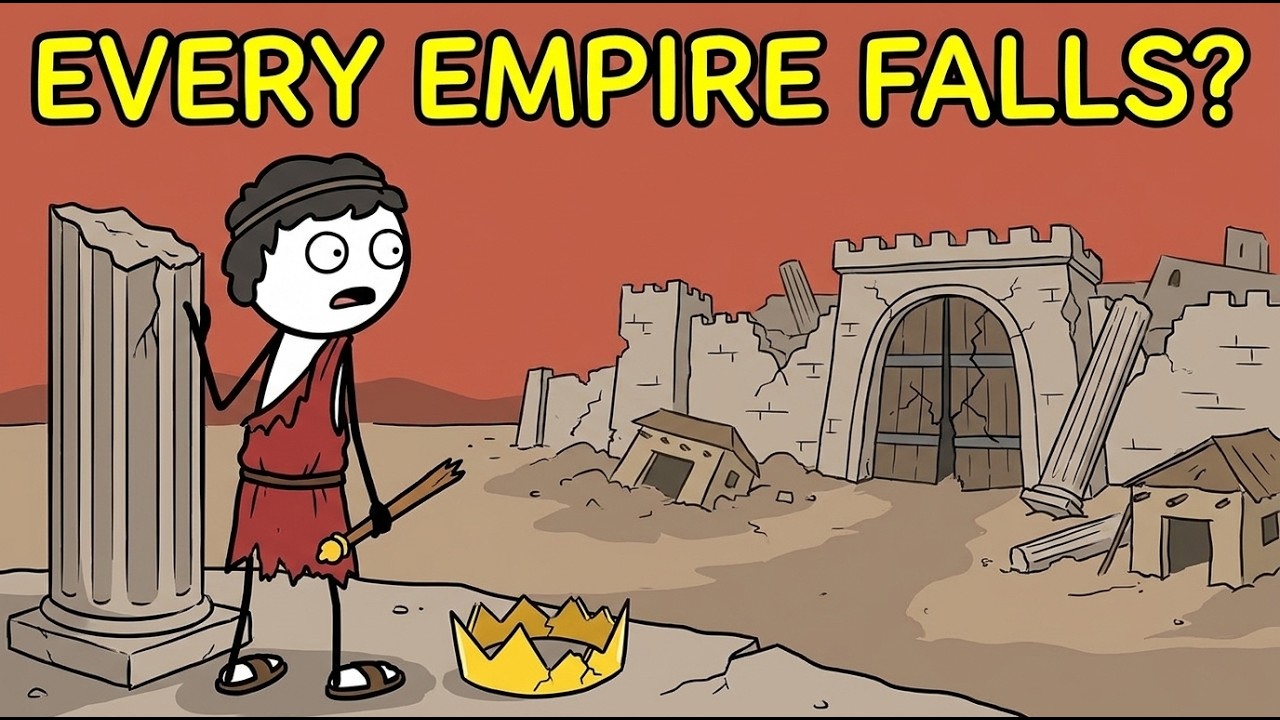
The pattern is real. However, this apparent pattern is an illusion produced by survivorship bias and retrospective narrative. The answer, when you go through the evidence carefully, is both. Each collapse has unique features.
The definition problem matters first, because civilizational collapse is not a straightforward concept, and the way you define it determines what you are explaining. Collapse is a rapid reduction in social complexity, typically within a period of decades or at most a century or two, involving the loss of centralized political authority, the disintegration of long-distance trade networks, and the abandonment of large population centers. This is different from transformation, which is the gradual change of one political form into another, and different from defeat, which is the military conquest and absorption of one society by another. By this definition, collapses are real and well-documented.
These are not historical narrative conventions. They are demographic and material facts visible in the archaeological record. The first and most consistently documented factor is complexity overshoot. Societies invest in complexity because complexity solves problems.
Each additional layer of administration, each additional fortification, and each additional bureaucratic function provides less benefit per unit of cost than the previous layer did. At this point, any significant stress—a drought, a plague, a military defeat, or a trade disruption—that reduces the resources available to maintain the existing complexity triggers a cascade. The society cannot afford to maintain all of its complexity. The Ugaritic palace economy, for example, was importing tin from as far away as Afghanistan and copper from Cyprus to produce bronze, the essential material of the military technology that sustained every palace state in the region.
When enough of these networks failed, all of them failed. The second consistently documented factor is environmental stress, specifically the intersection of environmental stress with social complexity in ways that amplify the impact of both. Civilizations are not separate from their environments; they are embedded in them, dependent on them for the food, water, timber, and material resources that sustain their populations and complexity. The civilizations’ own land use practices had made the landscape more drought vulnerable.
The mechanisms of elite competition for status, resources, and political power drive a progressive increase in elite resource consumption over time in most well-documented civilizations. The problem is that elite overextraction reduces the resources available to maintain the productive capacity that generates the surplus in the first place. Artisans who cannot invest in their tools and workshops produce less. Infrastructure that cannot be maintained because the surplus has been consumed by elites deteriorates.
The extraction system that generates the elite resources undermines its own productive base. Peter Turchin’s Cliodynamics research, the quantitative historical analysis of political violence and civilizational instability, has documented this dynamic with striking consistency across a wide range of historical civilizations. The mechanism is the compression of the productive population and the destabilization of the political system through elite competition for shrinking resources. This allows the society to function at a level of complexity that exceeds what any individual could manage alone.
It exists in the minds of specialists, in the documents and records that specialists produce, and in the training systems that reproduce specialists across generations. Once lost, it cannot be reconstructed from first principles quickly enough to prevent the cascade of failures that the loss triggers. Roman engineering knowledge for road construction, aqueduct building, concrete production, and the organization of large-scale construction projects did not survive the collapse at a level sufficient to maintain the infrastructure. The aqueducts fell into disrepair, and the roads were not maintained.
The knowledge to rebuild was not available, not because the physical materials were absent, but because the institutional knowledge of how to organize the labor, manage the supply chains, and maintain the technical standards that Roman engineering required had vanished. Disease is not simply a background stress that weakens civilizations at the margins. In several documented cases, epidemic disease was the primary trigger that converted a civilization already at its structural limits into one that was actively collapsing. The relationship between epidemic disease and civilizational collapse is not simple.
Epidemic disease operating on a civilization with sufficient adaptive capacity can produce painful but ultimately productive restructuring. The inhabitants of collapsing civilizations rarely experience their collapse as a single dramatic event. Each deterioration was explicable in local terms. The systemic character of the deterioration, the way that each local failure connected to and amplified every other local failure, was invisible from inside the experience.
Complex systems are specifically designed to absorb local failures without producing system-level visible signals. When a complex system is approaching its structural limits, the same absorption capacity that has been an asset becomes a liability, masking the accumulation of stress until the system crosses a threshold and the cascade becomes visible. By the time the systemic failure is obvious to everyone, it is typically too late to prevent it through the normal mechanisms of political and administrative response. The most important thing to understand about civilizational collapse is that these factors rarely operate independently.
They interact with each other in ways that amplify the impact of each. Adding complexity to solve the problem of a drought or a plague is exactly what the society cannot afford. There is a conflict of interest between elites who benefit from the status quo and the need to change it, and the collapse of institutional mechanisms for collective action at exactly the moment when collective action is most needed. This is the most chilling aspect of the civilizational collapse pattern.
The collapses happen not because the problems were invisible, but because the political and social dynamics of the civilization made effective response to visible problems impossible. There is a specific psychological and institutional mechanism that makes this failure of response so consistent across different civilizations and time periods. The people who benefit most from the status quo—elites who have prospered under the existing system, specialists whose position depends on the existing institutional structure, and populations whose daily welfare depends on the continuation of the existing economic arrangements—are precisely the people with the most influence over the response to civilizational stress. Reversing environmental degradation requires redirecting resources from current consumption to future resilience, which is politically costly in the short term.
The political economy of collapse is a political economy of gridlock in which those with the most power to change course have the most incentive to maintain it. Contemporary global civilization is the most complex in human history. It is also the most interconnected. These are civilizational-scale modifications of the planetary environment with implications for carrying capacity and resilience that are still being assessed and that the civilization is only beginning to incorporate into its planning.
Income inequality in most developed countries has been increasing for approximately five decades, with the share of surplus captured by the highest-income individuals growing consistently relative to the productive majority. These are systems that are maintained by specialists whose knowledge is not widely distributed, encoded in infrastructure that requires continuous maintenance, and vulnerable to failures that can cascade through interconnected systems faster than any historical precedent. The historical pattern of civilizational collapse does not constitute a deterministic law. The difference between historical civilizations that collapsed and the ones that managed decline rather than catastrophic failure typically came down to adaptive capacity.
The ability to reduce complexity in a controlled way before uncontrolled reduction became inevitable, to modify environmental practices before degradation exceeded recovery thresholds, and to redistribute surplus in ways that maintained the productive base were the deciding factors. These are not mysteries. The real question is whether the civilizations that came after learned anything from the ones that came before.
The historical record on that question is, to put it diplomatically, mixed.