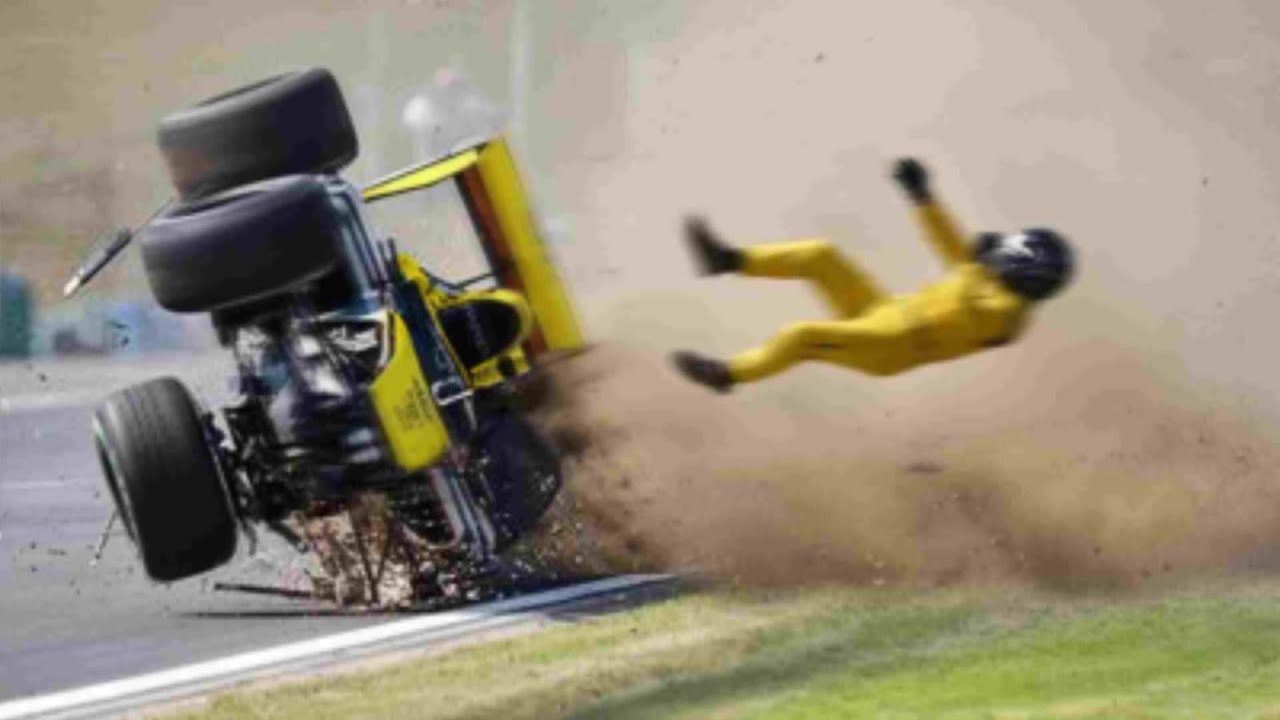
The survival of Formula 1 drivers has always walked a razor-thin line between engineering brilliance and sheer, unadulterated luck. While the sport’s modern era boasts unprecedented safety standards, the history of Grand Prix racing is littered with moments where the laws of physics and probability were defied in the most spectacular and terrifying fashion. From flaming infernos in the pit lane to cars split in half against concrete walls, these are the incidents that remind us just how fragile the human body is, and how miraculous it is that some walk away at all.
The 2023 Singapore Grand Prix provided a stark reminder of this peril during qualifying. Lance Stroll, pushing his Aston Martin to the absolute limit in a desperate bid to reach Q2, lost control in the final sector. The car speared into the barriers with a violence that left the chassis split in two, debris scattered across the track.
 The impact was so severe that the survival cell was visibly compromised, yet Stroll’s voice crackled over the radio moments later, confirming he was conscious and responsive. The fact that Lando Norris’s car missed the wreckage by mere inches added another layer of horror to a scene that could have been a tragedy. Stroll walked away, albeit sore and dizzy, a testament to the carbon fiber monocoque that absorbed an impact that would have been fatal two decades prior.
However, not all escapes rely solely on modern technology. The 2012 Belgian Grand Prix at Spa-Francorchamps remains a chaotic masterpiece of survival. Romain Grosjean, in a moment of catastrophic misjudgment, veered across the track at La Source, triggering a chain reaction that launched his Lotus over the cockpit of Fernando Alonso’s Ferrari.
The Spanish driver’s head was millimeters from being struck by Grosjean’s front wing, an impact that would have been unsurvivable. Alonso, who had been a sitting duck in the chaos, emerged from the wreckage with nothing more than bruised pride. The incident was so alarming that it became a primary catalyst for the introduction of the Halo device in 2018, a titanium ring that has since saved countless lives, including Stroll’s in Singapore.
But the annals of F1 history are filled with escapes that predate such safety innovations. The 2010 Abu Dhabi season finale saw Michael Schumacher spun around at the first chicane, his Mercedes stranded in the middle of the racing line. As the field scrambled to avoid him, a chain reaction of chaos unfolded.
Vitantonio Liuzzi’s car launched into the air, flipping directly over Schumacher’s cockpit. The underside of Liuzzi’s machine scraped past the seven-time champion’s helmet, a sight that made broadcasters gasp. Schumacher, unfazed, climbed out and walked back to the pits with a smile, fully aware that he had just cheated death by a fraction of a second.
The odds of a car landing precisely over another’s cockpit at 150 mph are astronomically low, yet he survived without a scratch.
Rewind to 1994, a year that remains the darkest in the sport’s history. Rubens Barrichello’s crash during the San Marino Grand Prix weekend was a harbinger of the tragedy to come. In Friday practice, the Brazilian lost control at the Variante Bassa, hitting the curb and launching his Jordan into a series of violent flips before landing upside down against the barriers.
 The impact registered a staggering 95g, and Barrichello was unconscious, having swallowed his tongue. Medical teams worked frantically for six minutes to revive him. He eventually woke with a broken nose and dislocated rib, but the memory loss he suffered for weeks afterward was a chilling reminder of how close he came to joining the weekend’s grim statistics.
He was fortunate to be alive, a fact that made the deaths of Roland Ratzenberger and Ayrton Senna later that same weekend even more devastating.
The 1994 season was a crucible of survival. At the Brazilian Grand Prix, a midfield battle between Eddie Irvine and Jos Verstappen turned violent when Irvine made a reckless move, forcing Verstappen onto the grass. The Dutchman’s Benetton clipped Martin Brundle’s car, launching it into a terrifying barrel roll.
Brundle’s helmet was struck by Verstappen’s tire, splitting the visor open. That both drivers walked away without a scratch remains one of the sport’s greatest miracles. Brundle, in particular, should have been killed instantly; the physics of a tire striking a helmet at speed simply do not allow for survival.
Yet he did, and Irvine’s subsequent race ban did little to soothe the nerves of a paddock already on edge.
That same year, Verstappen would find himself at the center of another near-death experience, this time in the pit lane at Hockenheim. During a routine stop, a fuel leak ignited, engulfing the Benetton and its mechanics in a massive fireball. The footage is horrifying: a wall of flame erupts, and Verstappen is seen scrambling out of the inferno, his overalls singed.
 Miraculously, no one was seriously injured. The mechanics’ quick reactions and the fire suppression systems prevented a catastrophe that could have claimed multiple lives. Verstappen’s escape was pure luck, a chaotic ballet of fire and speed that ended with everyone walking away.
But perhaps no one in F1 history has cheated death more times than Luciano Burti. The Brazilian driver’s brief career was a catalogue of violent shunts. In 2001, at Spa-Francorchamps, he attempted a pass on Eddie Irvine at the ultra-fast Blanchimont corner.
The move failed spectacularly. Burti’s Prost slammed into the wall at nearly 170 mph, the impact measured at a brain-rattling 111g. His helmet was shattered at the front, and he was rushed to hospital with a brain hemorrhage, close to a coma.
He survived, but his F1 career was over. The fact that he lived to tell the tale is a medical anomaly. His earlier crash in Hockenheim, where he plowed into the back of Michael Schumacher’s slow-moving car, was merely a prelude to the horror that awaited him in Belgium.
Sergio Perez’s Monaco crash in 2011 offers a more modern example of survival against the odds. Exiting the tunnel, the Mexican lost control, hitting the barriers sideways at full speed. The impact was so violent that the car was torn apart, and Perez was unconscious for several minutes.
Medics had to extract him from the wreckage, and he was later found to have only a bruise and a cut on his thigh. The crash was a stark reminder that even in the era of advanced safety, the high-speed nature of Monaco’s streets can turn a qualifying lap into a life-or-death gamble. Perez’s subsequent memory gaps were a small price to pay for a life that nearly ended in the principality’s concrete walls.
 The 1998 Canadian Grand Prix start was another scene of pure chaos. Alex Wurz, braking too late on the inside, launched his Benetton over the car of Jean Alesi, sending it into a series of flips. The Austrian’s car was a tumbling wreck, and his tires flew off, narrowly missing his own head as he spun through the air.
The fact that he emerged from the cockpit without a scratch defied all logic. The crash was a testament to the strength of the survival cell, but also to the sheer randomness of fate. Wurz’s escape was so improbable that it became a benchmark for how lucky a driver can be.
Yet, no story of survival is more harrowing than that of Martin Donnelly. At the 1990 Spanish Grand Prix, a suspension failure sent his Lotus into the barriers at 176 mph. The car exploded on impact, and Donnelly was thrown from the cockpit, landing 160 feet away, unconscious and not breathing.
The image of his broken body lying on the track is one of the most disturbing in F1 history. He had swallowed his tongue, and his heart stopped twice before Sid Watkins, the FIA’s medical delegate, arrived to stabilize him. Donnelly suffered multiple fractures and a severe head injury, and he was in a coma for weeks.
Against all odds, he not only survived but learned to walk again. His survival was due to the fact that he was ejected from the car, avoiding a sudden deceleration that would have killed him instantly. He spent 11 minutes suffocating on the track, a lifetime that he somehow endured.
These incidents, spanning decades, illustrate the brutal reality of Formula 1. The sport has evolved from a death-defying gamble to a highly regulated discipline, but the specter of danger remains ever-present. The Halo, the HANS device, and the deformable structures of modern cars have turned what were once fatal crashes into survivable ones.
Yet, as the stories of Stroll, Schumacher, Barrichello, and Donnelly show, there is always an element of luck involved. The margin between life and death in F1 is measured in millimeters and milliseconds. That these drivers are alive today is a testament to their own resilience, the ingenuity of engineers, and a healthy dose of divine intervention.
The sport owes them a debt, not just for their bravery, but for the lessons their crashes have taught, lessons that continue to save lives every single race weekend.