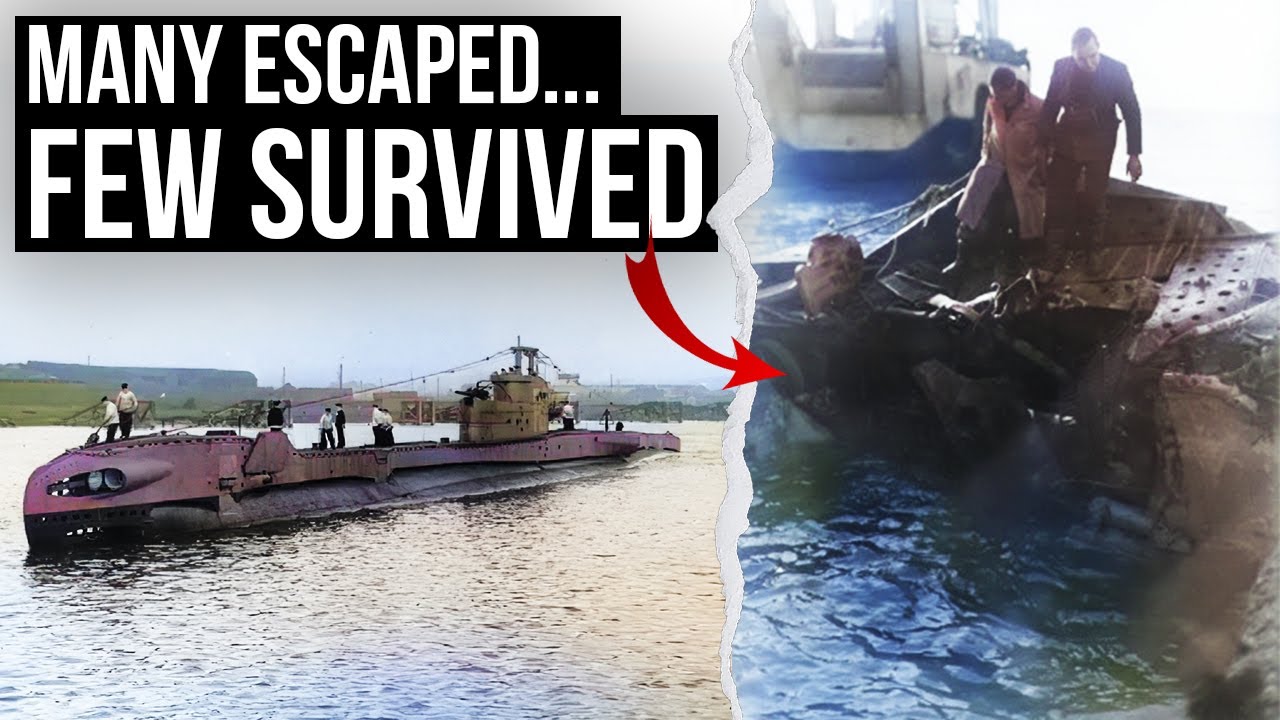
The cold, moonless night over the Thames Estuary on January 12, 1950, was supposed to mark the triumphant return of a war hero. Instead, it became the setting for one of the most devastating peacetime catastrophes in British naval history, a tragedy that would claim the lives of 64 men and expose fatal flaws in the Royal Navy’s approach to survival at sea. The HMS Truculent, a T-class submarine that had survived the brutal depths of World War II and sunk nine enemy vessels, was making a routine journey home after a refit, carrying a crew of 61 and 18 civilian dockyard workers from Chatham.
Within minutes of a routine transit, the vessel would be torn open, plunging dozens of men into a desperate fight for survival against the freezing, oil-choked waters of the estuary.
 The evening had been deceptively routine. After completing sea trials, the submarine was heading toward Sheerness, with most of the crew having just finished their evening meal. The conditions were harsh, with a biting, cold wind sweeping across the deck, but visibility was clear.
On the bridge, Lieutenant Humphrey Baker and his lookouts were diligently tracking the numerous vessels navigating the busy waterway, noting their navigation lights to ensure a safe passage. The darkness, however, was absolute, with no moonlight to illuminate the silhouettes of nearby ships. It was in this inky blackness that the first signs of confusion began to emerge, as the crew spotted a series of lights on their port bow that did not conform to the standard patterns they expected to see.
The lights belonged to the Divina, a small Swedish oil tanker of only 643 tons, heavily laden with paraffin. As was the practice for vessels carrying dangerous explosives, the Divina was displaying a red light high on her mast. However, as she prepared to exit the river and head into the open sea, the crew, busy securing the decks for rough waters, had forgotten to extinguish this warning light.
This single oversight created a lethal ambiguity for the crew of the Truculent, who, seeing the red light and the vessel’s position, concluded it must be stationary and anchored. The confusion was so profound that the bridge crew even called below for a seamanship manual to try and decipher the situation, wasting precious seconds that would seal the fate of the men below.
Captain C. P. Bowers was summoned to the bridge and, after observing the red light, concurred with the assessment that the vessel was stationary.
With dangerously shallow water to starboard, the only viable course of action seemed to be a turn to port to pass the supposed stationary ship. It was a fatal miscalculation. As the submarine began its turn, the dark silhouette of the Divina suddenly materialized directly in their path, far closer than anyone had anticipated and on a direct collision course.
In a frantic last-ditch effort, Captain Bowers bellowed orders for hard port, stopping engines, and shutting watertight doors, but it was too late. The Divina plowed into the starboard side of the submarine, tearing a gaping hole near the torpedo tube compartment.
The impact was catastrophic. Aboard the Divina, the crew felt a shudder and saw a long, low shape disappear beneath their hull. Aboard the Truculent, there was a moment of deathly silence before the submarine began to list and sink at the bow.
The crew, shaken from their stupor, burst into action, blowing the main ballast tanks in a desperate attempt to level the vessel. This action briefly stabilized the submarine, allowing men from the forward compartments to scramble aft, away from the flooding. But for those in the torpedo room, where the Divina had struck, there was no chance of survival.
 The impact had instantly killed them, sealing them in a watery grave.
In the engine room, Electrical Artificer Edward Charles Buckingham found himself in a race against time. As water surged through the vessel, he knew that if the batteries were compromised, they would generate chlorine gas, dooming everyone aboard. He began pulling fuses, isolating the battery banks, working frantically as drenched men rushed past him toward the stern.
He worked in the darkness, the urgency of his task overriding his fear, until the submarine was plunged into blackness, his job complete. Realizing he was alone, he moved toward the control room, only to find the conning tower hatch still open, with seawater cascading through it by the ton. He tried to close it, but it was blocked, jammed by the arm of a sub-lieutenant who had been trapped on the bridge.
The sub-lieutenant, who had managed to duck down to his diving station, had been caught by the heavy hatch as it swung down, pinning his arm. He eventually freed himself but was trapped on the bridge as the submarine sank, washed into the freezing water with the captain and other bridge crew. Buckingham, still fighting to close the hatch, was drenched by the torrent of water, but he persisted, eventually managing to shut it, sealing off the flooded sections.
As the lights flickered and died, the Truculent settled on the seabed, leaving dozens of men trapped in the dark, cold compartments of the aft section, their only hope being the Davis Submerged Escape Apparatus.
The men gathered in the engine room and the stoker’s mess, realizing they were sealed off from the flooded forward sections. They quickly discovered they had a critical problem: there were far too many men in the confined space to escape safely, and not enough DSEA sets to go around. The escape procedure involved flooding the compartment to equalize pressure, then using a twill trunk to ascend to the surface.
But with 40 to 50 men in the engine room, the buildup of carbon dioxide would be rapid, impairing their judgment and inducing drowsiness. The order was given to split into two groups, with one moving to the aft escape hatch and the other staying in the engine room, a decision that would test their courage and composure to the absolute limit.
As the men prepared, the true scale of their desperation became apparent. Two sailors, lacking breathing sets, grabbed large mess tins to wear as makeshift helmets. One man, Dennis Griffiths, decided to go without any apparatus, trusting his swimming ability to get him to the surface.
 He survived, later crediting his decision to stand on a table to keep out of the freezing water for as long as possible, a choice that protected him from the cold that would claim so many others. The bravery on display was immense, but the odds were stacked against them. The water was freezing, the darkness was absolute, and the current was strong, threatening to sweep them away the moment they surfaced.
In the aft section, First Lieutenant Hines took charge, his positive attitude instilling confidence in the men. He was the first to open the escape hatch, asking a leading electrician to hold his legs as he did so. As he opened it, a violent surge of water tore him from the man’s grasp, and he disappeared, never to be seen again.
He was later posthumously commended for his leadership. The men queued calmly behind him, making their way through the hatch one by one, their discipline holding even in the face of such terror. In the engine room, Sam Hine was doing the same, telling his men not to worry, that they weren’t deep and there was plenty of traffic about.
But as they opened their hatch, the water did not stop rising.
The men in the engine room heard the sound of propellers above them, leading them to believe rescue was imminent. This spurred them to escape quickly, each man ducking under the water and ascending through the hatch. Buckingham and Hine were the last two left, sitting on the warm engines, dreading the inevitable immersion in the icy water.
They exchanged a grim joke, each telling the other to go first, before Buckingham finally slipped off the engine and made his way through the trunk. He was rocketed to the surface, gasping for air, only to find a new horror awaiting him. There was no rescue waiting.
There was only the dark, freezing expanse of the Thames Estuary, and the lights of Sheerness growing smaller in the distance as the tide swept them out to sea.
The men who had escaped the submarine were now at the mercy of the elements. They tried to stay in groups, but the strong current pulled them apart. Men began to freeze, their limbs becoming numb, and one by one, they let go of each other.
 Sam Hine, who had made it to the surface, floated for a while with other men before disappearing, never to be seen again. He was posthumously awarded the Albert Medal for his bravery and example. Buckingham, who has no memory of being rescued, was picked up by the Divina, which had turned around and managed to haul 10 men from the water.
Forty-five minutes later, the Dutch ship Almdijk arrived and rescued most of the men who had been thrown from the bridge.
It was not until 8:14 p. m. that the outside world learned of the disaster, when the Almdijk sent an SOS signal reporting the collision and the sinking.
By the time rescue efforts were fully organized, 57 of the men who had successfully escaped the submarine had been swept away and died from drowning or exposure. The tragedy was compounded by the fact that the conditions were the worst possible. Had the water been warmer or the sea calmer, many of those men would have survived.
The inquiry that followed revealed a damning truth: a recommendation for insulated immersion suits had been made in 1946, and a prototype had been developed, but none were in production or available on the Truculent. The survivors had surfaced with no protection from the cold, no flashing lights to signal their position, and no chance of being spotted in the dark.
The aftermath of the disaster was a period of grim recovery. Bodies were found scattered across the estuary over the following days, some as far away as Barrow Deep, a testament to the powerful currents that had swept the men away. The salvage operation began in March, and when the submarine was finally raised, 10 bodies were still found aboard, mostly those killed in the initial collision.
The submarine was beached on Cheney Spit before being towed back to Sheerness. One survivor, Fred Henley, was called to identify the bodies. He recalled that their faces were just skulls, and he had to identify them by the names sewn into their clothing.
Henley, who died in 2021 at the age of 97, was the last surviving crewman from the Truculent.
The court of inquiry ultimately placed more responsibility on the Truculent for the collision than on the Divina, and Captain Bowers was court-martialed, though he continued to serve. The disaster did lead to significant changes, including the development of a port control system for the estuary and the introduction of an all-round white light on the bows of British submarines, which became known as the “Truculent light.” A film called Morning Departure, starring Richard Attenborough, was released shortly after the disaster.
Although filming had been completed before the incident, it was almost withdrawn, but it was ultimately released with a dedication to the men of the Truculent. The tragedy serves as a stark reminder that even in peacetime, the sea demands the utmost respect, and that the cost of complacency can be measured in the lives of young men, their families left to grieve, and their stories left to be told.