The famous claim that ancient humans rarely lived past 30 is mathematically correct but deeply misleading. The average age at death in many prehistoric populations did fall near 30, but that number is pulled down dramatically by staggering rates of infant and childhood mortality. It does not mean a healthy adult in their 30s was considered old. To understand what this number actually means, it is necessary to separate three concepts that are often confused: life expectancy at birth, individual lifespan, and the modal age at death.
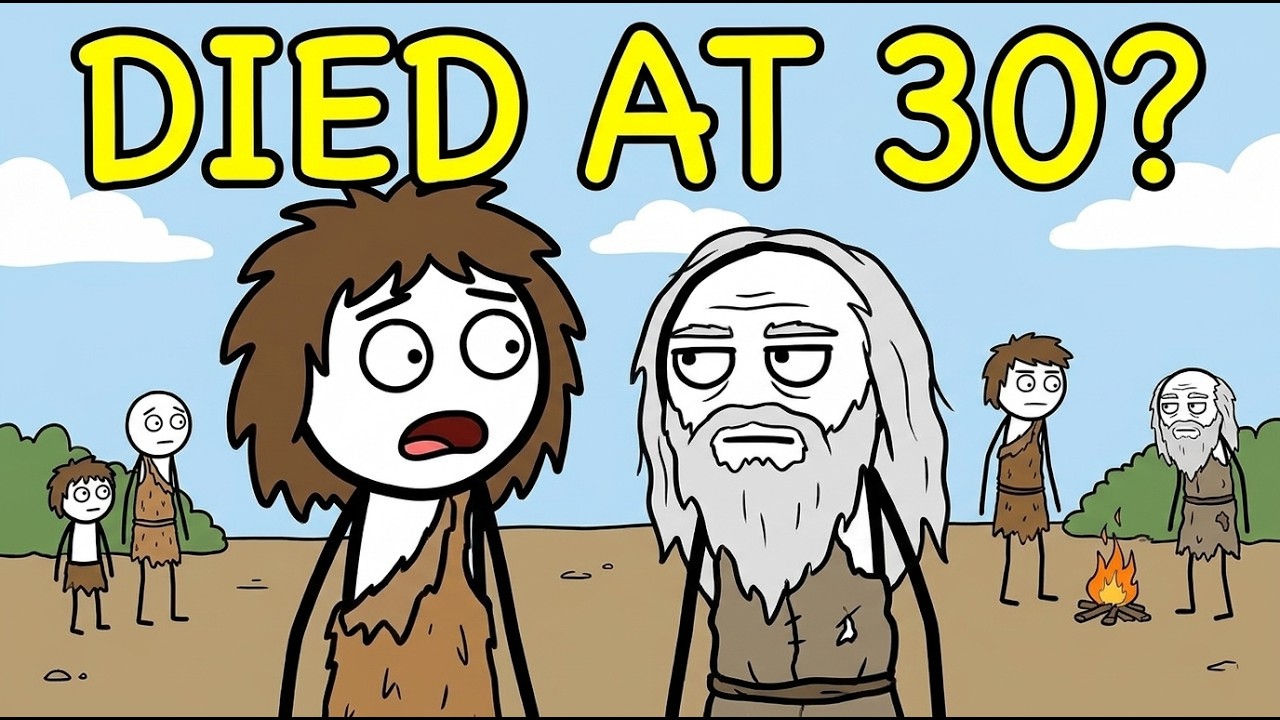
Life expectancy at birth is the average number of years a newborn would live under current mortality conditions. The modal age at death is the age at which deaths are most concentrated. In populations with high infant mortality, the average can plummet even while many adults reach their 60s and 70s. Research comparing several small-scale hunter-gatherer and horticultural populations has placed average life expectancy at birth in the low 30s, with considerable variation.
However, the same research found that roughly 60 percent of newborns survived to age 15, and the most common age of adult death was about 72, ranging approximately from the high 60s to the high 70s. This suggests that human bodies did not evolve to collapse at 30. The capacity for long adult life predates modern medicine. The first major filter was childbirth itself.
Human birth is unusually difficult due to large fetal heads and a tightly constrained birth canal. Without surgery, blood transfusions, antibiotics, or fetal monitoring, complications such as obstructed labor, hemorrhage, or infection could quickly become lethal for both mother and child. Ancient people had skilled birth attendants and practical knowledge, but they lacked reliable solutions for several emergencies that modern medicine now treats routinely. The first month of life was also perilous.
Newborns have immature immune systems and limited energy reserves. A mild infection that an adult could fight off could overwhelm an infant. Issues with breastfeeding could lead to malnutrition and dehydration. Infancy remained dangerous through the early years, with respiratory infections, gastrointestinal disease, contaminated water, and accidents posing constant threats.
Weaning created another vulnerable transition, as children began encountering new pathogens through shared food and water while losing the immune protection of breast milk. This is why the mortality curve was U-shaped. Risk was highest at the beginning of life, declined through later childhood and early adulthood, and then rose again as aging weakened the body. The middle of life was not safe, but it was safer.
Once a person reached age 15, they could expect on average to live into their early or middle 50s. The modal age of adult death, around 72, indicates that those who survived the early hazards frequently reached ages we would recognize as old. Long adult life distinguishes humans from other great apes. Wild chimpanzees experience high mortality across adulthood and rarely reach the ages humans can achieve without modern medicine.
Human survival appears to have been reshaped by food sharing, cooperation, skill accumulation, and childcare. Older adults remained valuable members of their communities, contributing through knowledge, teaching, healing, and preserving information. An older hunter may run more slowly, but they know where animals move during droughts and what happened the last time someone ate the red plant near the river. Natural selection had a reason to preserve long life.
If old people existed, why do prehistoric skeletons so often appear young? Because skeletal aging is an imprecise science. Archaeologists estimate age at death using dental development, tooth wear, joint degeneration, and other features. Children are easier to age because their growth follows a predictable sequence.
Adults are harder, as age must be estimated from gradual degeneration that varies widely based on activity, nutrition, and genetics. After age 50 or 60, these methods become especially imprecise, often compressing older adults into broad categories like 45-plus. Early skeletal studies also tended to undercount older adults because their reference methods were biased toward younger age structures. Newer approaches have recovered more older individuals from some cemeteries.
Preservation creates another filter entirely, as infant bones are fragile and decay easily. Burial customs varied, and many adults never made it into formal cemeteries. The archaeological population is only the fraction of the dead that entered preservable conditions, survived until discovery, and could be accurately aged. So what actually killed adults in the ancient world?
Infectious disease was likely among the largest categories. A cut from a stone tool or thorn could introduce bacteria that spread through the body without antibiotic intervention. Dental abscesses could become systemic. Pneumonia and gastrointestinal illness could overwhelm weakened bodies.
While ancient populations were smaller and more mobile, limiting certain crowd diseases like measles, zoonotic infections, parasites, and wound infections remained constant threats. Accidents formed another major category. Hunting large animals produced blunt trauma and crushing injuries. Gathering honey involved heights.
Fishing and water travel created drowning risks. A broken leg was not automatically fatal, but a broken leg far from camp without proper stabilization could lead to blood loss, infection, or the group’s inability to remain in one place. Violence also varied enormously among societies, with some experiencing little lethal conflict and others suffering raids and warfare. The past contains enough evidence to disappoint both the fantasy of permanent peace and the fantasy of constant war.
For women, pregnancy and childbirth added repeated exposure to risk. Even if maternal mortality per birth was low, the danger accumulated across multiple pregnancies. Hemorrhage, obstructed labor, and infection could kill healthy young women with little warning, elevating female mortality during reproductive ages in some populations. Men may have faced higher mortality from violence and dangerous hunting.
Farming did not immediately improve things. In many early agricultural populations, health initially worsened. Settled communities concentrated waste, people, and animals, giving pathogens reliable transmission routes. Diets narrowed around stable crops, and crop failure could devastate an entire settlement.
Dental decay increased, and repetitive labor left skeletal stress. Farmers could support larger populations, but individual bodies did not necessarily enjoy the arrangement. Later cities intensified crowding and epidemics, with historical life expectancy at birth remaining low in many premodern states. Old age itself looked different in the ancient world.
A person of 50 might have heavily worn teeth, arthritic joints, and healed fractures. Smoke exposure from hearths could damage lungs and eyes. Chronological age and physical condition did not move together neatly. A healthy 60-year-old with strong social support could remain active, while a 35-year-old with chronic infection could appear much older.
Modern medicine has not merely added years; it has changed what many ages feel like. The survival of older adults likely helped make human culture cumulative. Elders connect events separated by decades, comparing droughts, migrations, and mistakes. They make culture less dependent on rediscovery and more capable of preserving and improving innovations.
Longevity did not arrive after civilization. Civilization was partly built by a species already capable of longevity. The honest answer to what age most ancient humans died is that no single number can carry that much history. Across different eras, environments, and social structures, the mortality curve looked less like a wall at 30 and more like a valley.
Death was high at the entrance of life, fell as children strengthened, and rose again as aging narrowed the body’s ability to recover. Ancient humans did not usually die because they reached 30. They died because something happened at 3, 23, 47, or 70.
The tragedy was not that old age did not exist, but that getting there was never guaranteed.