She was the only woman to wade ashore on the beaches of Normandy on D-Day, a stowaway on a hospital ship who bandaged wounds and dodged gunfire while her estranged husband filed the story she had been denied. But for decades, history reduced Martha Gellhorn to a footnote: the third wife of Ernest Hemingway.
Now, newly surfaced accounts and a reevaluation of her vast body of work are forcing a brutal reckoning with how the literary world—and Hemingway himself—attempted to erase one of the 20th century’s most fearless war correspondents. The tragedy of Gellhorn is not that she was a great writer married to a greater one; it is that she was a greater journalist who was forced to fight her own husband for the right to witness history.
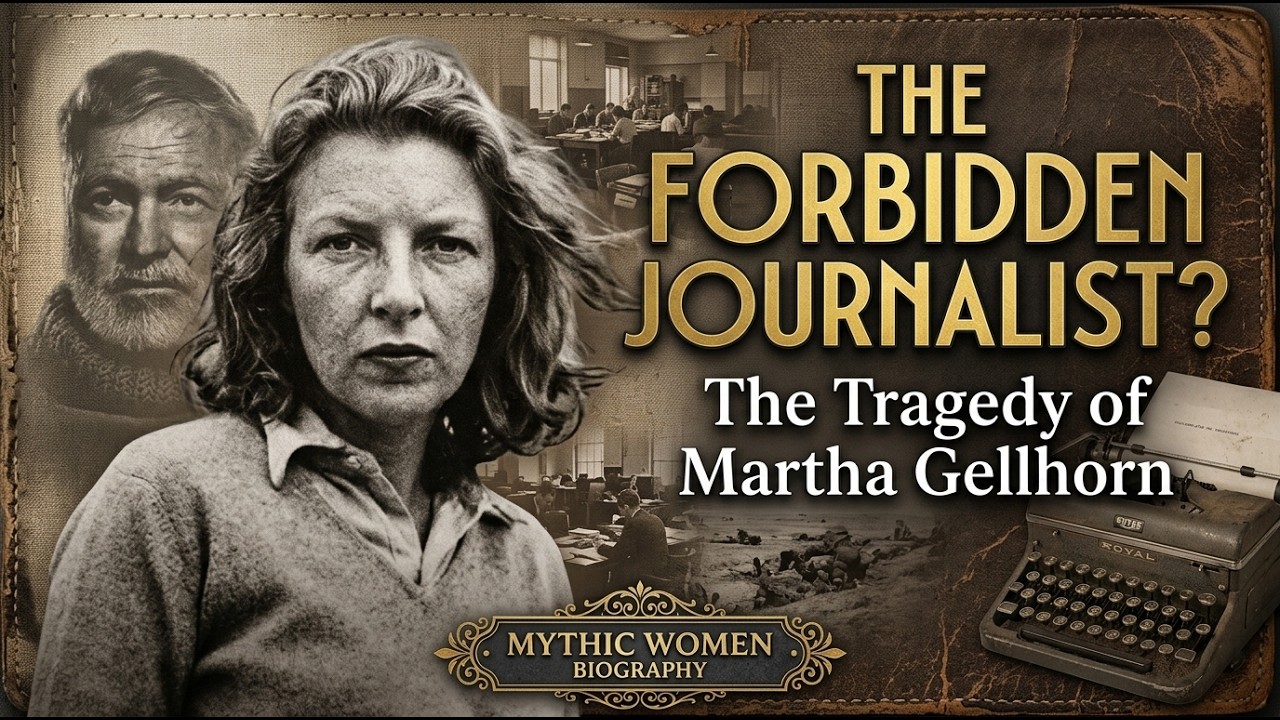 Gellhorn’s fall from grace began not with a failure of talent, but with a calculated campaign of male ego. In 1937, she talked her way into war-torn Spain, where she met Hemingway in the shell-battered Hotel Florida. He was already a legend.
She was a rising star whose reporting on Depression-era America had won her national acclaim.
But the romance that ignited under bombardment curdled into professional sabotage. When Gellhorn secured a coveted correspondent post at Collier’s magazine, Hemingway—without her knowledge—muscled his way into the same assignment. When she prepared to cover the Allied invasion of Europe, he took her job outright, leaving her to cross the Atlantic as a civilian on a freighter carrying military cargo.
The most chilling detail of their unraveling came early in Madrid, where Hemingway locked Gellhorn in her hotel room during a fascist artillery barrage. He claimed it was for her protection, but the message was unmistakable: she was his property, not a colleague. While the hotel shook and shells struck nearby, he sat downstairs playing cards.
When she escaped and confronted him, he admitted the act casually, as if managing her safety were his right.
His cruelty did not end with physical confinement. He mocked her in fiction, painting her as a grasping, talentless opportunist in a play he wrote during the Spanish Civil War. When her work succeeded, his praise curdled into resentment.
When her novel was published to thin reviews while his war epic dominated the conversation, he reminded her, with chilling precision, that the world would read him long after it had forgotten her.
The breaking point came in the spring of 1944. Gellhorn, desperate to cover the invasion of Europe, was quarantined in a London briefing room with other journalists who were kept in the dark. She refused to accept the exclusion.
She bluffed her way onto a hospital ship, hid in a bathroom until it was underway, and emerged off the coast of Normandy as the first woman to report from the front lines of the Allied landing.
Her account of the massacre on Omaha Beach—the oil-blackened water, the bodies bobbing in the surf, the medics working with terrifying calm—was raw, precise, and devastating. But when her articles ran in Collier’s, they appeared beneath Hemingway’s byline. His story was published above hers.
The magazine had given him her place, and he had taken it without a second thought.
Military officials retaliated for her unauthorized reporting by revoking her credentials. She was confined to a nurses’ training camp outside London—a punishment that kept her from the war she had risked her life to cover. She crawled under a fence, hitched a ride back to London, and fired off a letter of protest demanding to know why women correspondents were treated with such condescension.
Then she did what she had always done: she lied, bluffed, and stowed away to get back to the front.
By the time she reached Dachau, days after liberation, she had seen enough death to fill ten lifetimes. The railcars stacked with emaciated corpses. The living skeletons with hollow eyes.
The survivors who rushed the electric fence and died cheering. She wrote that she had never again felt the same hope for humanity. “Surely this war was made to abolish Dachau,” she wrote, “and all the other places like Dachau… We were blind and unbelieving and slow, and that we can never be again.”
The war broke something in her that never fully healed. She drifted, writing “bilgers”—lurid romances she despised—to fund her escape from memory. She married a kind, stable man she did not love and then left him, uprooting her adopted son, Sandy, who had come to depend on his stepfather’s steadiness.
The damage passed down. Raised with the Gellhorn standard—love that was conditional on achievement—Sandy never measured up. Martha, unable to accept his ordinariness, cut him off for five years.
When they reconciled, it was on the ragged edge of mutual exhaustion. The boy she had once called “bliss, bliss, bliss” had been crushed by the weight of her expectations.
Hemingway died in 1961. Gellhorn outlived him by 37 years, reporting from Vietnam in her 50s, Central America in her 70s, and Panama at age 81, her fury undimmed. She died in 1998, in London, by her own hand, blind and in pain, refusing to let anyone else decide when her story ended.
Her son scattered her ashes in the Thames. The woman who had crossed mined waters under barbed wire, who had dragged wounded men across a beach while shells screamed overhead, who had looked into the heart of the Holocaust and refused to blink—she became dust on the tide.
The tragedy of Martha Gellhorn is not that she was forgotten. It is that she was remembered only as the woman Hemingway tried to erase. But the work remains.
Her sentences are clear, furious, and undecorated. They are the truest witness we have of a century that did its worst while she watched, and wrote it all down.