A 1972 incident off the coast of California remains one of the most frequently cited cases of an orca biting a human in the wild, when a surfer required extensive medical treatment after being bitten on the leg. Yet, despite decades of close encounters between humans and killer whales worldwide, no confirmed pattern of wild orcas hunting people as prey has ever been documented. This absence is more revealing than any single dramatic story, pointing to a complex blend of culture, sensory perception, and ecological factors that keep humans off the orca menu. Orcas are not actually whales in the same family as blue or humpback whales.
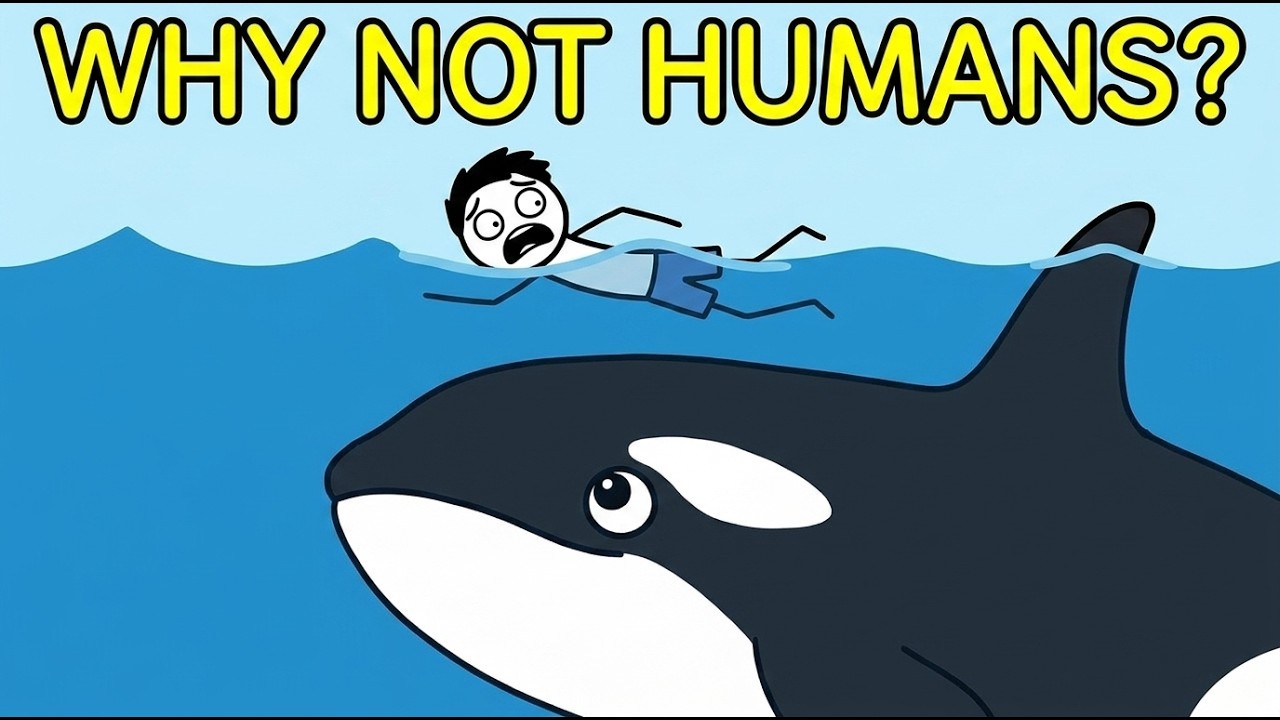
They are the largest members of the oceanic dolphin family, capable of reaching over eight meters in length and weighing several tons more than a car. They possess the speed, teeth, coordination, and social intelligence to hunt seals, sharks, dolphins, rays, and even whales larger than buses. Their hunting techniques can be brutal and highly coordinated, involving ramming, drowning, throwing prey, or cooperating with relatives to isolate targets. Across the species as a whole, their prey list is enormous, but no individual orca carries that entire global menu inside its head.
This is the first major clue. Orca feeding behavior is highly specialized at the population, family, and sometimes individual level. A fish-eating orca in the northeastern Pacific can swim through the same waters as a mammal-eating orca without ever adopting its diet, with different groups maintaining distinct calls, social organization, genetics, and feeding habits. Same ocean, different restaurant.
Feeding specialization is not simply a matter of opportunity. An orca calf does not inherit a gene for preferring large Chinook salmon. It inherits a body capable of hunting, then grows inside a family that teaches it what to pursue andhow to pursue it. Techniques are passed down verbally through observation and practice, from generating waves to wash seals off floating ice to deliberately surging onto beaches to seize prey.
These methods turn hunting into a form of culture,defined as information passed socially rather than genetically. This explains why a population like the Southern Resident killer whales, which specialize heavily in salmon, will struggle when their preferred fish are scarce rather than easily switching to seals. Hunting a seal requires different movement, silence, group size, timing, and handling than hunting a salmon. The mouth is ready, the culture is not.
To understand why humans are not hunted, one must consider how an orca perceives us. Toothed whales use echolocation, emitting clicks and analyzing returning echoes that reveal information about distance, direction, movement, size, shape, and internal structure. Research shows fish-eating killer whales rely on this for detecting and tracking prey, and experiments indicate they can distinguish different fish species through acoustic echoes alone. A human and a seal may form similar silhouettes in poor light, but they do not return the same acoustic image.
A seal has a different body shape, tissue distribution, lung structure, and movement pattern. A human moves like a primate negotiating an environment its ancestors entered only recently, splashing inefficiently, rising for air constantly, and often remaining beside boards, boats, or other objects. An orca approaching a swimmer gathers far more information than the swimmer realizes, allowing it to compare the entire scene with a lifetime of learned prey encounters. This makes mistakes possible but much less likely than commonly assumed.
Orcas also possess a different approach to investigation than sharks, which sometimes bite to test potential prey due to their sensory system. Orcas can circle, inspect, click, follow, and compare before making contact, and often use their snout or body instead of immediately removing a sample. For a new food source to enter a predator’s diet, several things usually must align. The predator must encounter it, identify it as edible, attack successfully, find the reward justifies the effort and risk, repeat the behavior, and potentially spread it through observation.
Humans seem to fail early in that chain. We are rare in open water compared with established marine prey. Even along busy coasts, a seal-eating orca may encounter thousands of seals for every lone swimmer it meets far from a vessel. We are also ecologically inconsistent, appearing sometimes beside a kayak, sometimes attached to a board, sometimes wearing bright fins or carrying metal tanks.
The same species appears in too many forms and unnatural contexts to create one simple prey template. Then there is the reward. It is often claimed that orcas avoid people because humans taste bad or lack blubber, though there is no direct evidence for this. However, prey economics matters.
Marine mammal specialists often target animals that contain substantial fat and provide predictable energy, while a human is smaller, relatively lean, awkwardly shaped, and surrounded by objects that increase uncertainty. Predators do not ask whether something can theoretically be eaten. They ask, through selection and experience, whether attacking it has paid before. For an orca family, humans have apparently failed to provide that first successful lesson.
Risk also strengthens the reluctance. Orcas are powerful but not disposable. Females can live for decades, calves require long care, reproduction is slow, and an injury to a jaw, eye, or fin can reduce hunting ability for years. Some populations have also experienced shooting, capture, entanglement, and lethal conflict with fisheries.
This encourages caution around novelty, especially an unfamiliar animal linked to noisy and sometimes dangerous boats. There is no solid evidence for a worldwide strategic pact among orcas to avoid harming humans out of fear of revenge, but individual whales can learn that vessels and humans are complicated. One bad memory or a maternal warning may be enough to discourage experimentation. Caution does not require a philosophy of human power.
Orca traditions can be extremely conservative. Once a family specializes, every generation receives the same diet, follows the same routes, recognizes the same prey sounds, and practices the same capture methods. Familiar prey becomes easier to catch because knowledge accumulates, while unfamiliar prey remains unfamiliar because nobody attacks it. No human hunt means no human hunting practice, no skilled human hunters, and no successful tradition for calves to copy.
A missing behavior can be inherited almost as effectively as a present one. This does not mean orcas ignore humans. They appear curious about us. Wild orcas have approached divers, nudged cameras, followed boats, and investigated dogs near shore.
A recent study collected dozens of cases where wild killer whales offered prey or other items to humans, often waiting nearby for a response. The offered objects included fish and other animals, a pattern almost aggressively opposite to predation. Researchers do not know exactly why these offerings happen, but the pattern reveals that orcas are noticing us and doing something other than hunting
That difference became clearer in the Iberian Peninsula, where a small population began interacting repeatedly with sailing vessels around 2020. The whales focused heavily on rudders, sometimes pushing, biting, or damaging them severely enough that vessels required rescue or sank.
Headlines called these attacks, some called them revenge, but researchers have been more careful. The behavior is real and dangerous to sailors, yet the motive remains uncertain, with expert assessments emphasizing play, social learning, and interaction with moving rudders as leading possibilities. The whales usually target the vessel’s steering system rather than the people aboard, and the pattern does not resemble predation. They do not isolate or seize a human or consume a body.
They engage with an object that moves, resists, and changes behavior when struck. An orca can damage something without trying to eat it. Intelligence produces curiosity, play, frustration, practice, and social trends alongside hunting. The Iberian behavior also shows how quickly an orca tradition can spread, with younger whales participating and the behavior persisting across seasons and locations.
Yet, after hundreds of vessel interactions, humans still have not become the target. The whales are demonstrating both sides of the answer at once. They can invent. They simply have not invented us as prey
The clean story becomes more uncomfortable when considering captivity.
Orcas held in marine parks have injured and killed people, proving that they possess the physical ability to direct lethal aggression toward humans. However, these events do not show human predation. Captivity radically changes movement, social grouping, stimulation, and contact with humans, and an attack may arise from aggression, frustration, play that becomes lethal, or motives that cannot be reconstructed from outside. Killing a trainer does not mean recognizing humans as food, any more than a tiger that kills its keeper has expanded its natural prey culture.
People often force orcas into one of two comforting roles, either as gentle ocean sages or black-and-white monsters, but they are neither. They are large dolphins with powerful social minds, specialized traditions, individual temperaments, and the ability to kill animals much larger than us. Their restraint around humans is striking but should not be romanticized into kindness. An orca does not need to hate you to injure you or hunt you to drown you accidentally.
There is also no guarantee that the pattern can never change. Culture is stable, not frozen. Orcas adopt new foraging behaviors, learn to take fish from fishing gear, follow vessels, and develop temporary behavioral fashions. Environmental change can place predators beside new food sources, and individual innovators can create habits that spread.
In principle, a group could learn that humans are vulnerable. The remarkable fact is that this apparently has not developed into a sustained wild tradition despite long contact. This is likely because several barriers operate together rather than one perfect explanation. Humans are rare in the right setting, acoustically distinct from familiar prey, behave strangely, offer uncertain energy, are associated with noisy and sometimes dangerous technology, and most importantly, no established culture defines them as food.
Remove any one barrier and the others remain. The strongest explanation for why orcas do not hunt humans is cultural prey recognition, supported by sensory accuracy, ecological opportunity, and risk. An orca does not open its mouth because an animal is helpless. It opens its mouth because that animal belongs to a learned category and the situation matches a practiced hunt.
To an orca, a seal is not merely a dark shape near the surface. It is a known package of sound, movement, smell, location, season, behavior, and reward, one that its family knows how to locate, escape, and share. A human is a question surrounded by fiberglass, and questions are often investigated rather than eaten. An orca’s intelligence is embedded in relationships and inherited knowledge, with the inherited library more powerful than the individual mind.
We survive encounters with orcas partly because we were never shelved in the section marked prey. There may be no conscious rule, no mercy, no recognition of human dignity, only generations of mothers teaching calves to chase something else. Orcas do not hunt humans because predation is not simply the ability to kill. It is a tradition of attention.
We entered the ocean weak and available, but we arrived outside the recipe. An orca could kill us. It simply was never taught to begin