For a brief moment, Ali MacGraw had everything Hollywood could offer.
The face.
The style.
The Oscar nomination.
The blockbuster romance that made millions cry.
And a level of fame that transformed her into one of the most recognizable women of the early 1970s.
Then Steve McQueen entered her life.
What followed was passion, jealousy, alcohol, control, and a marriage so consuming that MacGraw largely walked away from acting while still near the height of her fame.
Hollywood had created a superstar.
Within a few years, she seemed to vanish.
But the real story of Ali MacGraw’s disappearance began long before McQueen.
Born in New York, MacGraw grew up in a complicated household dominated by her father’s volatility.
Those early experiences left emotional scars, and as she grew older, she began searching for a world in which she could create an identity of her own.
Fashion provided the first escape.
MacGraw worked at Harper’s Bazaar, eventually moving in front of the camera through modeling and commercials.
She possessed something difficult to manufacture.
Natural elegance.
Intelligence.
A slightly unconventional beauty.
Hollywood noticed.
In 1969, Goodbye, Columbus changed her life.
MacGraw became an instant sensation.
Then came producer Robert Evans, one of the most powerful men in Hollywood.
They married, and MacGraw suddenly found herself at the center of an extraordinary world of movies, money, parties, and influence.
But nothing prepared her for Love Story.
Released in 1970, the film became a cultural phenomenon.
As Jenny Cavilleri, MacGraw turned a simple romantic tragedy into one of the defining films of the era.
She received an Academy Award nomination.
Her clothes became influential.
Her face appeared everywhere.
Ali MacGraw was no longer simply an actress.
She was a phenomenon.
Then, while making The Getaway, she met Steve McQueen.
The attraction was immediate and explosive.
McQueen was already one of the biggest stars in the world.
Rugged.
Rebellious.
Dangerously charismatic.
MacGraw was married to Evans, but her relationship with McQueen changed everything.
She left Evans and eventually married McQueen in 1973.
To the public, they looked like the ultimate Hollywood couple.
Behind closed doors, the reality was much more turbulent.
Their relationship was intensely passionate, but it was also marked by jealousy and control.
MacGraw later described a marriage in which McQueen expected her to put much of her own career aside.
And she did.
At precisely the moment Hollywood wanted more of Ali MacGraw, she largely stepped away.
The glamorous fantasy also had a darker side.
Alcohol and substance abuse surrounded parts of their life together.
MacGraw struggled with drinking herself.
The woman who had appeared so effortlessly composed in Love Story was living through a period of growing personal instability.
Eventually, the relationship with McQueen could not survive.
They divorced in 1978.
But MacGraw could not simply return to where she had left off.
Hollywood had changed.
Her momentum was gone.
And rebuilding a career after years away proved difficult.
She returned to acting, but the extraordinary heat surrounding her early career was never fully restored.
For a woman who had once seemed destined to dominate the decade, the decline was painful.
Alcohol increasingly became part of the problem.
Eventually, MacGraw reached the point where she needed help.
She entered the Betty Ford Center.
That decision became one of the most important turning points of her life.
Because this time, she was not trying to save a movie career.
She was trying to save herself.
Sobriety gradually gave MacGraw something Hollywood never had.
Clarity.
She began reevaluating the choices, relationships, and insecurities that had shaped her life.
And rather than desperately attempting to reclaim her former position in Hollywood, she began moving in another direction entirely.
MacGraw eventually settled in New Mexico.
The contrast could hardly have been greater.
She had once lived inside Hollywood’s most glamorous circles.
Now she embraced distance from them.
Yoga became central to her life.
She devoted time to animal welfare.
She pursued creative interests without needing them to become another blockbuster success.
And slowly, the woman who had once been defined by fame discovered that disappearing from Hollywood did not mean disappearing from life.
That may be the most surprising part of Ali MacGraw’s story.
For years, her career was often discussed as a cautionary tale.
The actress who became famous too quickly.
The woman who left Robert Evans for Steve McQueen.
The superstar who abandoned Hollywood at her peak.
But MacGraw’s later life suggests another interpretation.
She survived it.
The difficult childhood.
The overwhelming fame.
The turbulent marriages.
McQueen.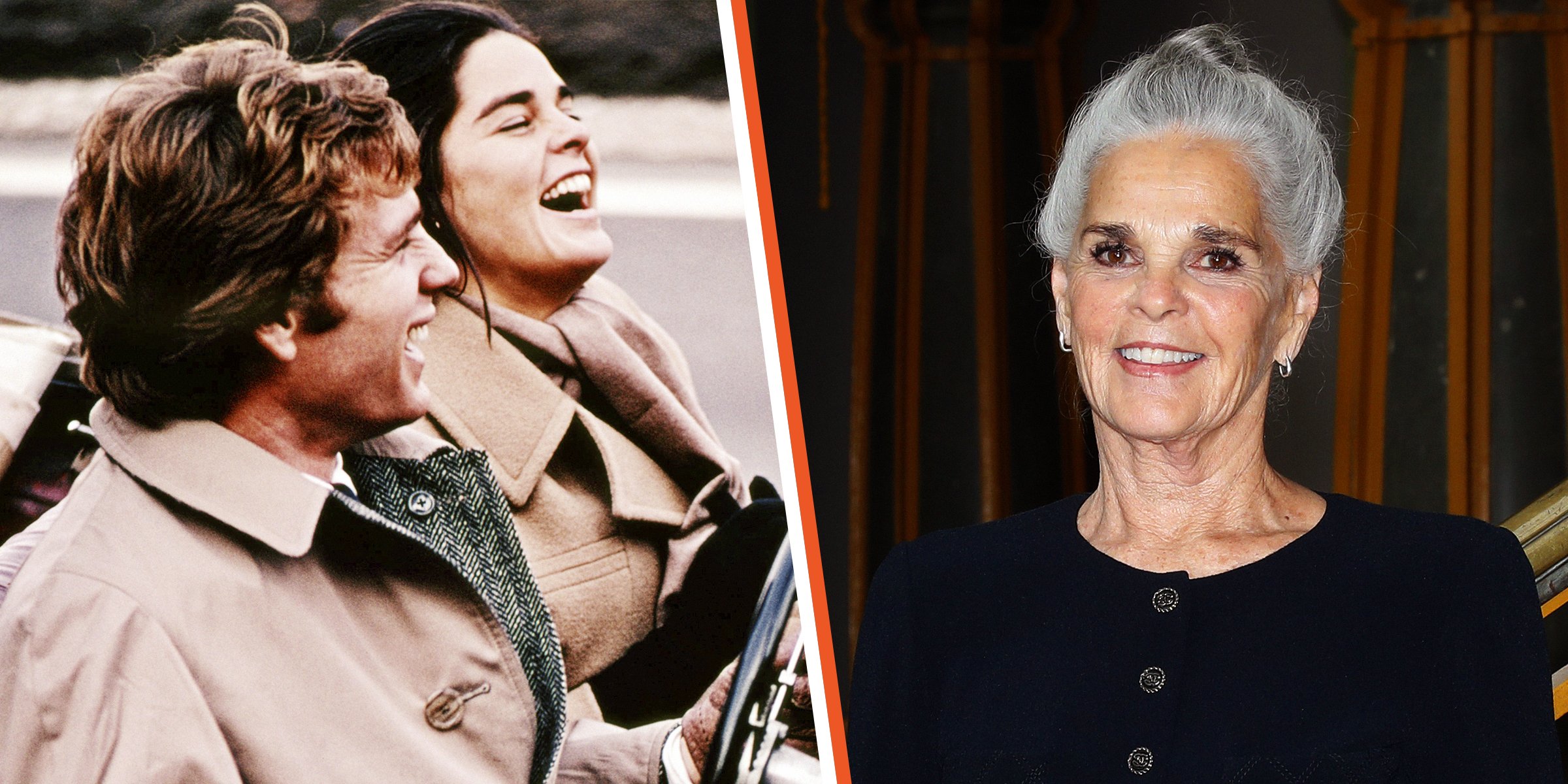
Alcohol.
The loss of a career that once seemed limitless.
And eventually, she found a version of herself that did not require a movie poster or a powerful man beside her.
Love Story made Ali MacGraw immortal.
Steve McQueen changed the direction of her life.
Alcohol nearly consumed part of it.
But Hollywood did not get the final chapter.
MacGraw did.
She walked away from the world that once defined her—and discovered that losing superstardom could also mean finally finding herself.