Keeping fire alive was the true challenge of ancient life, not starting it. Ignition was comparatively easy for most of human prehistory. The hard part was sustaining the flame through rain, wind, wet seasons, and long nights, because a fire that went out was not an inconvenience. For groups living in cold or wet conditions, losing fire meant facing slow emergencies like hypothermia, which starts with shivering, progresses to confusion, and ends quietly.
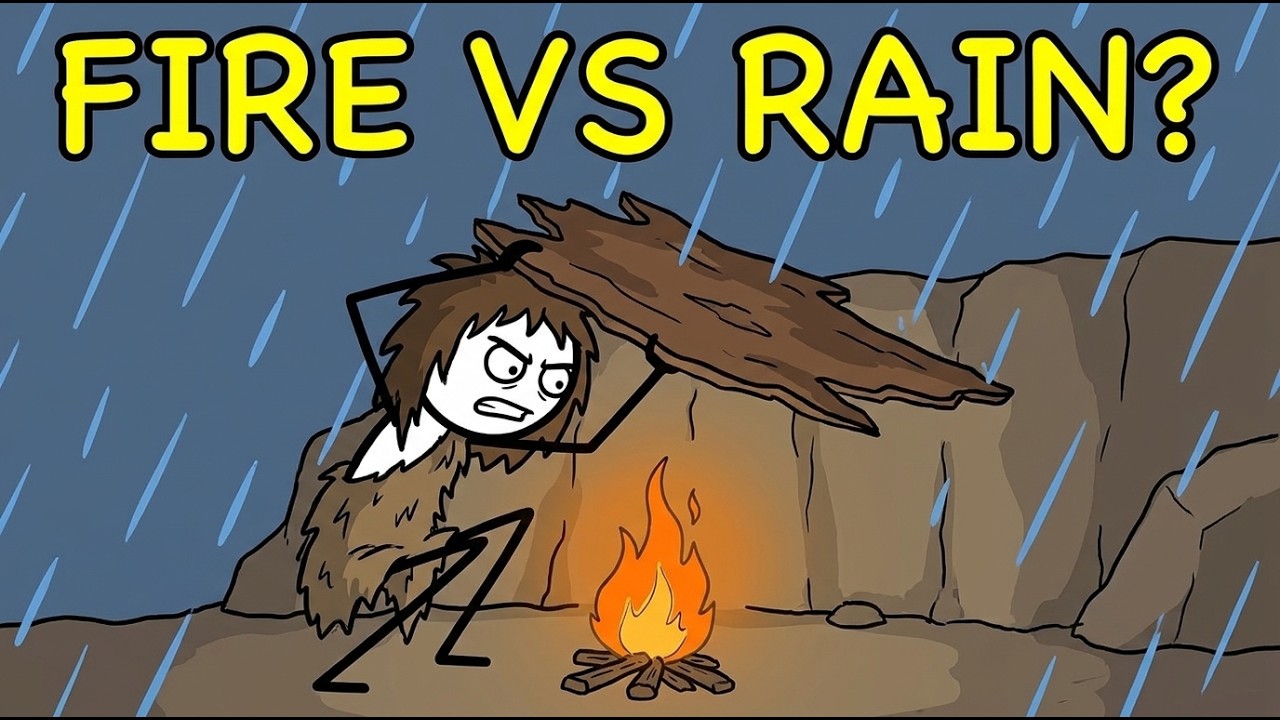
Protecting fire in adverse weather required layered strategies based on a critical distinction between protection and sustainability. Protecting meant keeping a specific flame alive through a single threat, while sustaining meant maintaining fire access indefinitely, which did not always require keeping the same fire burning. Ancient groups used both approaches depending on their circumstances. The most direct protection strategy was physical shelter for the fire itself.
Cave overhangs and natural rock shelters offered the simplest answer, providing overhead cover from rain while the open face maintained enough airflow for combustion. Archaeological hearths found at cave sites in South Africa, Israel, and France reflect not just fire use but deliberate fire management, positioning fires where they would survive the elements. Where caves were unavailable, people built shelter from local materials. Large bark slabs propped at angles intercepted wind and rain while leaving the fire ventilated.
Bundled grasses and vegetation were arranged over branch frames to create thatched covers. Animal hides draped over frameworks created adjustable protection. Birch bark was particularly valued because it was both water-resistant and highly flammable, serving as cover and kindling in one material. Locations played an essential role in fire survival.
Fire placement was treated with the same care as choosing a building site. Positioning a fire under a large tree offered partial protection from the canopy, while placing it against a rock face provided wind cover and created a thermal storage effect. The rock absorbed heat for hours and radiated it back, improving combustion and reducing fuel needs. Shallow pits for fires offered several simultaneous advantages.
Pit walls protected the base from wind, which kept the combustion stable, and concentrated heat upward. In heavy rain, the pit also protected the fire from surface runoff. These pit configurations appear consistently across archaeological records, showing they were a widely used and understood solution. Stones were another crucial part of fire survival.
Heated rocks accumulated enormous thermal energy, and when arranged around a fire, they kept radiating heat that prevented coals from dying even after rain extinguished the surface flame. These stone hearths also blocked low-angle, wind-driven rain and stored enough heat to help reignite surface fuel after the storm passed. The hearth stands as one of the oldest and most documented human technologies. Fuel management was just as important as fire placement.
Ancient fire managers knew they had to keep dry fuel in reserve at all times, not scramble for it when rain began. Large logs were more rain-resistant than small pieces, as their interiors stayed dry even when surfaces got wet. The priority was building up a deep coal bed rather than maintaining a small flame, because coals retained heat through rain events that would kill a young fire instantly. Banking a fire, covering the coals with ash, dense fuel, or earth, was a counterintuitive technique that helped it survive storms.
To the eye, the fire appeared to be out, but the coal core beneath retained heat for hours or longer. Banking protected the coals from water while reducing fuel consumption, extending the life of the heat reserve through the worst weather. When a group could not maintain fire in place, they carried it. Fire transport tools such as fire bundles were documented in ethnographic accounts across every continent.
A bundle consisted of a coal wrapped in slow-burning material such as dried dung, punk wood, or shelf fungus, enclosed in a covering that allowed limited air flow. The outer material smoldered slowly, keeping the core coal alive during hours of travel. Punk wood, the dry decayed heartwood of dead trees, was among the most effective materials for this purpose. It could maintain a coal without open flame, smoldering at very low temperatures and consuming so slowly that a single piece lasted for hours.
Fire bundles were typically entrusted to a designated group member, often an elder, and carrying this responsibility carried significant cultural weight. Rain also factored into fire management in ways that were not purely adversarial. Deliberately wetting the ground around a fire reduced the chance of uncontrolled spread. Cleared areas and barriers of non-combustible material shaped fire behavior in the landscape.
Groups that kept their fire burning through a storm found themselves with a competitive advantage afterward, because natural reignition became impossible in the saturated environment. This gave them strategic, social, and political leverage over groups that had lost their access to fire. The social organization of fire maintenance was just as crucial as the technical methods. A group that maintained continuous fire had roles, responsibilities, and collective investment in the outcome.
The individual who failed to protect the fire from rain compromised everyone’s welfare. These stakes shaped behavioral norms that treated fire care as a social expectation with consequences for failure. Knowledge transfer was institutional rather than individual. Fire management skills were passed from experienced elders to younger members through direct apprenticeship and observation.
This was high-stakes learning, because failure had immediate survival consequences. No single technique was sufficient in all conditions, but together these methods formed a system sophisticated enough to maintain fire access across every environment humans inhabited, from wet tropics to frozen north. The fire survived the rain because ancient humans planned for it before the storm appeared.
That was not luck but accumulated wisdom.