Hollywood has a long and well-documented history of chewing up its child stars, spitting them out, and leaving them to navigate a minefield of addiction, exploitation, and broken dreams. The narrative is so pervasive that it has become a tragic cliché. Yet, amidst the wreckage of tinsel town’s broken promises, one name stands as a defiant exception, a woman whose story is not one of downfall, but of resilience, faith, and an improbable friendship with a Hollywood legend.
Jane Withers, the girl who once rivaled Shirley Temple for the hearts of America, lived a life that defied every stereotype, but it was a life bought with a devastating, silent price.
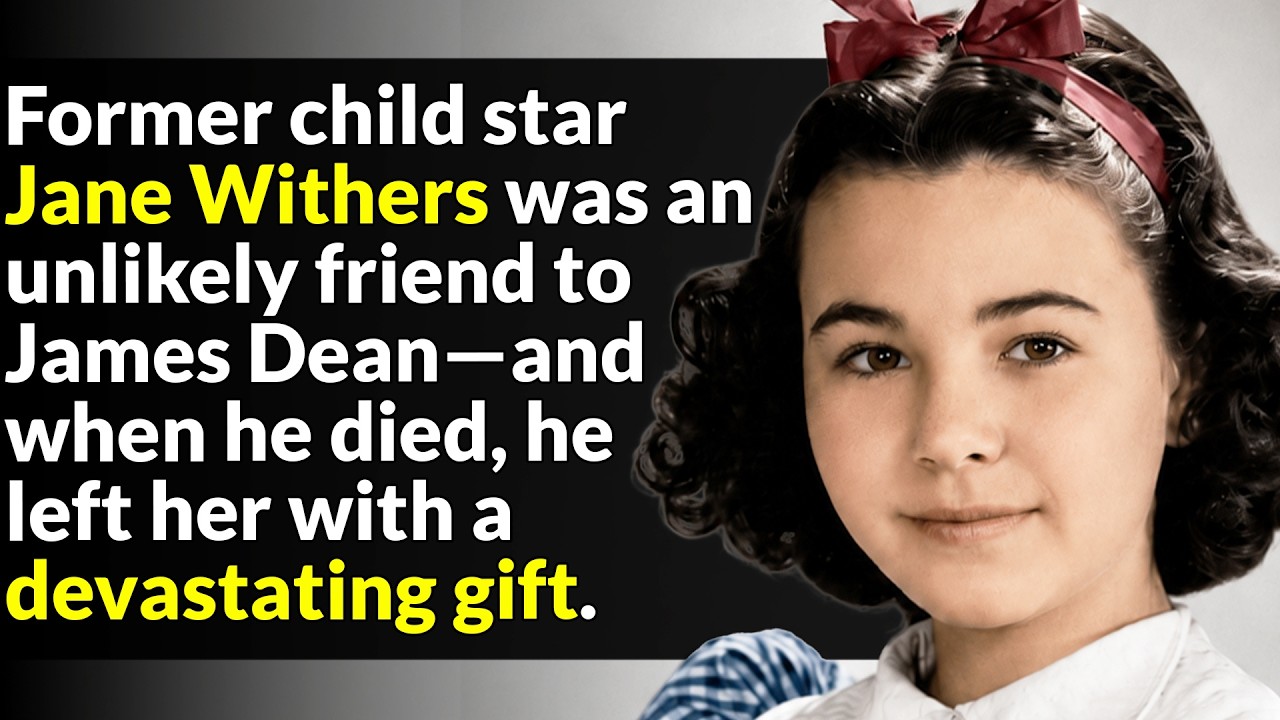 The story of Jane Withers is inextricably linked to the unfulfilled ambitions of her mother, Ruth. Ruth had always dreamed of seeing her name in lights, but her own parents had forbidden it. Undeterred, she devised a meticulous backup plan: she would marry, have a daughter, and live vicariously through her child’s success.
She even chose the name “Jane” because she believed it would look striking on a movie marquee. This was not a casual ambition; it was a predetermined destiny crafted for a girl before she was even born, setting the stage for a life of immense pressure and public scrutiny from her very first breath.
Born in 1925 in Atlanta, Jane Withers was a performer almost from birth, a creation of her mother’s will. By the age of three, she was already a radio star, charming audiences with her precocious interviews of visiting celebrities. The siren call of Hollywood, however, was too strong to resist.
Ruth and young Jane packed their bags and headed west, leaving Walter, the family patriarch, behind to send them a monthly stipend of $100. In the sprawling metropolis of Los Angeles, the local starlet from Atlanta quickly discovered she was just another face in an endless crowd of hopefuls. She was a dime a dozen, a reality that could have crushed a lesser spirit.
The early years in Hollywood were a grueling gauntlet of rejection. Ruth and Jane visited every studio and casting agent they could find, but success was elusive. Jane was relegated to extra work, sometimes earning a single scrap of dialogue, often nothing at all.
The odds were depressingly stacked against them. Yet, Ruth clung to a belief system that would become the cornerstone of Jane’s life: their deep Christian faith. Ruth assured her young daughter that God had a plan for them, that he would provide.
For a child of eight, this was a powerful and comforting promise. The belief was that if they remained steadfast and faithful, their prayers would be answered.
The answer came with her breakout role in the 1934 film “Bright Eyes,” though not in the way anyone expected. The film was a vehicle for the undisputed queen of child stars, Shirley Temple, and Jane was cast as her foil—a spoiled, mean-spirited character named Joyce. Jane later described the part as “the meanest and creepiest little girl that God ever put on this planet,” and she was convinced the audience would despise her.
Despite the shared experience of having a stage mom, the two child actresses never had a single conversation during production. Their mothers, Ruth and Gertrude Temple, were fiercely protective of their daughters’ careers and kept them apart, ensuring there was no competition or friendship between the two.
To Jane’s astonishment, the gamble paid off. The character of Joyce, which she feared would be her undoing, instead became the role audiences loved to hate. Critics were effusive, with some even declaring that Jane Withers had stolen the film from the great Shirley Temple.
The performance was a critical and commercial success, and Hollywood could no longer ignore her talent, charm, and undeniable work ethic. Fox Studios quickly signed her to a lucrative seven-year contract. However, there was a catch: Shirley Temple was already under contract with the same studio.
Jane was now forever locked in a shadow of a rivalry she never wanted, forever compared to the brighter star.
Jane’s career exploded in the 1930s. She churned out several movies a year, and by 1936 and 1937, theater owners had named her one of the most profitable movie stars in the country. But unlike many child stars who coasted on their early success, Jane and Ruth viewed acting as an art form.
They invested thousands of dollars back into her training, enrolling her in lessons for ice skating, voice, horse riding, foreign languages, and swimming. Ruth was militant about Jane’s earnings, meticulously saving them. This discipline transformed Jane from a child actor into the family’s primary breadwinner, earning a fortune through her studio salary, endorsements, and a vast array of licensed merchandise that bore her name—from dresses to dolls.
 But the price of fame was exorbitant. When Jane was only 10 years old, she began receiving anonymous letters with terrifying threats. The letters vowed to abduct her and 𝓀𝒾𝓁𝓁 her mother unless a ransom of $50,000 was paid.
Whether the threats were real or the work of a disturbed individual, Ruth and Jane could not afford to take the chance. Jane was given round-the-clock bodyguards, a constant reminder that her childhood was not normal. The stardom they had so desperately sought was not the idyllic dream they had imagined.
The golden cage was gilded, but it was still a cage, and the fear of an unseen predator was a heavy burden for a young girl.
Despite this, Jane earned a reputation as one of the most well-behaved and likable child stars in Hollywood. Her parents were determined to keep her grounded. They required her to give back to the community, performing at orphanages and hospitals.
She was generous with her vast doll collection, buying extras just to donate them. This discipline instilled in her a sense of gratitude and humility. However, as she grew into a teenager, the studio struggled to adapt.
They continued to pigeonhole her in family-friendly comedies, treating her as the same cute kid she had been at eight. She, however, was evolving into a real artist, craving more mature roles, but the studio system was inflexible.
At 16, she managed to show her creative range by writing the screenplay for her 1941 film “Small Town Deb” under the pen name Jerry Walters. The film was about a teenage girl whose ambitions were stifled by an overbearing mother, a story that mirrored her own life. However, it was too little, too late.
The child-star genre began to decline in the early 1940s, and Jane’s career followed the trend. She signed with Republic Pictures, but the momentum was gone. Fox had typecast her so thoroughly in light comedy that audiences could not imagine her in dramatic roles.
Jane, wise beyond her years, understood that her career had an expiration date, and she made peace with it.
Unlike many of her peers, Jane had always dreamed of a “normal” life: a happy marriage, children, and a quiet home. At 19, she met Bill Moss, a 25-year-old film producer and wealthy businessman. He seemed like the perfect prince to her fairytale.
Jane retired from acting, married him, and moved to a ranch to start a family. Ruth’s disciplined saving meant that Jane had a fortune of her own when she turned 21, a millionaire at an age when most people are just starting out. But the fairytale quickly soured.
Bill, the man who looked perfect on paper, turned out to be a drinker and a gambler. He was the one thing Hollywood failed to do; he broke Jane.
The stress of the marital breakdown and subsequent divorce in 1953 took a catastrophic toll on her. At 27, Jane suffered a complete emotional and physical collapse. She developed severe rheumatoid arthritis and full paralysis, landing her in the hospital for five months.
 It was a dark period of her life, and her faith was her only anchor. Fortunately, she made a full recovery with no long-term physical damage. In the divorce settlement, she was awarded full custody of their three children, a substantial property settlement, trust funds, and a stake in Bill’s oil fields.
She emerged from the wreckage not just alive, but financially secure, and her priority was clear: her children.
With her life rebuilt, Jane began to consider a return to Hollywood, but on her own terms. In 1955, she started studying film at the University of Southern California, hoping to transition into directing. Fate, however, intervened.
Director George Stevens offered her a supporting role in his 1956 epic, “Giant.” It was a film that would not only revive her career but also place her directly in the path of one of the most iconic and tragic figures in cinema history: James Dean.
During filming in Texas, Jane hosted parties at her home almost every night, creating a welcoming atmosphere for the cast, which included Elizabeth Taylor and Rock Hudson. It was there that a strange and unlikely friendship was born. Jane recalled that James Dean once confronted her, asking, “You don’t like me, do you?”
She was honest with him. She liked him, but she thought he could use an attitude adjustment. This frankness intrigued Dean, and the two developed a close bond.
One night, Jane was startled to find James in her bedroom, having entered through a window. When she asked why he didn’t use the front door, he told her he didn’t want to see anyone else, only her. She grabbed her toolkit and nailed the window shut right in front of him, telling him he had to use the front door like a normal person from now on, which he did.
Their friendship deepened during the sweltering Texas production. Jane noticed James always wore the same shirt, so she offered to wash it. This became a ritual.
He would bring her his dirty laundry, and she would wash it for him to pick up the next day. It was a small act of care that she could provide for the troubled and sensitive young man. She also noted that the studio had banned him from car racing during production, a hobby she knew he was passionate about.
When filming wrapped, James gave Jane his favorite pink cowboy shirt as a memento and rushed off to a race. It was on the way to that race that James Dean was killed in a car crash. Hollywood lost a legend, and Jane Withers lost a friend.
That pink shirt, a symbol of her friendship with the rebel without a cause, was kept by Jane for the rest of her life, a devastating souvenir of a friendship cut tragically short.
“Giant” did not just change Jane personally; it dramatically revived her career. She received dozens of offers for television and stage work. But unlike many actors facing a comeback, she was financially secure and could afford to be picky.
She rejected almost every role that required her to be away from her children. She had also found love again with Kenneth Errair, a singer from The Four Freshmen. They married in 1955 and had two more children.
 She did, however, accept one major role that allowed her to stay home.
From 1963 to 1974, Jane Withers became a household name all over again by playing the character “Josephine the Plumber” in a series of wildly popular Comet Cleanser commercials. The role not only thrust her back into the mainstream but also provided a steady, comfortable income. At a time when many former child stars were struggling, Jane was on top of the world.
She had her family, a loving marriage, and a successful comeback. But tragedy was waiting in the wings.
In 1968, her husband Kenneth was killed in a plane crash. It was a crushing, devastating blow. Jane was heartbroken but found a way to console herself by accepting it as “God’s will.”
This deep-seated faith, instilled by her mother, was the foundation that kept her standing when her world shattered. Then, in 1983, her mother Ruth passed away. Ruth never got to act herself, but she had achieved her goal vicariously through Jane, leaving an undeniable mark on Hollywood through her daughter’s success.
When asked by interviewers how she managed to be one of the few child stars who turned out so well-adjusted, Jane focused on her faith. At 48, she told them, “I always took my troubles to the good Lord, and I never failed to get an answer.” She did not credit her strict upbringing or her parents.
She credited her spiritual life. Even when it came to her on-screen rival, Shirley Temple, Jane chose grace. She never held a grudge despite spending so much of her career in Shirley’s shadow.
She claimed Shirley was a dear friend and called her every year on her birthday.
Jane Withers lived a long, full life. She had the world’s largest doll collections, and as she entered her twilight years, she began donating her vast trove of Hollywood memorabilia to museums. In 2004, she auctioned off hundreds of her prized dolls, a testament to her generosity.
She faced her final years with the same fortitude. Diagnosed with lupus in 1990, she suffered for over a decade before going into remission. In 2007, at 85, she was dealing with vertigo.
On August 7, 2021, Jane Withers died surrounded by her family at the age of 95. She left behind an underrated legacy, but more importantly, she left behind a story that upends the tragic narrative of the child star. She wasn’t the greatest star of her generation, but she was something rarer and more precious: she was good.
And she was grateful.