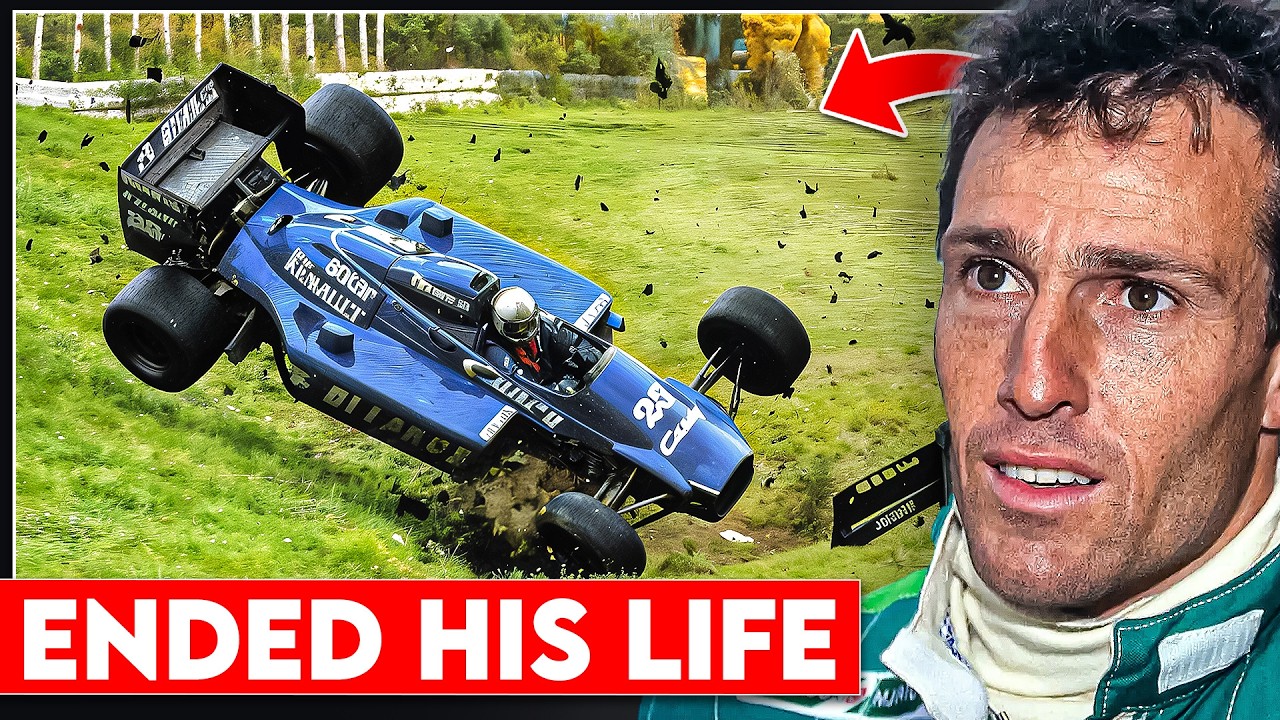
The roar of a motorcycle engine, a sound that had once been the prelude to Formula 1 glory, was abruptly silenced on the asphalt of Rome’s Grande Raccordo Anulare on the morning of October 5, 2014. Andrea de Cesaris, the man who had spent a lifetime courting danger at speeds exceeding 200 miles per hour, met his end not in the carbon-fiber cockpit of a Grand Prix machine, but on a Suzuki motorcycle on a familiar ring road encircling his beloved hometown. The impact with a guard rail was catastrophic, and the 55-year-old former driver was pronounced dead at the scene, leaving a motorsport world in stunned disbelief and forcing a reckoning with the legacy of a man known as much for his spectacular failures as his breathtaking speed.
The circumstances surrounding the fatal accident paint a picture of tragic irony that defined de Cesaris’s entire existence. He was a man who had survived some of the most violent crashes in Formula 1 history, walking away from infernos and barrel rolls that would have claimed lesser men. Yet, it was a routine ride on a public thoroughfare that proved fatal.
 Witnesses reported that de Cesaris lost control of the motorcycle while navigating a curve, the machine sliding across the asphalt before colliding violently with the roadside barrier. Emergency services arrived within minutes, but there was nothing to be done. The man who had cheated death so many times on the world’s most dangerous circuits had finally run out of luck on a road he had likely traveled a thousand times before.
For those who followed his career, the news was a gut punch of profound sadness, not only for the loss of life but for the cruel narrative arc it completed. De Cesaris was never just a driver; he was a phenomenon, a paradox wrapped in a fireproof suit. Born into wealth in Rome in 1959, he had every advantage, but his path to Formula 1 was paved with an insatiable, almost reckless hunger for speed.
He arrived in the sport in 1980 with the storied Alfa Romeo team, a 21-year-old prodigy with matinee-idol looks and a driving style that was as thrilling as it was terrifying. He was immediately hailed as the future of Italian motorsport, a successor to the greats who had come before him, and his early qualifying performances suggested that the hype was justified.
However, the raw talent that allowed him to out-qualify seasoned veterans was inextricably linked to a fatal flaw: an inability to temper his aggression with the patience required for race craft. His debut season was a harbinger of what was to come, a chaotic mix of stunning pace and inexplicable errors. He would push his machine to the absolute limit, extracting performance that the engineers didn’t know existed, only to lose control in a spectacular shower of sparks and carbon fiber.
The nickname that would haunt him for the rest of his life, “Andrea de Crasher,” was born not out of malice but out of a bewildered frustration from fans who watched him throw away certain points with alarming regularity. The crashes were not mere incidents; they were events, often involving airborne launches and multi-car pileups that became staples of Sunday afternoon broadcasts.
The financial toll of his habit was immense. Teams like Alfa Romeo, McLaren, and Lotus watched their budgets evaporate in a haze of replacement parts and repair bills. The breaking point came in 1985 at the Austrian Grand Prix, a race that would serve as a stark illustration of the cost of his style.
 Driving for the Ligier team, de Cesaris lost control and plowed into the barriers with such force that the car was reduced to a mangled wreck. The damage was so extensive and the financial burden so severe that the team principal, Guy Ligier, had no choice but to terminate his contract on the spot. It was a public humiliation that underscored the central tragedy of his career: his talent was a double-edged sword that cut both his rivals and his own chances of success.
Yet, to reduce de Cesaris to a mere crash artist is to ignore the flashes of sheer genius that occasionally broke through the chaos. He possessed a qualifying pace that was genuinely world-class, capable of putting his car on the front row of the grid when the stars aligned. His performance at the 1983 German Grand Prix, where he drove a brilliant race to finish second, was a testament to what he could achieve when he managed to keep the car on the black stuff.
He secured five podium finishes in total, each one a tantalizing glimpse of a career that could have been. But the ultimate prize, a Grand Prix victory, remained agonizingly elusive. He holds the unenviable, record-breaking distinction of having the most Formula 1 starts without a single win, a statistic that serves as a permanent, damning indictment of his inconsistency.
The psychological burden of this failure must have been immense. He was a man who knew he had the speed to win, yet he could never string together the necessary combination of speed, reliability, and luck to stand on the top step of the podium. This internal conflict likely fueled his erratic behavior on track.
He was a driver who seemed to be in a constant battle with himself, his desire to prove his brilliance often overriding his better judgment. The pressure of being the great Italian hope, a label he carried for years, must have weighed heavily on his shoulders. Every crash was not just a mechanical failure but a personal failure, a reinforcement of the narrative that he was a man of unfulfilled potential.
 In the years following his final Grand Prix in 1994, de Cesaris transitioned into a different role within the sport, working as a driver representative and a familiar face in the paddock. He seemed to have found a sense of peace, his wild days behind him. He spoke with fondness about his career, acknowledging his mistakes with a self-deprecating humor that endeared him to a new generation of fans and drivers.
He had survived the dangerous era of the 1980s, a time when drivers were dying with alarming frequency, and he had emerged with his life and his spirit intact. It appeared that he had finally outrun the demons that had plagued his racing career.
The news of his death on that October morning shattered that illusion of safety. The irony was not lost on anyone: a man who had walked away from a fiery crash at the Monaco Grand Prix and a violent testing accident at Paul Ricard was killed on a public road. The tragedy served as a stark reminder that motorsport is not the only dangerous pursuit; the love of speed that defined de Cesaris was a lifelong addiction that he could not shake.
Even in retirement, he sought the thrill of acceleration, and it was that very pursuit that ultimately claimed his life. The Grande Raccordo Anulare, a road he knew intimately, became his final, unforgiving circuit.
Tributes poured in from across the globe, from former world champions to the mechanics who had worked on his cars. They spoke not of the crashes, but of the man: his warmth, his passion, and his infectious love for the sport. They remembered the driver who would push a car beyond its breaking point, not out of arrogance, but out of a desperate desire to succeed.
 They remembered the man who, despite his record, never gave up, always believing that the next race would be the one where it all came together. His legacy is a complex one, a tapestry woven with threads of brilliance, frustration, and tragedy.
The story of Andrea de Cesaris is a cautionary tale about the fine line between courage and recklessness. It is a story about the human element in a sport that often glorifies machinery over men. He was a reminder that the drivers are not robots; they are individuals with fears, desires, and flaws.
His inability to consistently harness his talent was a human failing, a vulnerability that made him relatable even as it frustrated his teams. He embodied the risk inherent in motorsport, the understanding that the pursuit of glory often comes with a price. His life was a high-stakes gamble, and while he lost the battle for victories, he won the hearts of many who appreciated his fearless, if flawed, approach.
As the sun set on Rome that day, the motorsport world mourned not just a former driver, but a character, a personality that had added color and unpredictability to the sport. The “Andrea de Crasher” nickname, once a source of mockery, now seems a cruel simplification of a man who was so much more than his mistakes. He was a dreamer who chased a dream that always seemed just out of reach.
The sadness of his final moments lies not just in the suddenness of his death, but in the lingering thought that he never quite got the happy ending his passion deserved. He left behind a legacy of what-ifs and a profound sense of loss for a man who lived his life at full throttle until the very end.