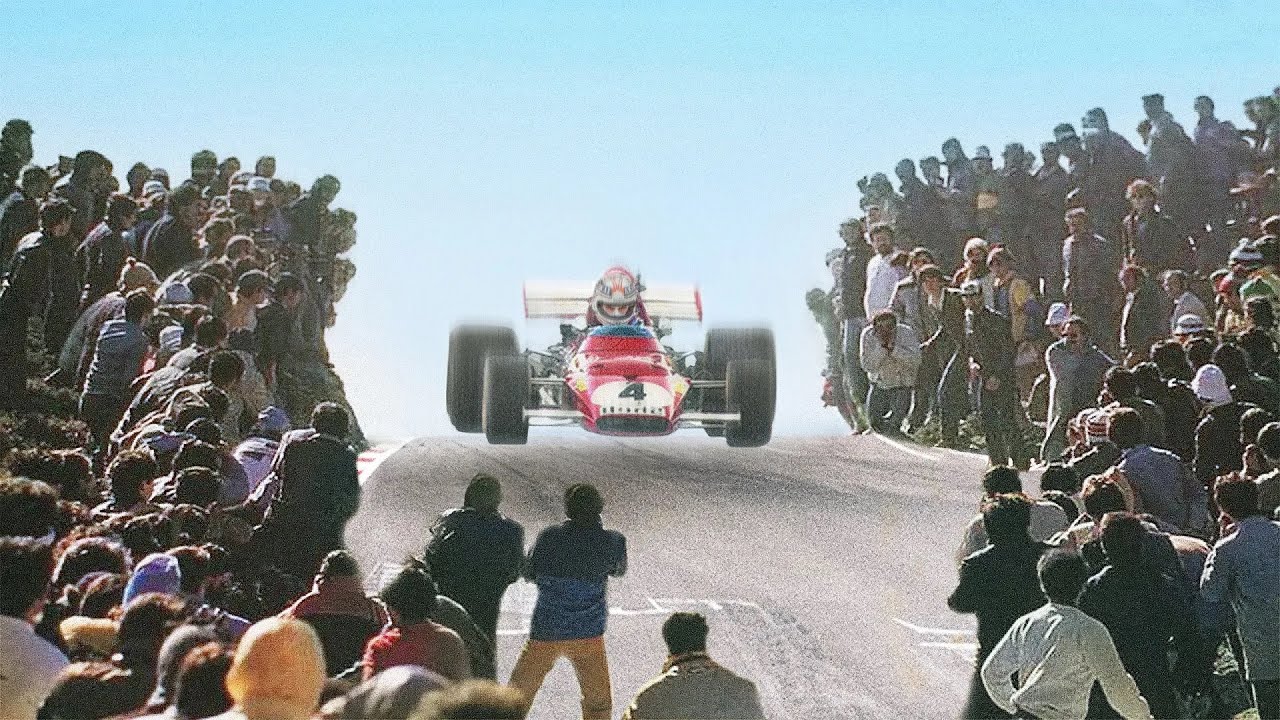
The smoke had barely cleared from the fiery wreckage of the 1973 Dutch Grand Prix before the world recoiled in horror, yet the circus rolled on, dragging a coffin behind the motorhome. Roger Williamson was trapped upside down, his body pinned beneath a burning inferno of magnesium and fuel, while his close friend David Purley sprinted from his own car to attempt a rescue that would prove futile. The marshals, dressed in nothing more than ordinary clothing, stood paralyzed, their single fire extinguisher useless against the chemical blaze that consumed a man alive for over five agonizing minutes.
It was not the first death, nor the last, but it crystallized a decade of absolute insanity that defined Formula 1 in the 1970s, a period where technological genius raced neck-and-neck with suicidal negligence.
 To understand the sheer madness, one must first grasp the paradox of the sport’s evolution. In the 1950s, Formula 1 was comparatively safer, not because of any regulatory foresight, but because of primitive simplicity. Cars produced a modest 300 horsepower, raced on abandoned airfields lined with hay bales, and the only engineering obsession was raw engine output.
The teams were small, the speeds were manageable, and while deaths occurred, they were not the weekly bloodletting that would define the following decades. The 1960s introduced a slow creep of sophistication, but it was the 1970s that unleashed a perfect storm of unregulated innovation and breakneck velocity that turned every race into a lottery ticket with a 50 percent chance of survival.
The technical freedom of the era was both its glory and its curse. Teams experimented with six-wheeled monstrosities like the Tyrrell P34, which looked like a fever dream and handled like a handful. They strapped enormous wings onto cars without any structural reinforcement, and the legendary Lotus 72, which won the 1970 championship, weighed a featherlight 540 kilograms including liquids, a death trap wrapped in a revolution.
Colin Chapman, the visionary genius behind Lotus, had introduced aerodynamic downforce at Monaco in 1968, and by the 70s, every team was piling on front and rear wings with reckless abandon, not understanding the stresses they were imposing on flimsy chassis that were essentially thin sheets of metal wrapped around a fuel tank and a driver’s seat.
The results were catastrophic predictability. Twelve drivers lost their lives during the 1970s, a staggering toll that dwarfs the three deaths of the past three decades, two of which occurred during the tragic Imola weekend of 1994. To put that into perspective, consider the crash of Niki Lauda at the 1976 German Grand Prix, an impact that looked almost benign to the casual observer but resulted in his Ferrari bursting into flames, leaving him with severe burns that should have been fatal.
He survived through sheer grit and modern medicine, but countless others were not so fortunate. The cars were built for speed, not survival, and the cockpit was a thin shell with zero crash protection, a fact that remained true until 1981 when the survival cell was finally mandated.
 The speed differential alone explains the danger. In 1950, Juan Manuel Fangio took pole position at Monaco with a time of one minute and 50. 2 seconds.
By 1970, Jackie Stewart lapped the same circuit in one minute and 24 seconds, a staggering 26-second improvement in just 20 years. The cars were gaining pace at an exponential rate while safety measures languished decades behind. Drivers were jumping into these mechanical rockets with shockingly minimal experience, and the sport’s driver pool included individuals like George Follmer, who made his debut at 39 years and one month old, having spent most of his life racing touring cars before suddenly being asked to handle a 190-mph missile.
The lack of preparation was a death sentence waiting to be served.
Even the basic survival gear was absent. Fireproof driver overalls did not become mandatory until 1975, a full five years into a decade that was already producing horrifying fire-related deaths. Before that, drivers raced in simple cotton or wool suits that offered no protection whatsoever, an oversight that seems unimaginable today.
And while modern fans complain about the weight of current F1 cars, a minimum of 798 kilograms, that bulk is precisely what saves lives. The crash structures, carbon fiber monocoques, and advanced energy absorption systems are the difference between a driver walking away from a 200-mph crash and a family attending a funeral. In the 70s, a crash at half that speed was often fatal, as the car would simply disintegrate around the unprotected driver.
 The tracks themselves were not much better than the cars. Run-off areas were nonexistent or nominal, consisting of grass that offered zero deceleration. Barriers were unstandardized, with metal Armco barriers often installed improperly, as demonstrated by the deaths of François Cevert at the 1973 US Grand Prix and Helmuth Koinigg a year later at the same track.
Cevert’s car slid into the steel barrier at high speed, and the force was so violent that it sheared the car in half. Koinigg’s impact was even more horrifying, as the Armco barrier, which had been secured inadequately, sliced through his car like a guillotine, killing him instantly. These weren’t freak accidents; they were predictable outcomes of a sport that had priorities entirely out of whack.
With such lax standards, it is astonishing that more officials didn’t intervene earlier, but the sport’s governance was reactive at best. The first safety car wasn’t deployed until the 1973 Canadian Grand Prix, and its debut was an embarrassing shambles. The safety car driver mistakenly thought the wrong car was leading, and it took three hours after the race to determine the true winner.
There was no pit lane speed limiter, meaning drivers could and did attack the pit entrance at maximum velocity, weaving through mechanics and equipment with reckless abandon. That rule wasn’t introduced until after the tragic Imola weekend of 1994, which also brought about standardized barriers and significant track alterations. Decades of madness were allowed to continue unabated while drivers paid the ultimate price.
Perhaps the most gut-wrenching moment of the entire decade, one that encapsulates everything wrong with 70s F1, occurred at the 1977 South African Grand Prix. Driver Renzo Zorzi had pulled off the track with a fuel pump failure, and his car caught fire. Two marshals, untrained and unprepared, decided to run across the live track without permission, one carrying a fire extinguisher.
 The first marshal made it to Zorzi’s car, but the second misjudged the closing speed of oncoming cars and was struck by Tom Pryce at over 170 miles per hour. The young marshal, just 19 years old, died instantly, and the fire extinguisher he was carrying flew from his grasp, striking Pryce directly on the helmet and killing him immediately. The crash was a triple tragedy that showed how far the sport had to go, yet incredibly, the race was not even red-flagged, a decision that boggles the mind even fifty years later.
It was this kind of callousness, this acceptance of death as an occupational hazard, that pushed Jackie Stewart to become the sport’s most vocal safety advocate. Stewart, who won three world championships, lost an astonishing 57 colleagues during his career, and his relentless campaigning eventually forced the FIA to take notice. His efforts, combined with the tragic deaths of Roland Ratzenberger and Ayrton Senna at Imola in 1994, finally ignited a comprehensive safety revolution.
The halo, the HANS device, advanced crash structures, and modern barriers are all direct results of lessons learned from those fateful decades. It took far too long, but the sport did eventually change, and today’s drivers are the beneficiaries of a transformation that came at too high a cost.
When fans today complain about the overly safe, processional nature of modern Formula 1, they would do well to remember the absolute insanity of the 1970s. Twelve drivers died in that decade alone, and countless others suffered horrific injuries that ended careers and lives. The cars were dangerously fast, the tracks woefully inadequate, and the governing bodies criminally negligent.
It is easy to romanticize the era as a golden age of bravery and raw racing, but the reality is far grimmer. The sport has rightfully evolved because the alternative was extinction. The lessons of the 70s are not just historical footnotes; they are the very foundation upon which modern safety is built, and any desire to return to that level of “purity” ignores the tombstone-strewn path that led us here.
Racing should always be about pushing limits, but not at the cost of lives that can be saved with a little foresight and a lot more respect for the men and women who strap themselves into these machines.