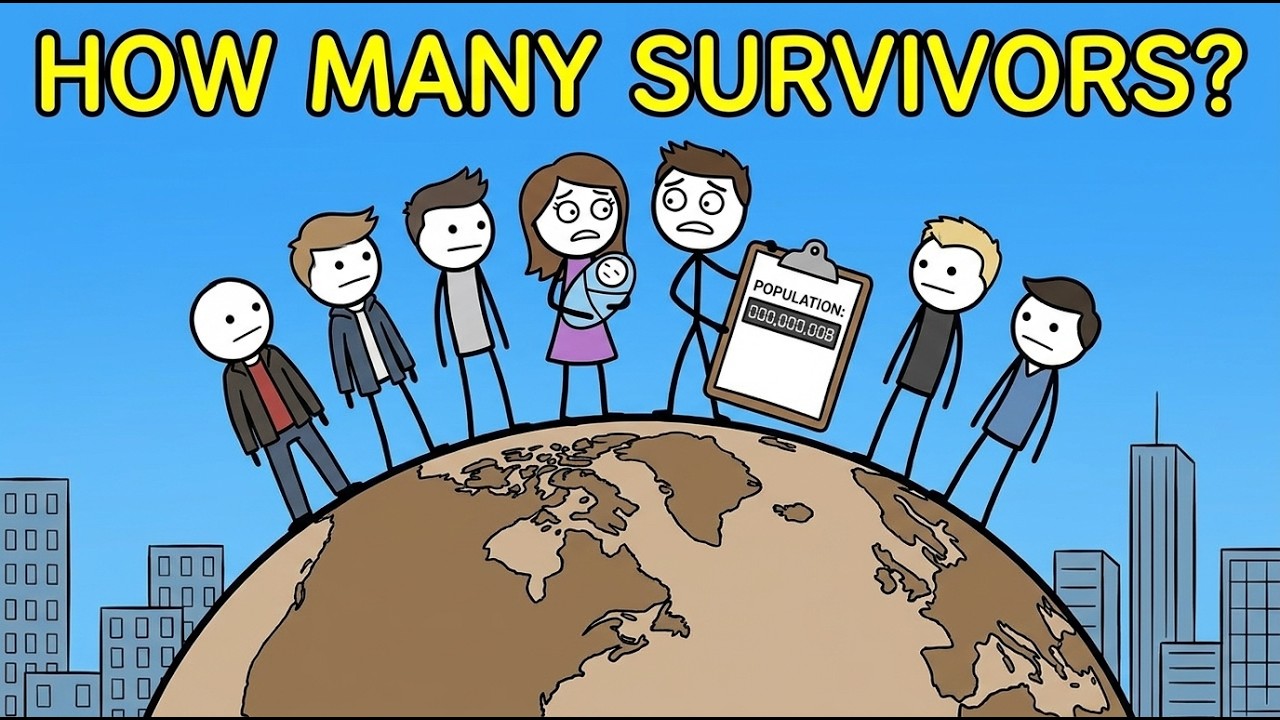
The commonly repeated notion that two remaining humans could restart civilization is a dangerous oversimplification, and population geneticists offer a far more complicated and sobering answer. The absolute biological minimum might be shockingly small, but the responsible minimum is orders of magnitude larger, and the gap between those two numbers reveals what it actually takes for humanity to survive. . Two fertile survivors could certainly have children, but those children would inherit only the genetic variants present in those two parents.
Within a generation, every possible partner would be a sibling, and the resulting family tree would become a wreath rather than a tree. Hidden recessive disease variants, harmless when rare in a large population, would suddenly have repeated opportunities to meet in their children. While this does not guarantee immediate sickness, it raises the risk of recessive disorders, miscarriages, infant mortality, reduced fertility, and a broad biological decline known as inbreeding depression across successive generations. .
The danger is not just the first children, but the compounding effect over generations. With only two founders, any harmful variants they share become everyone’s problem, and there is nowhere else for new genetic material to come from. If either founder is infertile, dies young, produces only sons or only daughters, or refuses to cooperate with the reproduction plan, the experiment ends immediately. Two is therefore not a minimum viable population, but a lottery ticket with chromosomes, as one geneticist would put it.
. Increasing the number of survivors does not automatically solve the problem. Population geneticists distinguish the census population size, or simple headcount, from the effective population size, which is roughly the number of individuals actually contributing genes to the next generation. In a post-apocalyptic group of 100 survivors, only a fraction may be of reproductive age, healthy, and willing to have children.
If 50 men and 50 women survive, but only five men father children, the population behaves genetically like a much smaller group, accelerating inbreeding and random genetic drift, which is the chance fluctuation in gene frequencies that can remove useful variants simply because their carriers have no children…
. Conservation biologists have long used rules of thumb to address this. A guideline known as the 50/500 rule suggested an effective population of about 50 might limit dangerous inbreeding in the short term, while about 500 might preserve enough genetic variation for long-term adaptation. Later research argued that these targets should be closer to 100 for limiting short-term inbreeding and 1,000 for retaining evolutionary potential over the long term.
Even those values refer to effective population size, meaning the actual census population might need to be several thousand people, depending on age structure, sex ratio, reproductive inequality, and population growth over time…
. Historical examples show that small founder populations can survive, but they also reveal the price of starting small. On Pingelap Atoll in Micronesia, a devastating typhoon in the 18th century reportedly reduced the population to around 20 survivors. The community later recovered numerically, but one survivor is believed to have carried a rare recessive variant associated with achromatopsia, a condition involving little or no color vision, severe light sensitivity, and reduced visual sharpness.
Inside the tiny founder population, that variant multiplied, eventually affecting roughly one person in 10, compared with only a tiny fraction of most populations. The population survived, but the genetic bottleneck left a signature visible centuries later, proving that population growth copies the surviving genetic library without restoring the diversity that was lost…
. Mutation slowly creates new variants, but not on a schedule useful to the first few centuries. Genetic drift also removes diversity by chance, and small populations are especially vulnerable to demographic randomness.
A generation might produce far more boys than girls. Several women may experience infertility or die from pregnancy complications. One accident could remove the only midwife and three reproductive age adults. Large populations absorb this kind of bad luck; small populations become it, fueling what conservation biologists call an extinction vortex, where inbreeding and loss of diversity reduce health, lower population growth, and make the population even smaller in a self-tightening spiral…
.
Humans could resist this with knowledge. Survivors could record pedigrees, calculate relatedness, distribute reproduction more evenly, screen for harmful variants, preserve sperm and eggs, and use assisted reproduction. With advanced technology, a surprisingly small living population could access the genetic diversity of thousands of donors. If two survivors discovered a functioning, independently powered fertility clinic containing frozen embryos from thousands of unrelated people, humanity would no longer have only two genetic founders.
However, stored genetic material does not gestate itself. One man can father many children, but one woman can usually complete only one pregnancy at a time with months of recovery and significant medical risk. The ideal founder group would not merely have equal numbers of men and women, but enough reproductive age women to increase the population without turning every woman into compulsory infrastructure…
. Even if genetic challenges could be managed, civilization itself presents a bigger problem.
Modern society is not stored inside individual human intelligence, but distributed across millions of specialists and enormous supply chains. A surgeon depends on sterile tools, nurses, anesthetics, blood products, electricity, pharmaceuticals, laboratories, and factories the surgeon cannot personally rebuild. A farmer may depend on fuel, replacement parts, fertilizer, irrigation, and seed systems. For the first years, survivors could scavenge warehouses and hospitals, but eventually rubber cracks, batteries fail, fuel degrades, drugs expire, and components break.
The community would have to simplify, and the question would shift from how to restart the old world to how much complexity could be maintained with the labor and knowledge available…
. This pushes the practical minimum beyond the genetic minimum. Thousands of survivors allow redundancy, ensuring more than one doctor, more than one mechanic, several farmers, people who understand childbirth, water systems, construction, metal working, ecology, chemistry, education, governance, and the quiet miracle of making soap. A larger community can also absorb conflict, allowing people to move, choose different partners, and replace leadership without dividing humanity into two settlements.
Geography matters too. If survivors are scattered randomly across Earth, 10,000 people might function like hundreds of isolated micro populations, unable to find one another before transport and communication collapse. A thousand survivors concentrated in one fertile, temperate region with clean water, stored food, and infrastructure might fare far better…
. The nature of the catastrophe also changes the estimate.
If humans vanish while farms, climate, ecosystems, and buildings remain intact, survivors receive a planet-sized supply depot. If the crash was caused by nuclear war, an asteroid winter, engineered disease, or ecological collapse, the same event may continue killing survivors. Crops may fail, radiation may contaminate land, and a pathogen may remain active. Repopulation cannot begin until the cause of depopulation stops.
The founders also need broad ancestry to avoid concentrating rare variants, and selecting only people who look medically perfect could reduce useful diversity, since some variants harmful in one setting may be useful in another…
. The ideal group would contain unrelated adults across a range of backgrounds, a balanced reproductive age structure, children and adolescents to bridge generations, and enough older survivors to preserve skills, experience, and judgment. A population made entirely of 20-year-olds would have fertility, but might lack the judgment to stop turning every disagreement into a crisis. Even with ideal conditions, population growth would be slow.
If a population grows by 2% per year, it doubles in roughly 35 years. Starting with 1,000 people, repeated doubling would produce about 1 million after around 350 years, and reaching 8 billion would take roughly another 450 years. In a model, Earth could return to billions in around 800 years, but reality would interfere constantly through infant mortality, food limits, epidemics, conflict, and environmental change…
. Once the population reaches tens or hundreds of thousands across several connected settlements, random local disasters become less capable of eliminating the species.
Genetic drift slows, specialized work becomes easier, and knowledge can be stored across more minds. The most dangerous period is the beginning, when every founder is disproportionately valuable and every death removes a person, a set of genes, skills, relationships, memories, and perhaps one of only a few adults able to produce children. This is why the minimum should never be mistaken for the recommended number. A lifeboat may technically hold 20 people, but that does not make 19 passengers and one sandwich a sensible ocean crossing strategy…
.
Under ideal conditions with unrelated healthy founders, carefully managed reproduction, stable food, medical support, excellent records, and considerable luck, a few dozen humans might establish a growing population. But around 100 effective breeders offers a far better short-term genetic buffer, and around 500 well-chosen founders could make long-term survival biologically plausible, especially if reproduction were distributed and the population expanded rapidly. To achieve an effective population near 1,000, the census population might need to be several thousand, and if the goal is to preserve a durable, skilled, socially flexible society, a starting community in the thousands or tens of thousands would be far safer…
. The honest answer is that two people can make a child, 20 can make a bottleneck, 100 can make a dangerously fragile community, 500 carefully chosen founders can make recovery plausible, 1,000 effective breeders can offer a stronger genetic future, and several thousand real people can begin to create something that behaves like a society rather than an endangered family.
The final survivors would not spend their first years dramatically staring over empty cities promising to rebuild; they would spend them keeping water clean, preventing infection, tracking family lines, repairing roofs, delivering babies, teaching children, storing food, resolving conflict, and trying not to let a minor accident remove 10% of the world’s electricians. Their greatest technology would be planning across generations, planting trees whose wood they might never use, preserving books for children not yet born, and training several people for every essential role…
. Rebuilding humanity would be less like breeding an endangered species and more like carrying an entire ecosystem through a keyhole. Genes must pass through, so must skills, culture, and the willingness to cooperate with people who will become everyone’s distant relative.
Humanity would probably not need millions to begin again, but nobody sensible would choose the smallest number that might work. They would choose the largest number they could save because the difference between 500 and 5,000 is not merely 10 times as many people, but more possible partners, more genetic variants, more pregnancies that do not all depend on the same few women, more farmers when crops fail, more medics when disease arrives, more engineers when machines break, more teachers when knowledge begins to fade, more settlements when one is destroyed, and more chances for one mistake not to become the final mistake. The true minimum is the point where humanity can reproduce, but the safer minimum is the point where humanity can recover, and those are very different numbers…
.