In early 19th-century London, a strange and grisly profession flourished in the shadows of the city’s overcrowded graveyards. Known as resurrection men, these night workers dug up freshly buried bodies and sold them to medical schools desperate for anatomical specimens. It was dangerous, morally corrosive work, but the pay was exceptional—a single adult body could fetch eight to ten guineas in the 1820s, equivalent to several months of wages for an unskilled laborer. The trade was driven by a fundamental economic imbalance.
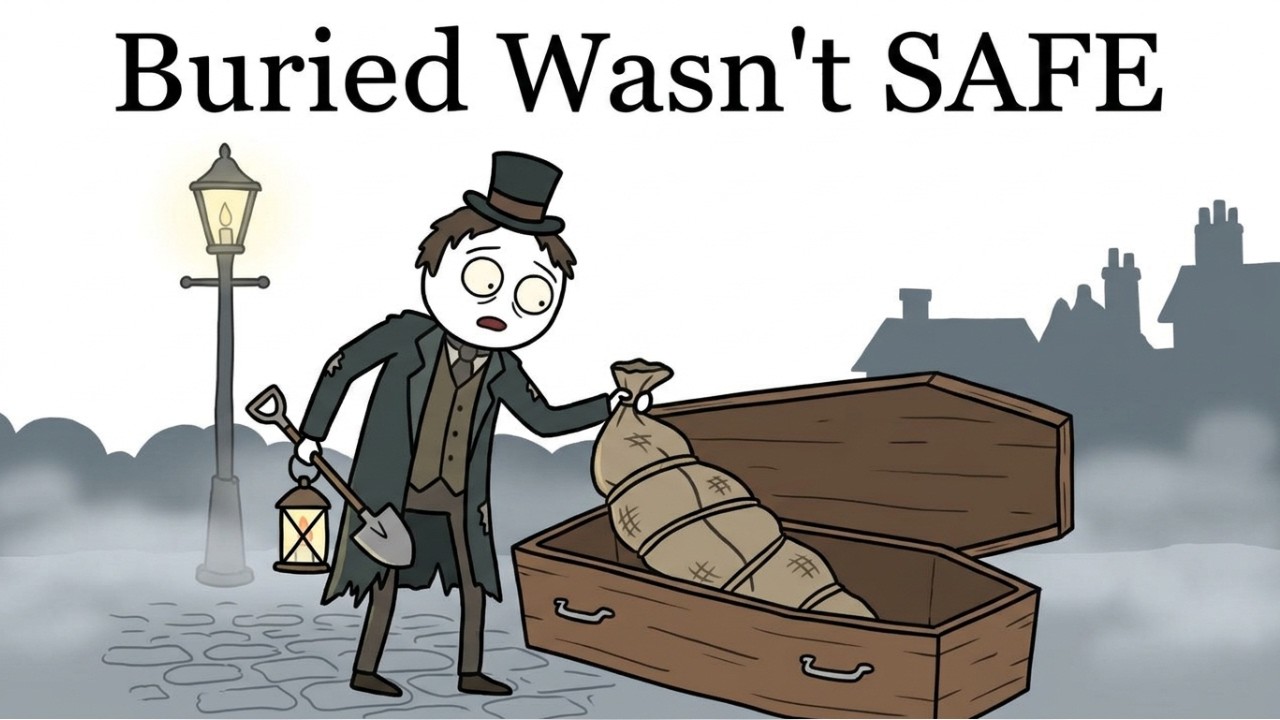
London’s medical schools were expanding rapidly, but the legal supply of cadavers was almost nonexistent. The Murder Act of 1752 allowed the bodies of executed murderers to be used for dissection, but executions provided only three to five bodies per year for all of London’s teaching hospitals. With class sizes swelling and each anatomy lecturer needing roughly one body per student, the math simply did not work. Resurrection men filled that gap.
Working at night with wooden shovels to reduce noise, they located fresh graves, dug down, pried open coffins, and extracted the bodies before refilling the earth so families would not immediately notice. A successful operation might take forty minutes. Winter was prime season, as cold weather preserved the bodies and poor weather kept grieving relatives away from the graves. The work was not anonymous.
Resurrection men developed regular relationships with specific anatomists, understanding exactly what their customers required. Some worked freelance, selling to whoever paid best that week. Rival gangs competed for territory, sometimes stealing bodies that had already been dug up by others. Night watchmen could sometimes be bribed if the payment cost less than the value of a single body.
Public outrage over body snatching was intense and occasionally violent. Families installed iron cages called mortsafes over graves, piled stones on fresh burials, planted thorny bushes, or took turns watching over burial grounds. Riots broke out when crowds attacked anatomy schools, convinced that professors and students were complicit. The poor were especially vulnerable, as wealthy families could afford protection while working-class families had bodies just as valuable to anatomists but far fewer resources to defend them.
Everything changed in 1828 with the Burke and Hare case in Edinburgh. Over roughly ten months, William Burke and William Hare murdered sixteen people and sold their bodies to the anatomist Robert Knox. The scandal crossed a line that grave robbing alone had never crossed—they were not stealing bodies, they were creating supply by killing people. Public horror was immediate, and the case became a media sensation.
The direct response was the Anatomy Act of 1832. Under the new law, unclaimed bodies from workhouses, hospitals, and prisons could legally be used for anatomy if relatives did not claim them. This dramatically increased the legal supply of cadavers and eliminated the economic incentive that had sustained the resurrection trade. The act also imposed harsher penalties for illegal body procurement, making the risks higher while the profits collapsed.
The Anatomy Act did not end body snatching overnight, particularly in rural areas where the new system took longer to implement. But in London, the golden age of the resurrection men was effectively over. Prices dropped as supply increased, police enforcement became more consistent, and the public focus shifted to new concerns about whether poor people in workhouses would receive proper burials. Some resurrection men transitioned into legitimate work as undertakers or cemetery employees, using their knowledge of burial practices legally.
Others simply disappeared from the historical record, their trade having become obsolete almost overnight. A small number were arrested and prosecuted under the new laws. The profession had operated in a shadowy space between what doctors needed and what society would permit. Medical schools genuinely required bodies to train competent surgeons—students who had never opened a human body were a danger with a scalpel.
But the system that supplied that knowledge treated the poor as unofficial anatomy stock and turned grief into market research. Families could not rest easy knowing their loved ones might be dug up and sold. The language of the trade reflected its uneasy moral position. A corpse became a subject.
Grave robbing became procurement. Desecration became education. Everyone involved understood the arrangement, but nobody wanted to say the whole sentence out loud. Deliveries were made at night through side entrances, money changed hands, and questions were kept politely vague.
The Victorian obsession with elaborate mourning rituals and grand cemeteries that developed later in the century was in part a reaction to this era, when even graves could not be considered secure. The Anatomy Act of 1832 acknowledged that the old system had failed everyone—doctors forced into morally compromising positions, families living in fear of desecration, and criminals like Burke and Hare exploiting the chaos for profit. The resurrection trade was always economically unstable. It existed because the law had not kept pace with social and technological change, an unregulated gray market that operated until Parliament finally caught up with reality.
When the law changed, the profession vanished as quickly as it had emerged. Medical education continued to advance with a steady legal supply of bodies, but the uneasy relationship between medical progress and public distrust of doctors lingered for decades.