In 9th-century China, somewhere between the mountains of Sichuan or Shanxi province, a group of Taoist alchemists were attempting something that had nothing to do with warfare at all. They were trying to live forever. Convinced that the right combination of metals could produce an elixir of immortality, they spent years mixing, heating, and experimenting with whatever materials they could find, following recipes passed down through generations of mystical and medical tradition. At some point, one particular mixture combined three ingredients: saltpeter, charcoal, and sulfur.
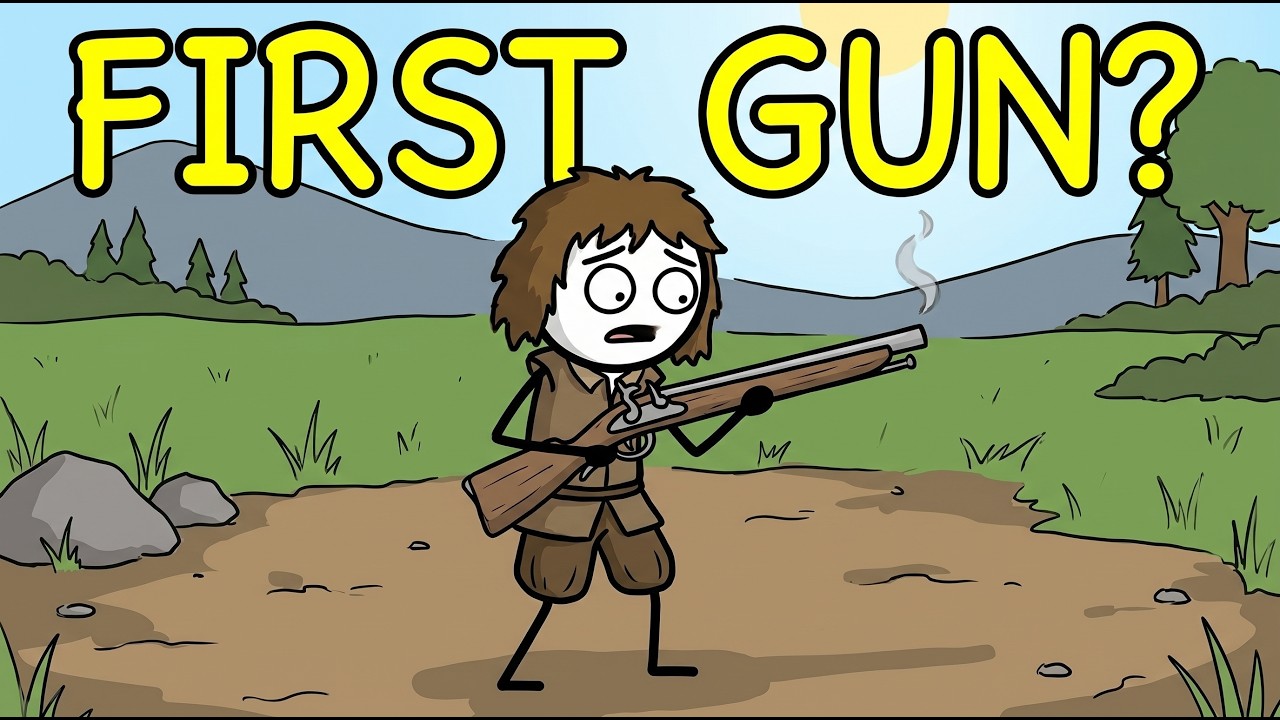
Instead of granting them eternal life, that mixture did something far more dramatic. It exploded. Accounts of singed beards and wrecked workshops appear in early historical records, which tells you everything you need to know about how that first encounter actually went. Nobody in that room was trying to invent a weapon.
They called the resulting substance “huo yao,” which means “fire medicine. ” A name that still carries a faint, slightly embarrassing memory of its original purpose as a failed pharmaceutical product rather than a future instrument of conquest. Yet that accidental mixture that burned beards and was a failed immortality drug, eventually became the most important chemical discovery in the history of human conflict. The seed from with every gun, every cannon, and ultimately every firearm on Earth would sprout.
So how did humanity go from a failed potion in a Taoist alchemy lab to the firearm? The answer takes us through bamboo tubes lashedt to spears. A siege that proved the new technology actually worked. Several centuries of painstaking refinement, anda slow, steady migration of knowledge across an entire continent, ultimately reshaping the balance of power onevery inhabited landmass on Earth.
Let’s start with what that early gunpowder mixture actually was, in the simplest possible terms. Because understanding the basic chemistry helps explain why everything that followed happened the way it did. The mixture these alchemists stumbled upon combined potassium nitrate, known as saltpeter, with charcoal and sulfur in an approximate weight ratio of 75to15to10. Saltpeter acted as an oxidizer, meaning it rapidly releases oxygen when heated, fueling an extremely fast combustion reaction that produced a sudden, violent expansion of gas.
That expanding gas is the entire secret behind everything gunpowder would ever be used for. Whether that meant launching fireworks into the night skyor firing a metal projectile from a tube with enough force to punch through armor. In its earliest documented uses, gunpowder wasn’t a weapon at all. It was used for fireworks, smoke signals, and festival entertainment.
Exactly the kind of ceremonial, decorative applications you’d expect from something originally discovered by monks chasing immortality, not military engineers chasing battlefield superiority. For generations, ordinary people across China treated the stuff as a spectacle rather than a threat, brightening festivals and religious rituals with flashes of color and noise that had nothing whatsoever to do with fighting. That changed once military leaders of the Song Dynasty realized what this new, highly volatile substance couldreally do. Between the 10th and12th centuries, Chinese engineers developed what was called the”huo qiang,” or fire lance.
The design was extraordinarily simple, about as simple as any weapon could possibly be. Take a piece of bamboo, lash it tightly tothe tip of a spear, fill the tube with gunpowder, and ignite it during close combat. The result was along weapon that blasted flame and burning debris directly at anyone within reach, turning an ordinary spear into something far more terrifyingin direct confrontations. Defenders used fire lances during the siege of De’an in1132 against attacking forces scaling their walls.
And by all accounts, the weapon worked exactly as intended, burning and disorienting attackersin a way traditional spears simply could not match. The psychological effect alone was enormous. Soldiers who had spent their entire lives training to fight with swords and spears suddenly found themselves facing an enemy that could hurl fire itself. That kind of shock mattered on a medieval battlefield just as much as the actual physical damage done to the opponent.
Once gunpowder proved its worthin actual combat, innovation accelerated, and every subsequent improvement followed a logical, almost inevitable, step from what came before. Fire lance makers began packing clay pellets and pottery shards into their bamboo tubes alongside the gunpowder, transforming aweapon that only produced flames into one that launched small projectiles with real force. That was a genuinely important conceptual leap, because it shifted the weapon’s purpose from sheer intimidation and burning to inflicting actual penetrating injury from a distance. The core concept behind every firearm that would ever appear.
The next major obstacle was bamboo itself, which simply couldn’t withstand the pressure generated by stronger powder charges without splitting apartor explodinginthe user’s hands, sometimes injuringthe soldier carrying it. Once Chinese craftsmen learned to cast sturdy bronze tubescapable of safely containingthat pressure, the hand cannon was born. A weapon that used the expanding gas from burning gunpowder to propel a single solid projectile with far greater power and range than any bamboo fire lance could achieve. By the13th century, metal-barreled hand cannons were in regular use across China, markinga genuine technological leapin reliability and effectiveness compared to bamboo weapons.
Chinese engineers also scaled upthe same core concept, producing devices with names like the”thunderclap bomb” and the”heaven-shaking cannon,” weaponscapable of delivering genuinely powerful explosions on the battlefield and destroying fortified positions that once seemed impregnable. When the Mongols invaded China in the13th century, they encountered these gunpowder weapons directly during sieges such as the famous defense of Kaifeng in1232, and the experience left an indelible mark. Rather than being defeated by this new technology, the Mongols absorbed it and mastered it. Once they conquered China and established the Yuan Dynasty, they carried gunpowder weapons west with them as they expanded into new conquests across Asia and toward the Islamic world.
This is genuinely one of the most important and least appreciated technology transfersin history, because Mongol military campaigns functioned almost like an accidental delivery system, moving gunpowder knowledge across vast distances far faster than trade caravansor diplomatic exchanges alone ever could, spreadinga Chinese invention across Eurasia within just a few generations. It’s also worth noting that gunpowder weapons didn’t develop alonga single straight line during that period. Alongside hand cannons and fire lances, Chinese military engineers also developed rockets and fire arrows, gunpowder-propelled projectiles that found their way not only across China, but into Korea and India as well, traveling along paths separate from but overlapping with the hand cannon’s route westward. These rocket weapons didn’t simply vanish the way the fire lance did after true guns matured.
Instead, they continued as a distinct branch of gunpowder technology, one that would re-emerge centuries later in European warfare. And much later still, as early ancestors of modern military and space rockets. In other words, the story of gunpowder doesn’t only lead to the gun. It branches into two paths; one toward the firearm, anda completely separate one toward the rocket.
Both rootedin the same accidental discovery by chemists who wanted neither of those outcomes. From there, gunpowder technology spread outward along multiple overlapping routes, reaching the Islamic world and Europe througha combination of military contact, trade, and the broader wave of cultural exchange that characterized the13th and14th centuries. Historians who study this period point toa wider pattern worth considering. Gunpowder wasn’t the only major Chinese invention that made its way westward during that era.
Paper, printing, and the magnetic compass followed the same general routes duringroughly the same time period. It was part ofa far larger flow of technology and knowledge, moving from east to west, long before the term globalization was ever coined. Some historians have noted that early European cannons bear structural similarities so closeto Chinese designs that direct knowledge transfer seems far more plausible than an independent invention accidentally producing nearly identical solutions. Once this technology reached Europein the late13th century, it settled intoa political and military landscape that gunpowder weapons would utterly and permanently transform over the following centuries, ultimately helping dismantle feudal military power structures that had persisted for hundreds of years.
That transformation wasn’t immediate. Early European hand cannons, much like their Chinese predecessors, were crude, slow to reload, and nearly impossible to aim with any real precision. Essentiallya small cannon awkwardly mounted onthe end ofa pole. You loaded powder and projectile into the open muzzle, fumbled for a small touchhole with a glowing emberora slow-burning match, and hoped, with far more optimism than confidence, that the resulting explosion would send the projectile somewhere useful.
But even inthis crude form, the weapon hada psychological and practical impact that traditional close-quarters weapons simply couldn’t match. Castle walls that had withstood conventional siege equipment for generations began falling under cannon fire. Armored knights, the dominant military forcein medieval Europefor centuries, found themselves increasingly vulnerable toa weapon that didn’t care how thick the steel armor you wore was, because the force generated by gunpowder could punch right through it regardless. The entire social and military order built around expensive, heavily armored knights began to crack, becausea relatively cheap weaponinthe hands ofa cheaper-to-train soldier could now neutralize an opponent who had spent his life and fortune preparing to fightthe traditional way.
This shift had consequences reaching far beyondthe battlefield itself, reshapingthe very structure of European warfare. As cannons grew more powerful and effective against vertical stone walls, traditional castle designs, based on tall, thin walls meant to repel siegers and arrows, became obsolete almost overnight by historical standards. Military engineers responded by developing the “star fort” and the”trace italienne. ” Low, sloping, heavily reinforced fortifications designed specifically to deflect and absorb cannon fire rather than merely standing asa tall tower and hoping for the best.
The medieval castle, an architectural form that had dominated European landscapes for centuries, was gradually replaced by structures that barely resembled it at all. All because ofa weapon born onthe other side of the planetinthe hands of monks chasing immortality. The next truly major leap camein the late15th century with the invention of the matchlock mechanism. This single development finally transformed gunpowder weapons from clumsy novelties into the backbone of organized infantry warfare across the continent.
The fundamental problem with early hand cannons was that firing them required both hands anda great deal of coordination. One hand to hold the weapon, the other to place a glowing emberormatch directly onto the touchhole at exactly the right moment, all while trying to aim at a moving target ona chaotic battlefield. The matchlock mechanism solved this problem elegantly by securinga slow-burning matchina curved clamp calleda”serpentine” directly onto the weapon itself. Pulling the trigger lowered this burning match directly intoa small pan of priming powder, ignitingthe main charge automatically, freeing the shooter to hold and aim the weapon with both hands right up until the moment of discharge.
That may sound likea simple mechanical adjustment, but it was genuinely transformative because it wasthe first mechanical firing device ever applied toa small firearm. It allowed, for the first timein history,a single trained soldier to firea gun witha real degree of aiming precision rather than merely pointing it roughly toward the target and hoping for the best. Bythe early15th century, matchlock muskets began appearingin growing numbers across Western Europe, particularlyin Spain, France, and the lands of the Holy Roman Empire, and the weapons spread rapidly from there across all of Eurasia. The Ottoman Empire, which had possessed gunpowder weapon expertise since the14th century, integrated matchlock weapons directly into its elite Janissary corps, using them toe great effectin battles such as the Battle of Chaldiranin1514.
Meanwhile, in South Asia, the Mughal Empire adopted matchlocks on a massive scale, using them alongside Portuguese forces who also relied heavily on matchlock weapons duringthat period. In1543, Portuguese traders introduced matchlock technology to Japan, where local gunsmiths refined the design so meticulously that Japanese matchlock muskets, known as tanegashima, came to be regarded among the finest firearms made anywherein the world duringthat era. They were highly prized for their accuracy and craftsmanship even bye European observers. China, which had started this entire chain of innovation centuries earlier, ended up receiving an improved version of its own original invention back, developing matchlock weapons known as”bird guns,” specifically to counter continued Mongol raids along its northern borders.
A strange and fitting historical circle for a technology that began as a failed immortality elixir in that same region. Matchlock muskets eventually became heavy and powerful enough to requirea forked rest to support the barrel while aiming, weighing up to20 poundsinsome configurations, but they were capable of penetrating metal armor from ranges that made traditional swords and spears far less relevantin open battlefields. Because reloading and firinga matchlock was time-consuming, and because the weapon left the user vulnerable forashort period duringthat process, a musketeer typically needed protection from close assault, usually provided by pikemen standing beside him. That combination of pikes and muskets dominated European battlefields from the16th century throughthe early17th century.
An intricate, carefully choreographed tactical system requiring intensive training to coordinate effectively, with musketeers firing from behindorbetween ranks of pikemenin tightly organized formations. Outside Europe, many armies that adopted matchlock muskets retained their traditional formations rather than developing the same disciplined, intensive infantry coordination, lacking either the resourcesorthe specific tactical incentives that drove European armies towardthis particular developmentin combined-arms warfare. The matchlock musket had one obvious, persistent weakness that everyone who used it recognized immediately. It requireda constantly burning, exposed match flame, making it nearly uselessin wet weather, revealinga soldier’s positionin darkness, and demanding constant management ofthe burning cord, even when nothing was happening onthe battlefield at all.
The solution came gradually through several intermediate steps worth understanding. The wheellock, developedin the early16th century, useda spring-loaded wheel that spun rapidly againsta piece of iron pyrite to generate sparks, entirely eliminatingthe need for a constantly burning match. This made wheellocks far more practical for cavalrymen who neededa weapon they could carry loaded and ready without having to attend toa naked flame while riding. German mercenaries, along with English cavalry units, became particularly associated with this mechanism duringthe16th and early17th centuries.
But wheellocks were expensive and mechanically complex to manufacture, preventingthem from fully replacing the cheaper, simpler matchlock among ordinary infantry, who continued carryingthe older, more economical design well into the next century. Even as wealthier cavalrymen adopted the more advanced alternative, the real breakthrough came with the flintlock. Credit is generally given to French gunsmith Marin le Bourgeoys, who developed the mechanism in its recognizable modern form around1610to1615. The flintlock useda spring-loaded hammer holdinga piece of flint, which struck againsta steel surface calleda”frizzen” to generate sparks directly into the priming pan, ignitingthe charge.
It was faster to operate thana matchlock, significantly more reliablein bad weather, and required no exposed flame to maintainat all, meaning soldiers also no longer betrayed their positionsin darkness simply by carryinga lit weapon. Bythe1630s, the flintlock mechanism spread rapidly across Europe, with the Dutch States Army amongthe first to officially adopt it asa standard infantry weapon. Within a few decades, it became the dominant firearm mechanismin nearly every major European army, a position it would hold for roughly two centuries, through colonial expansion, the Napoleonic Wars, and the American Revolution that followed, where flintlock muskets carried bye colonial militias and British soldiers definedthe entire conflict from startto finish. The arrival of the flintlock coincided with another genuinely important innovation: the socket bayonet, which appearedin the late17th century, attachingaround the outside ofa musket’s muzzle viaa metal ring rather than being plugged directly into the barrel as older bayonet designs had been, methods that made the musket incapable of firing while the bayonet was attached.
This seemingly simple change meanta soldier could fix his bayonet and still fire his musket normally. Combining long-range firepower with close-quarters combat capabilityin a single weapon for the first time. The practical impact of this was enormous. Armies no longer needed dedicated pikemen standing beside musketeers for protection, because every soldier carryinga flintlock musket and bayonet could function as both shooter and spearman depending on what the moment required.
This combined development, sometimes calledthe infantry revolution, simplified training and logistics, radically reshaping how European armies organized themselves on the battlefield, allowing regiments to become far more versatile and capable of engaging enemies at rangeorin close combat without needing to rearrange their ranks between the two modes of fighting. The bayonet charge also carried its own distinctive psychological weighton the battlefield, wherethe sight of an advancing line of soldiers with fixed bayonets often broke enemy morale beforea single shotorthrust actually found its target. The flintlock’s nearly two-century reign endedin the early19th century withthe arrival of the percussion cap system, a small metal cap containinga shock-sensitive chemical compound that ignited when struck bye the hammer, entirely eliminatingthe need for loose priming powder, flint, and steel. This final ignition innovation rendered all previous mechanisms, includingthe traditional flintlock, the wheellock, and the advanced matchlock, effectively obsolete withina few decades.
It markedthe last major milestone ina centuries-long chain of improvements that had begun with immortality-seeking monksin9th-century China. From there, the pace of change accelerated, leadingtobreech-loading rifles, rapid advancesin metallurgy and manufacturing, and ultimately weapons that would have been utterly unrecognizable to the soldiers who once stoodin disciplined ranks with pikes and matchlock muskets, waiting for their turn to fire. Looking atthe entire arc, froma Taoist alchemy labin9th-century China to the matchlock muskets that dominated European battlefields nearly eight centuries later, the story of humankind’s invention of firearmsis genuinelya story of accident, accumulation, and migration happening together overan enormous span of time. No one initially planned to invent the firearm.
A group of monks seeking immortality stumbled upona explosive chemical reaction, nearly burning off their beardsin the process. Military engineers who observed that explosive reaction gradually realized its violent force could be directed. That began witha tube strappedto a spear, thena cast bronze cylinder, then increasingly sophisticated mechanical systems designed to ignite that same core chemical reaction more reliably, more quickly, and with less risk to whoever heldthe weapon. Every individual improvement, from bamboo to bronze, from exposed flame to spring-loaded mechanisms, from matchlock to flintlock, addresseda specific practical problem soldiers and engineers actually encountered when using the previous version.
None of it requireda single stroke of genius for a complete invention. It required centuries of incremental refinements that traveled across continents courtesy of trade routes, military campaigns, andthe kind of slow cultural exchange that quietly reshapes the world while no one watchesin real time. The technology passed throughthe hands of Chinese engineers, Mongol conquerors, Ottoman Janissaries, Japanese gunsmiths, andEuropean craftsmen, with each group adding its own improvements along the way. The weapon that would eventually endthe dominance of knights, reshape castle architecture, and determine the outcomes of colonial conquests and continental wars across multiple centuries, began its existence asa mistake made bye people who were not trying to builda weaponat all.
They were looking for something far more peaceful.